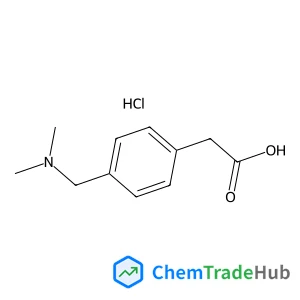
4-(Dimethylaminomethyl)phenylacetic acid hydrochloride
CAS Number:
99985-52-1
Molecular Formula:
C11H16ClNO2
Malgorzata Bayda, Gonzalo Angulo, Jerzy Karolczak, Jacek Koput, Jacek Dobkowski, Bronislaw Marciniak
Si-Bridged chromophores have been proposed as sources for blue-green emission in several technological applications. The origin of this dual emission is to be found in an internal charge transfer reaction. The current work is an attempt to describe the details of these processes in these kinds of substances, and to design a molecular architecture to improve their performance. Nuclear motions essential for intramolecular charge transfer (ICT) can involve processes from twisted internal moieties to dielectric relaxation of the solvent. To address these issues, we studied ICT between adjacent chromophores in a molecular compound containing N-isopropylcarbazole (CBL) and 1,4-divinylbenzene (DVB) linked by a dimethylsilylene bridge. In nonpolar solvents emission arises from the local excited state (LE) of carbazole whereas in solvents of higher polarity dual emission was detected (LE + ICT). The CT character of the additional emission band was concluded from the linear dependence of the fluorescence maxima on solvent polarity. Electron transfer from CBL to DVB resulted in a large excited-state dipole moment (37.3 D) as determined from a solvatochromic plot and DFT calculations. Steady-state and picosecond time-resolved fluorescence experiments in butyronitrile (293–173 K) showed that the ICT excited state arises from the LE state of carbazole. These results were analyzed and found to be in accordance with an adiabatic version of Marcus theory including solvent relaxation.
Minqiang Hou, Jianling Zhang, Buxing Han, Qingqing Mei, Hui Ning, Dezhong Yang
DOI: 10.1039/C3CP44670K
Juraj Sibik, Evgenyi Y. Shalaev, J. Axel Zeitler
DOI: 10.1039/C3CP51936H
Ymène Houari, Adèle D. Laurent
DOI: 10.1039/C3CP50791B
João Pina, J. Seixas de Melo, D. Breusov, Ullrich Scherf
DOI: 10.1039/C3CP52056K
DOI: 10.1039/C3CP51650D
Joshua J. Melko, Shaun G. Ard, Joseph A. Fournier, Jun Li, Nicholas S. Shuman, Hua Guo, Albert A. Viggiano
DOI: 10.1039/C3CP50335F
DOI: 10.1039/C3CP50191D
DOI: 10.1039/C3CP50606A
Andrej Grubisic, Volker Schweikhard, Thomas A. Baker, David J. Nesbitt
DOI: 10.1039/C3CP44385J
Chang-Lyoul Lee, Shinuk Cho, Seung-Hwan Oh, Seung-Hyeon Moon, Ahmed Elbarbary
DOI: 10.1039/C3CP52151F
Waste containing N-Methoxy-N-methyl-1,3-thiazole-5-carboxamide (CAS: 898825-89-3...
N-(4-Biphenylyl)dibenzo[b,d]furan-4-amine should be stored in a tightly sealed c...
The market for 3-Acetamido-5-amino-2,4,6-triiodobenzoic acid (CAS: 1713-07-1) is...
Benzyl 2-O-acetyl-3,4,6-tri-O-benzyl-beta-D-galactopyranoside (CAS: 61820-03-9) ...
2-Ethylpiperazine dihydrochloride (CAS: 438050-52-3) is regulated under the Glob...
1,1'-[1,3-Phenylenebis(methylene)]bis(3-methyl-1H-pyrrole-2,5-dione) (CAS: 11946...
Several alternatives can be used in the synthesis of 5-Fluoro-2-(1-pyrrolidinyl)...
Proper personal protective equipment (PPE) must be worn when handling this compo...
When handling 6-Bromoimidazo[1,2-a]pyridin-8-amine, it is important to wear appr...
Alternatives to (2S,4R)-4-(4-Nitrobenzyl)pyrrolidine-2-carboxylic acid hydrochlo...

Physical Chemistry Chemical Physics (PCCP) is an international journal co-owned by 19 physical chemistry and physics societies from around the world. This journal publishes original, cutting-edge research in physical chemistry, chemical physics and biophysical chemistry. To be suitable for publication in PCCP, articles must include significant innovation and/or insight into physical chemistry; this is the most important criterion that reviewers and Editors will judge against when evaluating submissions. The journal has a broad scope and welcomes contributions spanning experiment, theory, computation and data science. Topical coverage includes spectroscopy, dynamics, kinetics, statistical mechanics, thermodynamics, electrochemistry, catalysis, surface science, quantum mechanics, quantum computing and machine learning. Interdisciplinary research areas such as polymers and soft matter, materials, nanoscience, energy, surfaces/interfaces, and biophysical chemistry are welcomed if they demonstrate significant innovation and/or insight into physical chemistry. Joined experimental/theoretical studies are particularly appreciated when complementary and based on up-to-date approaches.

![4-Chloro-2-{[(2-chlorophenoxy)acetyl]amino}benzoic acid structure](https://static.chemtradehub.com/structs/351/351424-20-9-9467.webp "4-Chloro-2-{[(2-chlorophenoxy)acetyl]amino}benzoic acid structure")