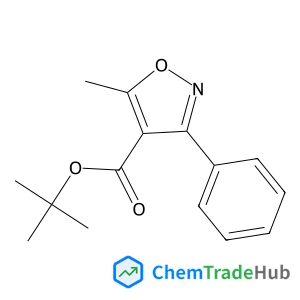
2-Methyl-2-propanyl 5-methyl-3-phenyl-1,2-oxazole-4-carboxylate
CAS Number:
211429-79-7
Molecular Formula:
C15H17NO3
Parameswar K. Iyer, J. Benjamin Beck, Christoph Weder, Stuart J. Rowan
Metal–ligand interactions between metal ions, such as Zn2+, and ditopic low-molecular weight conjugated monomers, which utilize the 2,6-bis(1′-methylbenzimidazolyl)pyridine ligand, lead to the formation of supramolecular conjugated polymers with interesting optical properties.
N. Ramanathan, Shubhra Sarkar, K. Sundararajan
DOI: 10.1039/C9CP05237B
Peter Lackner, Zhiyu Zou, Sabrina Mayr, Ulrike Diebold, Michael Schmid
DOI: 10.1039/C9CP03322J
Hiroki Uratani, Chien-Pin Chou
DOI: 10.1039/C9CP04739E
Qing-Bo Yan
DOI: 10.1039/C9CP05318B
Zepei Yu
DOI: 10.1039/C9CP05228C
Guangtao Liu, Linyan Wang, Xue Yong, Guoying Gao, Hanyu Liu
DOI: 10.1039/C9CP02409C
Alex Pifer Coleone, Leonardo Gois Lascane
DOI: 10.1039/C9CP02638J
Li Wang, Zhourong Xiao, Guozhu Li, Lichang Wang
DOI: 10.1039/C9CP05022A
Jefferson Maul, Giuseppe Spoto, Lorenzo Mino, Alessandro Erba
DOI: 10.1039/C9CP05418A
When handling 4-Methyl-6-(trifluoromethyl)quinoline (CAS: 40716-16-3), safety go...
4-(3,5-Difluorophenyl)aniline is an aromatic organic compound with the CAS numbe...
5-{[4-(Trifluoromethyl)phenyl]sulfanyl}-1,2,3-thiadiazole-4-carboxylic acid can ...
The market for 4-Benzylaniline hydrochloride (CAS: 6317-57-3) is steadily growin...
[3-(Diethylsulfamoyl)phenyl]boronic acid is generally considered safe when handl...
3-Bromo-2,5-dimethoxyaniline is mainly used in the pharmaceutical and chemical i...
N-Methyl-1-(5-methyl-1H-indol-3-yl)methanamine (CAS: 915922-67-7) is subject to ...
This compound is primarily used in the pharmaceutical industry for the synthesis...
2-Methyl-2-propanyl [(1S,3R)-3-aminocyclohexyl]carbamate (CAS: 1298101-47-9) sho...
Ethyl 2-bromo-4,4,4-trifluorobutanoate (CAS: 367-33-9) is utilized in the pharma...

ChemComm publishes urgent research which is of outstanding significance and interest to experts in the field, while also appealing to the journal’s broad chemistry readership. Our communication format is ideally suited to short, urgent studies that are of such importance that they require accelerated publication. Our scope covers all topics in chemistry, and research at the interface of chemistry and other disciplines (such as materials science, nanoscience, physics, engineering and biology) where there is a significant novelty in the chemistry aspects. Major topic areas covered include: Analytical Chemistry Catalysis Chemical Biology and medicinal chemistry Computational Chemistry and Machine Learning Energy and sustainable chemistry Environmental Chemistry Green Chemistry Inorganic Chemistry Materials Chemistry Nanoscience Organic Chemistry Physical Chemistry Polymer Chemistry Supramolecular Chemistry