












Podoviridae bacteriophage for the biocontrol of Pseudomonas aeruginosa in rainwater
Literature Information
Publication Date
2019-11-13
DOI
10.1039/C9EW00896A
Impact Factor
4.251
Authors
Brandon Reyneke, Sehaam Khan, Pilar Fernández-Ibáñez, Wesaal Khan
View Original
Abstract
Bacteriophages targeting Pseudomonas spp. were isolated and characterised for the biocontrol pre-treatment of rainwater. Bacteriophages PAW33 and PFW25 were characterised as members of the Podoviridae and Myoviridae families, respectively. Bacteriophage PAW33 displayed specific activity against Pseudomonas aeruginosa (P. aeruginosa) strains and was applied in small-scale bacteriophage pre-treatment trials (8 h and 24 h) to restrict the proliferation of an environmental P. aeruginosa S1 68 strain. Hereafter, the respective samples (bacteriophage pre-treated and non-pre-treated samples) were subjected to treatment in small-scale SODIS compound parabolic collector (SODIS-CPC) systems for 4 h under natural sunlight. For the 8 h pre-treatment and SODIS-CPC trials, similar total log reductions in colony forming units (CFU) per mL and gene copies (GC) per mL were obtained for the bacteriophage pre-treated [3.68 log (CFU) and 2.34 log (GC)] and non-pre-treated [3.74 log (CFU) and 2.33 log (GC)] samples. In contrast, for the 24 h trial (followed by SODIS) a higher CFU per mL log reduction was recorded for the pre-treated sample (4.61 log) in comparison to the non-pre-treated sample (3.91 log), with comparable results obtained using EMA-qPCR. Gene expression analysis indicated that PAW33 pre-treatment for 24 h influenced the ability of P. aeruginosa S1 68 to initiate stress response mechanisms (decreased expression of the recA and lexA genes) during the SODIS-CPC treatment and resulted in the decreased expression of the phzM gene (virulence factor responsible for pyocyanin production). Bacteriophage PAW33 thus displays promise as a pre-treatment strategy of rainwater as it restricts the proliferation of P. aeruginosa and may increase the efficiency of primary disinfection methods.
Recommended Journals
Related Literature
Kinetic and mechanistic study of the reaction of OH radicals with methylated benzenes: 1,4-dimethyl-, 1,3,5-trimethyl-, 1,2,4,5-, 1,2,3,5- and 1,2,3,4-tetramethyl-, pentamethyl-, and hexamethylbenzene
P. Alarcón, B. Bohn
2015-04-20
Paper
DOI: 10.1039/C5CP00253B
Dithiafulvalene functionalized diketopyrrolopyrrole based sensitizers for efficient hydrogen production
S. Niveditha, K. Bhanuprakash
2015-04-27
Paper
DOI: 10.1039/C5CP01777G
Competitive excited-state single or double proton transfer mechanisms for bis-2,5-(2-benzoxazolyl)-hydroquinone and its derivatives
Jinfeng Zhao, Junsheng Chen, Jianyong Liu, Mark R. Hoffmann
2015-03-24
Paper
DOI: 10.1039/C4CP05651E
Structural phase transformation and microwave dielectric studies of SmNb1−x(Si1/2Mo1/2)xO4 compounds with fergusonite structure
S. D. Ramarao, V. R. K. Murthy
2015-04-10
Paper
DOI: 10.1039/C5CP00569H
Using lithium carbonate-based electron injection structures in high-performance inverted organic light-emitting diodes
Chih-Hao Chang, Ming-Kuan Hsu, Szu-Wei Wu, Mei-Hsin Chen, Hung-Hsuan Lin, Chia-Shou Li, Tun-Wen Pi, Hsin-Hua Chang, Nien-Po Chen
2015-04-16
Paper
DOI: 10.1039/C5CP01692D
Experimental and computational study of solvent effects on one- and two-photon absorption spectra of chlorinated harmines
Dalibor Hršak, Lotte Holmegaard, Anton S. Poulsen, Nanna H. List, Jacob Kongsted, M. Paula Denofrio, Rosa Erra-Balsells, Franco M. Cabrerizo, Ove Christiansen, Peter R. Ogilby
2015-04-09
Paper
DOI: 10.1039/C5CP00773A
Potential-dependent structures investigated at the perchloric acid solution/iodine modified Au(111) interface by electrochemical frequency-modulation atomic force microscopy
Toru Utsunomiya, Shoko Tatsumi, Yasuyuki Yokota, Ken-ichi Fukui
2015-04-09
Paper
DOI: 10.1039/C5CP01156F
Electrical and thermal transport properties of Pb1−xSnxSe solid solution thermoelectric materials
Chao-Feng Wu, Tian-Ran Wei, Jing-Feng Li
2015-04-20
Paper
DOI: 10.1039/C4CP06021K
The electronic states of a double carbon vacancy defect in pyrene: a model study for graphene
Francisco B. C. Machado
2015-04-13
Paper
DOI: 10.1039/C4CP05751A
Volume shrinkage and rheological studies of epoxidised and unepoxidised poly(styrene-block-butadiene-block-styrene) triblock copolymer modified epoxy resin–diamino diphenyl methane nanostructured blend systems
Debora Puglia, Josè M. Kenny, Jyotishkumar Parameswaranpillai, Poornima Vijayan P, Jűrgen Pionteck
2015-03-31
Paper
DOI: 10.1039/C5CP00612K
You might also like
Compound Q&A
What are the main uses of (5-Sulfamoyl-3-pyridinyl)boronic acid (CAS: 951233-61-7)?
(5-Sulfamoyl-3-pyridinyl)boronic acid is primarily used in chemical synthesis, p...
951233-61-7(5-Sulfamoyl-3-pyrid...
Compound Q&A
How is Benzyl 2-methyl-2-(methylsulfonyl)-4-pentenoate (CAS: 1942858-50-5) typically synthesized?
Benzyl 2-methyl-2-(methylsulfonyl)-4-pentenoate is typically synthesized via est...
1942858-50-5Benzyl 2-methyl-2-(m...
Compound Q&A
What precautions should be taken when handling 8-Fluoroquinolin-6-ol (CAS: 209353-22-0)?
When handling 8-Fluoroquinolin-6-ol (CAS: 209353-22-0), it is important to use p...
209353-22-08-Fluoroquinolin-6-o...
Compound Q&A
What are the physical and chemical properties of 1,3-Dibromo-5-(2-methyl-2-propanyl)benzene (CAS: 129316-09-2)?
1,3-Dibromo-5-(2-methyl-2-propanyl)benzene (CAS: 129316-09-2) is a crystalline c...
129316-09-21,3-Dibromo-5-(2-met...
Compound Q&A
What industries use Ethyl 7-chloro-4-oxo-1-(1,3-thiazol-2-yl)-1,4-dihydro-1,8-naphthyridine-3-carboxylate (CAS: 174726-87-5)?
Ethyl 7-chloro-4-oxo-1-(1,3-thiazol-2-yl)-1,4-dihydro-1,8-naphthyridine-3-carbox...
174726-87-5Ethyl 7-chloro-4-oxo...
Compound Q&A
What precautions should be taken when handling Delta-7-Avenasterol (CAS: 23290-26-8)?
When handling Delta-7-Avenasterol (CAS: 23290-26-8), it is important to wear app...
23290-26-8Delta-7-Avenasterol
Compound Q&A
What precautions should be taken when handling N-({(5R)-3-[3-Fluoro-4-(4-morpholinyl)phenyl]-2-oxo-1,3-oxazolidin-5-yl}methyl)acetamide (CAS: 872992-20-6)?
Proper handling involves the use of personal protective equipment such as gloves...
872992-20-6N-({(5R)-3-[3-Fluoro...
Compound Q&A
What precautions should be taken when handling 2-Methyl-2-proanyl 4-[(2-aminophenyl)amino]-1-piperidinecarboxylate (CAS: 79099-00-6)?
When handling 2-Methyl-2-proanyl 4-[(2-aminophenyl)amino]-1-piperidinecarboxylat...
79099-00-62-Methyl-2-propanyl ...
Compound Q&A
What is N-Methyl-4-chlorobenzylamine hydrochloride (CAS: 65542-24-7)?
N-Methyl-4-chlorobenzylamine hydrochloride (CAS: 65542-24-7) is a organic compou...
65542-24-7N-Methyl-4-chloroben...
Compound Q&A
Is [2-(Dodecyloxy)ethoxy]acetic acid (CAS: 27306-90-7) safe?
[2-(Dodecyloxy)ethoxy]acetic acid (CAS: 27306-90-7) is generally considered safe...
27306-90-7[2-(Dodecyloxy)ethox...
Source Journal
Environmental Science: Water Research & Technology

CiteScore:
0
Self-citation Rate:
0%
Articles per Year:
0
Recommended Compounds
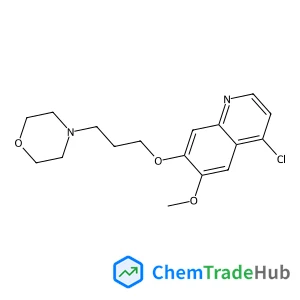
4-(3-((4-Chloro-6-methoxyquinolin-7-yl)oxy)propyl)morpholine
CAS Number:
205448-32-4
Molecular Formula:
C17H21ClN2O3
![2-Methyl-2-propanyl 4-oxo-3,9-diazabicyclo[4.2.1]nonane-9-carboxylate structure](https://static.chemtradehub.com/structs/131/1312456-05-5-9a15.webp "2-Methyl-2-propanyl 4-oxo-3,9-diazabicyclo[4.2.1]nonane-9-carboxylate structure")
2-Methyl-2-propanyl 4-oxo-3,9-diazabicyclo[4.2.1]nonane-9-carboxylate
CAS Number:
1312456-05-5
Molecular Formula:
C12H20N2O3
Recommended Suppliers






Disclaimer
This page provides academic journal information for reference and research purposes only. We are not affiliated with any journal publishers and do not handle publication submissions. For publication-related inquiries, please contact the respective journal publishers directly.
If you notice any inaccuracies in the information displayed, please contact us at support@chemtradehub.com. We will promptly review and address your concerns.