












The valence and Rydberg states of dienes
Literature Information
Publication Date
2020-02-25
DOI
10.1039/C9CP06952F
Impact Factor
3.676
Authors
Jiaxin Ning, Donald G. Truhlar
View Original
Abstract
The molecules 1,4-cyclohexadiene (unconjugated 1,4-CHD) and 1,3-cyclohexadiene (conjugated 1,3-CHD) both have two double bonds, but these bonds interact in different ways. These molecules have long served as examples of through-bond and through-space interactions, respectively, and their electronic structures have been studied in detail both experimentally and theoretically, with the experimental assignments being especially complete. The existence of Rydberg states interspersed with the valence states makes the quantum mechanical calculation of their spectra a challenging task. In this work, we explore the electronic excitation energies of 1,4-CHD and 1,3-CHD for both valence and Rydberg states by means of complete active space second-order perturbation theory (CASPT2), extended multi-state CASPT2 (XMS-CASPT2), and multiconfiguration pair-density functional theory (MC-PDFT); it is shown by comparison to experiment that MC-PDFT yields the most accurate results. We found that the inclusion of Rydberg orbitals in the active space not only enables the calculation of Rydberg excitation energies but also improves the accuracy of the valence ones. A special characteristic of the present analysis is the calculation of the second moments of the excited-state orbitals. Because we find that the CASPT2 densities agree well with the CASSCF ones and since the MC-PDFT methods gets accurate excitation energies based on the CASSCF densities, we believe that we can trust these moments as far as giving a more accurate picture of the diffuseness of the excited-state orbitals in these prototype molecules than has previously been available.
Related Literature
No-wash fluorogenic labeling of proteins for reversible photoswitching in live cells
Kenji Torii, Yuichiro Hori
2023-12-18
Edge Article
DOI: 10.1039/D3SC04953A
Electronic configuration regulation of single-atomic Mn sites mediated by Mo/Mn clusters for an efficient hydrogen evolution reaction
2024-01-08
Edge Article
DOI: 10.1039/D3SC06053E
Carborane-based heteromolecular extended networks driven by directional C–Te⋯N chalcogen bonding interactions
Maxime Beau, Olivier Jeannin, Marc Fourmigué, Emmanuel Aubert, Enrique Espinosa, Sunhee Lee, Won-Sik Han, Ie-Rang Jeon
2023-10-17
Communication
DOI: 10.1039/D3CC04338J
Recent applications of organic cages in sensing and separation processes in solution
Sonia La Cognata, Valeria Amendola
2023-10-25
Feature Article
DOI: 10.1039/D3CC04522F
Strategic design of an NIR probe for viscosity imaging in inflammatory and non-alcoholic steatohepatitis mice
Yaogeng Ma, Min Li, Huilin Sun, Jing-Yuan Ge, Yang Bai, Lin Qiu, Xuan Wu, Jiuxi Chen, Zhongyan Chen
2023-11-10
Communication
DOI: 10.1039/D3CC04041K
Enolate addition to bicyclobutanes enables expedient access to 2-oxo-bicyclohexane scaffolds
Kyla J. Woelk, Kushal Dhake, Nathan D. Schley, David C. Leitch
2023-10-10
Communication
DOI: 10.1039/D3CC04234K
ATP-responsive Mn(ii)-based T1 contrast agent for MRI
Lawerence Kenning, Graeme J. Stasiuk
2023-09-19
Communication
DOI: 10.1039/D3CC03430E
You might also like
Compound Q&A
What are the main uses of (5-Sulfamoyl-3-pyridinyl)boronic acid (CAS: 951233-61-7)?
(5-Sulfamoyl-3-pyridinyl)boronic acid is primarily used in chemical synthesis, p...
951233-61-7(5-Sulfamoyl-3-pyrid...
Compound Q&A
How is Benzyl 2-methyl-2-(methylsulfonyl)-4-pentenoate (CAS: 1942858-50-5) typically synthesized?
Benzyl 2-methyl-2-(methylsulfonyl)-4-pentenoate is typically synthesized via est...
1942858-50-5Benzyl 2-methyl-2-(m...
Compound Q&A
What precautions should be taken when handling 8-Fluoroquinolin-6-ol (CAS: 209353-22-0)?
When handling 8-Fluoroquinolin-6-ol (CAS: 209353-22-0), it is important to use p...
209353-22-08-Fluoroquinolin-6-o...
Compound Q&A
What are the physical and chemical properties of 1,3-Dibromo-5-(2-methyl-2-propanyl)benzene (CAS: 129316-09-2)?
1,3-Dibromo-5-(2-methyl-2-propanyl)benzene (CAS: 129316-09-2) is a crystalline c...
129316-09-21,3-Dibromo-5-(2-met...
Compound Q&A
What industries use Ethyl 7-chloro-4-oxo-1-(1,3-thiazol-2-yl)-1,4-dihydro-1,8-naphthyridine-3-carboxylate (CAS: 174726-87-5)?
Ethyl 7-chloro-4-oxo-1-(1,3-thiazol-2-yl)-1,4-dihydro-1,8-naphthyridine-3-carbox...
174726-87-5Ethyl 7-chloro-4-oxo...
Compound Q&A
What precautions should be taken when handling Delta-7-Avenasterol (CAS: 23290-26-8)?
When handling Delta-7-Avenasterol (CAS: 23290-26-8), it is important to wear app...
23290-26-8Delta-7-Avenasterol
Compound Q&A
What precautions should be taken when handling N-({(5R)-3-[3-Fluoro-4-(4-morpholinyl)phenyl]-2-oxo-1,3-oxazolidin-5-yl}methyl)acetamide (CAS: 872992-20-6)?
Proper handling involves the use of personal protective equipment such as gloves...
872992-20-6N-({(5R)-3-[3-Fluoro...
Compound Q&A
What precautions should be taken when handling 2-Methyl-2-proanyl 4-[(2-aminophenyl)amino]-1-piperidinecarboxylate (CAS: 79099-00-6)?
When handling 2-Methyl-2-proanyl 4-[(2-aminophenyl)amino]-1-piperidinecarboxylat...
79099-00-62-Methyl-2-propanyl ...
Compound Q&A
What is N-Methyl-4-chlorobenzylamine hydrochloride (CAS: 65542-24-7)?
N-Methyl-4-chlorobenzylamine hydrochloride (CAS: 65542-24-7) is a organic compou...
65542-24-7N-Methyl-4-chloroben...
Compound Q&A
Is [2-(Dodecyloxy)ethoxy]acetic acid (CAS: 27306-90-7) safe?
[2-(Dodecyloxy)ethoxy]acetic acid (CAS: 27306-90-7) is generally considered safe...
27306-90-7[2-(Dodecyloxy)ethox...
Source Journal
Physical Chemistry Chemical Physics

CiteScore:
5.5
Self-citation Rate:
10.3%
Articles per Year:
3036
Physical Chemistry Chemical Physics (PCCP) is an international journal co-owned by 19 physical chemistry and physics societies from around the world. This journal publishes original, cutting-edge research in physical chemistry, chemical physics and biophysical chemistry. To be suitable for publication in PCCP, articles must include significant innovation and/or insight into physical chemistry; this is the most important criterion that reviewers and Editors will judge against when evaluating submissions. The journal has a broad scope and welcomes contributions spanning experiment, theory, computation and data science. Topical coverage includes spectroscopy, dynamics, kinetics, statistical mechanics, thermodynamics, electrochemistry, catalysis, surface science, quantum mechanics, quantum computing and machine learning. Interdisciplinary research areas such as polymers and soft matter, materials, nanoscience, energy, surfaces/interfaces, and biophysical chemistry are welcomed if they demonstrate significant innovation and/or insight into physical chemistry. Joined experimental/theoretical studies are particularly appreciated when complementary and based on up-to-date approaches.
Recommended Compounds
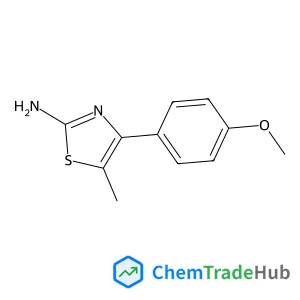
4-(4-Methoxyphenyl)-5-methyl-1,3-thiazol-2-amine
CAS Number:
105512-88-7
Molecular Formula:
C11H12N2OS
Recommended Suppliers





Disclaimer
This page provides academic journal information for reference and research purposes only. We are not affiliated with any journal publishers and do not handle publication submissions. For publication-related inquiries, please contact the respective journal publishers directly.
If you notice any inaccuracies in the information displayed, please contact us at support@chemtradehub.com. We will promptly review and address your concerns.