












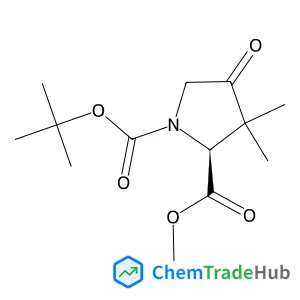
2-Methyl 1-(2-methyl-2-propanyl) (2S)-3,3-dimethyl-4-oxo-1,2-pyrrolidinedicarboxylate
CAS Number:
478698-30-5
Molecular Formula:
C13H21NO5
P. M. Tan, N. X. Ca, N. T. Hien, H. T. Van, P. V. Do, L. D. Thanh, V. H. Yen, V. P. Tuyen, Y. Peng
Eu-doped CdS quantum dots (QDs) with the Eu dopant concentration in the range of 0.5–10% and zinc blende (ZB) structure were successfully synthesized by a wet chemical method. The fabricated Eu-doped CdS QDs exhibited emissions in the visible window approximately at 465, 590, 618 and 696 nm, which correspond to the excitonic emission of CdS QDs and the electronic transitions of the intra 4f6 configuration from the 5D0 level to 7F1, 7F2 and 7F4 levels of Eu3+ dopant ions, respectively. Judd–Ofelt theory was used to estimate the properties of ligand field and luminescence quantum efficiency of the material. The interaction mechanism and the efficiency of the energy transfer process from CdS QDs to Eu3+ ions were found by using Reisfeld's approximation formulas. The luminescence quenching of Eu3+-doped CdS QDs was studied through analysis of emission spectra and decay curves. The dominant interaction mechanism between Eu3+ ions and energy transfer parameters have been found by fitting the decay curves to the Inokuti–Hirayama model. The cross-relaxation channels leading to the luminescence quenching of Eu3+ have also been predicted.
Elisa N. Stephens, Xiao-Nan Zhang, Albert T. Lam, Jiawei Li, Hua Pei
DOI: 10.1039/D3CC04343F
Camelia Dutta, Sonia Maniappan, Jatish Kumar
DOI: 10.1039/D3CC04902G
Shafiur Rehman Khan, K. Naresh, Alka Kumari, Vineet Aniya, Praveen K Khatri, Anjan Ray, Suman L Jain
DOI: 10.1039/D3CC04389D
DOI: 10.1039/D3SC06053E
Jiawei Huang, Xiaoman Li, Yu Wei, Liang Xu
DOI: 10.1039/D3CC04351G
Mokilla Ramachandra Reddy, Eerappa Rajakumara, Gedu Satyanarayana
DOI: 10.1039/D3CC04473D
Darren L. Langer, Sewon Oh
DOI: 10.1039/D3SC05613A
Kenji Watanabe, Qiyue Mao, Zhouen Zhang, Machi Hata, Masahito Kodera, Hiroaki Kitagishi
DOI: 10.1039/D3SC04365G
Souvick Biswas, Kazuumi Fujioka, Ivan Antonov, Grace L. Rizzo, Steven D. Chambreau, Stefan Schneider, Rui Sun, Ralf I. Kaiser
DOI: 10.1039/D3SC05096C
(5-Sulfamoyl-3-pyridinyl)boronic acid is primarily used in chemical synthesis, p...
Benzyl 2-methyl-2-(methylsulfonyl)-4-pentenoate is typically synthesized via est...
When handling 8-Fluoroquinolin-6-ol (CAS: 209353-22-0), it is important to use p...
1,3-Dibromo-5-(2-methyl-2-propanyl)benzene (CAS: 129316-09-2) is a crystalline c...
Ethyl 7-chloro-4-oxo-1-(1,3-thiazol-2-yl)-1,4-dihydro-1,8-naphthyridine-3-carbox...
When handling Delta-7-Avenasterol (CAS: 23290-26-8), it is important to wear app...
Proper handling involves the use of personal protective equipment such as gloves...
When handling 2-Methyl-2-proanyl 4-[(2-aminophenyl)amino]-1-piperidinecarboxylat...
N-Methyl-4-chlorobenzylamine hydrochloride (CAS: 65542-24-7) is a organic compou...
[2-(Dodecyloxy)ethoxy]acetic acid (CAS: 27306-90-7) is generally considered safe...

Physical Chemistry Chemical Physics (PCCP) is an international journal co-owned by 19 physical chemistry and physics societies from around the world. This journal publishes original, cutting-edge research in physical chemistry, chemical physics and biophysical chemistry. To be suitable for publication in PCCP, articles must include significant innovation and/or insight into physical chemistry; this is the most important criterion that reviewers and Editors will judge against when evaluating submissions. The journal has a broad scope and welcomes contributions spanning experiment, theory, computation and data science. Topical coverage includes spectroscopy, dynamics, kinetics, statistical mechanics, thermodynamics, electrochemistry, catalysis, surface science, quantum mechanics, quantum computing and machine learning. Interdisciplinary research areas such as polymers and soft matter, materials, nanoscience, energy, surfaces/interfaces, and biophysical chemistry are welcomed if they demonstrate significant innovation and/or insight into physical chemistry. Joined experimental/theoretical studies are particularly appreciated when complementary and based on up-to-date approaches.

![2-Methyl-2-propanyl 4-oxo-3,9-diazabicyclo[4.2.1]nonane-9-carboxylate structure](https://static.chemtradehub.com/structs/131/1312456-05-5-9a15.webp "2-Methyl-2-propanyl 4-oxo-3,9-diazabicyclo[4.2.1]nonane-9-carboxylate structure")





