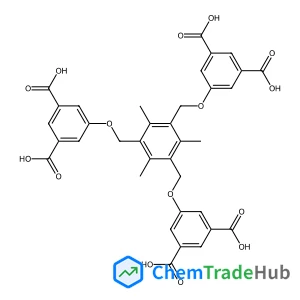
5,5',5''-(((2,4,6-Trimethylbenzene-1,3,5-triyl)tris(methylene))tris(oxy))triisophthalic acid
CAS Number:
1159974-70-5
Molecular Formula:
C36H30O15
Simón Ramírez-Hinestrosa, Daan Frenkel
The Lennard-Jones 12-6 potential (LJ) is arguably the most widely used pair potential in molecular simulations. In fact, it is so popular that the question is rarely asked whether it is fit for purpose. In this paper, we argue that, whilst the LJ potential was designed for noble gases such as argon, it is often used for systems where it is not expected to be particularly realistic. Under those circumstances, the disadvantages of the LJ potential become relevant: most important among these is that in simulations the LJ potential is always modified such that it has a finite range. More seriously, there is by now a whole family of different potentials that are all called Lennard-Jones 12-6, and that are all different – and that may have very different macroscopic properties. In this paper, we consider alternatives to the LJ 12-6 potential that could be employed under conditions where the LJ potential is only used as a typical short-ranged potential with attraction. We construct a class of potentials that are, in many respects LJ-like but that are by construction finite ranged, vanishing quadratically at the cut-off distance, and that are designed to be computationally cheap. Below, we present this potential and report numerical data for its thermodynamic and transport properties, for the most important cases (cut-off distance rc = 2σ (“LJ-like”) and rc = 1.2σ (a typical “colloidal” potential)).

Foundations of Chemistry

European Journal of Organic Chemistry

Molecules

Journal of Enzyme inhibition and Medicinal Chemistry

Contact Lens & Anterior Eye

Mini-Reviews in Medicinal Chemistry

Green Chemistry

Advanced Engineering Materials

Current Pharmaceutical Biotechnology

Angewandte Chemie International Edition
Evan T. Miller, Oleg V. Tsodikov, Sylvie Garneau-Tsodikova
DOI: 10.1039/D3NP00036B
Donya Mohammadi Amidi, Kamran Akhbari
DOI: 10.1039/D3NJ05198F
Lucas H. G. Kalinke, Mariany S. Silva, Ana K. Valdo, Felipe T. Martins, Nicolás Moliner, Miguel Julve, Francesc Lloret, Joan Cano, Danielle Cangussu
DOI: 10.1039/D3NJ04701F
Tao Ban, Maolian Guo, Yajie Wang, Jiawang Ma, Xinxin Wang, Zihui Wang, Xiuling Zhu
DOI: 10.1039/D3TA05382B
Sundararajan Parani, Eun-young Choi, Jang-Kun Song
DOI: 10.1039/D3TA03016D
Rabban Rabban, Jinti Moni Kumar, Naiwrit Karmodak, Bappaditya Gole
DOI: 10.1039/D3NJ05283D
Maria Bastianini, Michele Sisani, Annarita Petracci, Irene Di Guida, Riccardo Narducci
DOI: 10.1039/D3NJ04942F
DOI: 10.1039/D3NP00025G
Rachita Panigrahi, Bhabani S. Mallik
DOI: 10.1039/D3NJ04685K
Waste containing N-Methoxy-N-methyl-1,3-thiazole-5-carboxamide (CAS: 898825-89-3...
N-(4-Biphenylyl)dibenzo[b,d]furan-4-amine should be stored in a tightly sealed c...
The market for 3-Acetamido-5-amino-2,4,6-triiodobenzoic acid (CAS: 1713-07-1) is...
Benzyl 2-O-acetyl-3,4,6-tri-O-benzyl-beta-D-galactopyranoside (CAS: 61820-03-9) ...
2-Ethylpiperazine dihydrochloride (CAS: 438050-52-3) is regulated under the Glob...
1,1'-[1,3-Phenylenebis(methylene)]bis(3-methyl-1H-pyrrole-2,5-dione) (CAS: 11946...
Several alternatives can be used in the synthesis of 5-Fluoro-2-(1-pyrrolidinyl)...
Proper personal protective equipment (PPE) must be worn when handling this compo...
When handling 6-Bromoimidazo[1,2-a]pyridin-8-amine, it is important to wear appr...
Alternatives to (2S,4R)-4-(4-Nitrobenzyl)pyrrolidine-2-carboxylic acid hydrochlo...

Physical Chemistry Chemical Physics (PCCP) is an international journal co-owned by 19 physical chemistry and physics societies from around the world. This journal publishes original, cutting-edge research in physical chemistry, chemical physics and biophysical chemistry. To be suitable for publication in PCCP, articles must include significant innovation and/or insight into physical chemistry; this is the most important criterion that reviewers and Editors will judge against when evaluating submissions. The journal has a broad scope and welcomes contributions spanning experiment, theory, computation and data science. Topical coverage includes spectroscopy, dynamics, kinetics, statistical mechanics, thermodynamics, electrochemistry, catalysis, surface science, quantum mechanics, quantum computing and machine learning. Interdisciplinary research areas such as polymers and soft matter, materials, nanoscience, energy, surfaces/interfaces, and biophysical chemistry are welcomed if they demonstrate significant innovation and/or insight into physical chemistry. Joined experimental/theoretical studies are particularly appreciated when complementary and based on up-to-date approaches.
![2-Methyl-2-propanyl {3-[4-(4,4,5,5-tetramethyl-1,3,2-dioxaborolan-2-yl)phenyl]-3-oxetanyl}carbamate structure](https://static.chemtradehub.com/structs/127/1279090-25-3-1b84.webp "2-Methyl-2-propanyl {3-[4-(4,4,5,5-tetramethyl-1,3,2-dioxaborolan-2-yl)phenyl]-3-oxetanyl}carbamate structure")