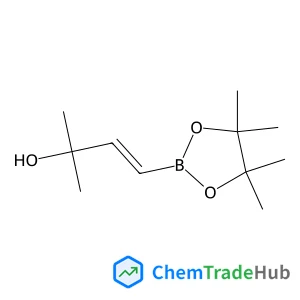
(E)-2-methyl-4-(4,4,5,5-tetramethyl-1,3,2-dioxaborolan-2-yl)but-3-en-2-ol
CAS Number:
581802-26-8
Molecular Formula:
C11H21BO3
J. J. Quijano-Briones, H. N. Fernández-Escamilla, J. Guerrero-Sánchez, E. Martínez-Guerra, Noboru Takeuchi
The stretching and compression effects on puckered arsenene nanotubes (AsNTs) are investigated by using density functional calculations. The atomic arrangement determines the nanotube properties and relative stability; therefore, zigzag, chiral, and armchair present different properties. Since the AsNT properties depend on the diameter, three cases are considered: (a) (0, 9) and (9, 0), (b) (0, 14) and (14, 0), and (c) (0, 19) and (19, 0) NTs. For all calculated parameters of the smallest NTs, it is found that the armchair (0, 9) nanotube is always more stable than the zigzag (9, 0) nanotube. On the other hand, for the two largest NTs, a structural transition from armchair to zigzag is found upon stretching. Phase transitions are of great interest, in part because they result in changes of the properties of the material under study, changes that can be used in many technologies. To our knowledge, this is the first time that a structural transition in a puckered nanotube has been predicted. Our results show that the electronic band gap of the AsNTs can be modulated by increasing or decreasing the axial lattice parameter. It is also found that semiconductor NTs are more stable than metallic NTs.
Pucheng Wang, Jingwen Dai, Lei Liu, Qibao Dong, Hu Wang, Ruke Bai
DOI: 10.1039/C4PY00902A
Sonu Kumar, Rituparna Acharya, Urmi Chatterji, Priyadarsi De
DOI: 10.1039/C4PY00620H
Xiaofu Wu, Hui Tong, Lixiang Wang
DOI: 10.1039/C4PY00592A
Prabhjot K. Saini, Charles Romain, Yunqing Zhu, Charlotte K. Williams
DOI: 10.1039/C4PY00748D
Laibing Wang, Nozomu Suzuki, Jiangfei Liu, Takashi Matsuda, Nor Azura Abdul Rahim, Wei Zhang, Michiya Fujiki, Zhengbiao Zhang, Nianchen Zhou, Xiulin Zhu
DOI: 10.1039/C4PY00865K
Yi Zeng, Peng Li, Xinyang Liu, Tianjun Yu, Jinping Chen, Guoqiang Yang, Yi Li
DOI: 10.1039/C4PY00714J
H. Salmi, X. Allonas, C. Ley, A. Defoin, A. Ak
DOI: 10.1039/C4PY00927D
When considering alternatives to 1-(4-Chlorophenyl)-N-hydroxymethanimine (CAS: 3...
This compound should be stored in a cool, dry place away from direct sunlight. I...
3-(4-Bromophenyl)-5-(2-fluorophenyl)-1,2,4-oxadiazole is synthesized through a m...
5-Chloro-2-(4-chlorophenyl)-4-methyl-6-[3-(1-piperidinyl)propoxy]pyrimidine (CAS...
2-Chloro-4-(difluoromethoxy)pyridine is used in the pharmaceutical industry for ...
3-Chloro-6-methylpyridazine (CAS: 1121-79-5) is classified under the Globally Ha...
Several alternatives can be used in the synthesis of Methyl 4,5-dimethyl-2-nitro...
Alternatives to (2E,2'E)-3,3'-(1,4-Phenylene)bisacrylaldehyde include other acry...
3-Amino-5-chloropyridin-2-ol hydrochloride is an organic compound with the CAS n...
When handling 6,7-Difluoro-2,3-dihydro-4H-chromen-4-one, it is essential to wear...

Physical Chemistry Chemical Physics (PCCP) is an international journal co-owned by 19 physical chemistry and physics societies from around the world. This journal publishes original, cutting-edge research in physical chemistry, chemical physics and biophysical chemistry. To be suitable for publication in PCCP, articles must include significant innovation and/or insight into physical chemistry; this is the most important criterion that reviewers and Editors will judge against when evaluating submissions. The journal has a broad scope and welcomes contributions spanning experiment, theory, computation and data science. Topical coverage includes spectroscopy, dynamics, kinetics, statistical mechanics, thermodynamics, electrochemistry, catalysis, surface science, quantum mechanics, quantum computing and machine learning. Interdisciplinary research areas such as polymers and soft matter, materials, nanoscience, energy, surfaces/interfaces, and biophysical chemistry are welcomed if they demonstrate significant innovation and/or insight into physical chemistry. Joined experimental/theoretical studies are particularly appreciated when complementary and based on up-to-date approaches.
![(2S)-2-{[(9H-Fluoren-9-ylmethoxy)carbonyl]amino}-4-(methylselanyl)butanoic acid structure](https://static.chemtradehub.com/structs/121/1217852-49-7-f252.webp "(2S)-2-{[(9H-Fluoren-9-ylmethoxy)carbonyl]amino}-4-(methylselanyl)butanoic acid structure")