












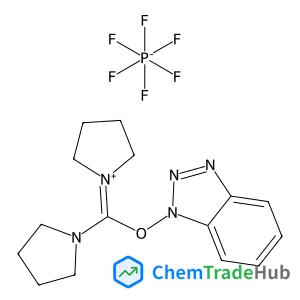
(1H-Benzotriazol-1-yloxy)(di-1-pyrrolidinyl)methylium hexafluorophosphate
CAS Number:
105379-24-6
Molecular Formula:
C15H21F6N5OP
Shanshan Tang, Narcisse T. Tsona, Lin Du
The effect of a single water molecule on the atmospheric reaction between nitrous acid (HONO) and the hydroxyl radical (OH) has been investigated in this work. The CCSD(T)/aug-cc-pVTZ//UωB97X-D/aug-cc-pVTZ level of theory was used to obtain all stationary points on the energy surface and to determine the rate constants. Due to the two HONO configurations (cis- and trans-) existing in the atmosphere, the water-free HONO + OH reaction has two major elementary channels, both based on the HONO hydrogen abstraction by the hydroxyl radical. The products, NO2 + H2O, are formed with substantial energy gain, but separated by relatively low energy barriers. In the presence of water, the reaction becomes more complex, proceeding through twelve different channels, each starting with the formation of a binary complex between water and one reactant followed by its interaction with the third species. The products are similar to those of the water-free reaction. At 298 K, the rate constants of water-free cis-HONO + OH and trans-HONO + OH reactions are 1.34 × 10⁻¹² and 1.00 × 10⁻¹⁵ cm3 molecule−1 s−1, respectively. The calculated rate constants for H2O-complexed HONO or OH increase by one to two orders of magnitude, but weighted by their relative abundances, the H2O-complexed fractions of the reactants in the atmosphere are so small that the effect of H2O on the overall reaction rate is minor.
Junghyun Choi, Pitchaimuthu Sudhagar, Joo Hyun Kim, Jiseok Kwon, Jeonghyun Kim, Chiaki Terashima, Akira Fujishima, Taeseup Song, Ungyu Paik
DOI: 10.1039/C6CP08199A
Tao Cheng, William A Goddard, III, Qi An, Hai Xiao, Boris Merinov, Sergey Morozov
DOI: 10.1039/C6CP08055C
Masashi Hattori, Keigo Kamata
DOI: 10.1039/C6CP06864B
Marnik Bercx, Nasrin Sarmadian, Rolando Saniz, Bart Partoens, Dirk Lamoen
DOI: 10.1039/C7CP90033C
Yuanjun Lu, Bryan E. G. Lucier, Yue Zhang, Anmin Zheng, Yining Huang
DOI: 10.1039/C7CP00199A
Michelle C. Fairhurst, Michael J. Ezell, Carla Kidd, Pascale S. J. Lakey, Manabu Shiraiwa, Barbara J. Finlayson-Pitts
DOI: 10.1039/C6CP08663B
Denis S. Grebenkov, Gleb Oshanin
DOI: 10.1039/C6CP06102H
Guillaume Bareigts, Christophe Labbez
DOI: 10.1039/C6CP08056A
Josep Bonet Avalos
DOI: 10.1039/C6CP08511C
When handling 4-(2-Furylmethyl)thiomorpholine 1,1-dioxide (CAS: 79206-94-3), it ...
When handling 4-Chloro-N-[2-(4-morpholinyl)ethyl]benzamide (CAS: 71320-77-9), it...
Waste containing this compound (CAS: 62921-74-8) should be handled according to ...
Waste containing (S)-Methyl 2-amino-3-cyclohexylpropanoate should be collected i...
This compound can be synthesized using a multi-step process involving the conjug...
There are several alternatives to (2E)-3-(3,4-Dichlorophenyl)acrylic acid in syn...
Ethyl 6-(2-nitrophenyl)imidazo[2,1-b][1,3]thiazole-3-carboxylate (CAS: 925437-84...
Waste containing 2-(1,3-Thiazol-2-yl)ethanamine (CAS: 18453-07-1) should be coll...
Methyl 5-iodo-2-methylbenzoate can be synthesized through the iodination of meth...
5-Chloro[1,2,4]triazolo[1,5-a]pyridine is commonly synthesized via the condensat...

Physical Chemistry Chemical Physics (PCCP) is an international journal co-owned by 19 physical chemistry and physics societies from around the world. This journal publishes original, cutting-edge research in physical chemistry, chemical physics and biophysical chemistry. To be suitable for publication in PCCP, articles must include significant innovation and/or insight into physical chemistry; this is the most important criterion that reviewers and Editors will judge against when evaluating submissions. The journal has a broad scope and welcomes contributions spanning experiment, theory, computation and data science. Topical coverage includes spectroscopy, dynamics, kinetics, statistical mechanics, thermodynamics, electrochemistry, catalysis, surface science, quantum mechanics, quantum computing and machine learning. Interdisciplinary research areas such as polymers and soft matter, materials, nanoscience, energy, surfaces/interfaces, and biophysical chemistry are welcomed if they demonstrate significant innovation and/or insight into physical chemistry. Joined experimental/theoretical studies are particularly appreciated when complementary and based on up-to-date approaches.
![[4-Amino-2-(methylsulfanyl)-5-pyrimidinyl]methanol structure](https://static.chemtradehub.com/structs/588/588-36-3-fc73.webp "[4-Amino-2-(methylsulfanyl)-5-pyrimidinyl]methanol structure")







