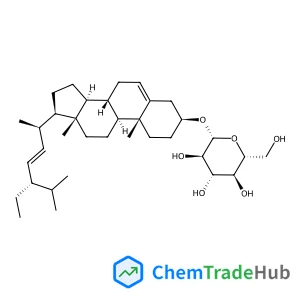
(3beta,22E)-Stigmasta-5,22-dien-3-yl beta-D-glucopyranoside
CAS Number:
19716-26-8
Molecular Formula:
C35H58O6
Matthew R. Henry, Songkil Kim
A new state of radical thermal non-equilibrium in surface adsorbed molecules is discovered that enables rapid surface diffusion of energized adatoms with a negligible effect on the substrate surface temperature. Due to enhanced surface diffusion, growth rates can be achieved that improve the feasibility of many nanofabrication techniques. Since the adatom temperature cannot be directly measured without disturbing its thermodynamic state, the first principle hard-cube model is used to predict both the adatom effective temperature and the surface temperature in response to gaseous particle impingement in a vacuum. The validity of the approach is supported by local, spatially-resolved surface temperature measurements of the thermal response to supersonic microjet gas impingement. The ability to determine and control the adatom effective temperature, and therefore the surface diffusion rate, opens new degrees of freedom in controlling a wide range of nanofabrication processes that critically depend on surface diffusion of precursor molecules. This fundamental understanding has the potential to accelerate research into nanoscale fabrication and to yield the new materials with unique properties that are only accessible with nanoscale features.
Qiang Hao, Xiuxiu Niu, Changshun Nie, Simeng Hao, Wei Zou, Jiangman Ge, Daimei Chen, Wenqing Yao
DOI: 10.1039/C6CP06122B
Nannan Wu, Hailong Lv, Jiurong Liu, Yuzhen Liu, Shenyu Wang, Wei Liu
DOI: 10.1039/C6CP06066H
Hui Zhao, Wei-xiao Ji, Chang-wen Zhang, Ping Li, Feng Li, Pei-ji Wang, Run-wu Zhang
DOI: 10.1039/C6CP06034J
P. S. Ghosh, A. Arya, G. K. Dey, N. Kuganathan, R. W. Grimes
DOI: 10.1039/C6CP05794B
Prabir Khatua, Jaya C. Jose, Neelanjana Sengupta, Sanjoy Bandyopadhyay
DOI: 10.1039/C6CP04925G
Yoshinori Kuroiwa, Susie Park, Tetsu Tatsuma
DOI: 10.1039/C6CP06973H
Linying Liu, Jianhua Zhang, Xiaowei Zhao, Zheng Mao, Na Liu, Youyu Zhang
DOI: 10.1039/C6CP05998H
Xue-Bing Yin, Rui Yang, Kan-Hao Xue, Zheng-Hua Tan, Xiao-Dong Zhang, Xiang-Shui Miao, Xin Guo
DOI: 10.1039/C6CP06049H
Simone Conti, Marco Cecchini
DOI: 10.1039/C6CP05249E
When handling 2-Chloro-1,2-bis(4-methylphenyl)ethanone (CAS: 71193-32-3), it is ...
4-Ethoxy-3-(5-methyl-4-oxo-7-propyl-1,4-dihydroimidazo[5,1-f][1,2,4]triazin-2-yl...
Methyl 3-Oxo-4-Androsten-17-Carboxylate (CAS: 2681-55-2) should be stored in a c...
(R)-3-Amino-4-(3-hexylphenylamino)-4-oxobutylphosphonic acid is primarily used i...
2-Methyl-2-propanyl 3-amino-3-carbamoyl-1-azetidinecarboxylate (CAS: 1254120-14-...
There are alternative reagents that can be used in synthesis instead of (E)-4-(t...
[2-(3-Chlorophenyl)-1,3-thiazol-4-yl]methanol (CAS: 121202-20-8) is a crystallin...
The market and research trends for Methyl (2S)-[(4S)-2,2-dimethyl-1,3-dioxolan-4...
The market for 1-Bromo-2-isocyanatoethane (CAS: 42865-19-0) is driven by its use...
4-Nitro-D-phenylalanine hydrochloride (CAS: 147065-06-3) is primarily used in re...

Physical Chemistry Chemical Physics (PCCP) is an international journal co-owned by 19 physical chemistry and physics societies from around the world. This journal publishes original, cutting-edge research in physical chemistry, chemical physics and biophysical chemistry. To be suitable for publication in PCCP, articles must include significant innovation and/or insight into physical chemistry; this is the most important criterion that reviewers and Editors will judge against when evaluating submissions. The journal has a broad scope and welcomes contributions spanning experiment, theory, computation and data science. Topical coverage includes spectroscopy, dynamics, kinetics, statistical mechanics, thermodynamics, electrochemistry, catalysis, surface science, quantum mechanics, quantum computing and machine learning. Interdisciplinary research areas such as polymers and soft matter, materials, nanoscience, energy, surfaces/interfaces, and biophysical chemistry are welcomed if they demonstrate significant innovation and/or insight into physical chemistry. Joined experimental/theoretical studies are particularly appreciated when complementary and based on up-to-date approaches.