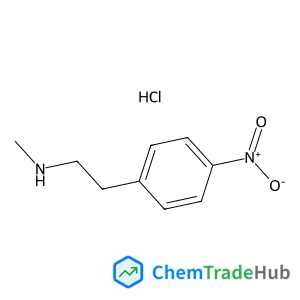
N-Methyl-2-(4-nitrophenyl)ethanamine hydrochloride (1:1)
CAS Number:
166943-39-1
Molecular Formula:
C9H13ClN2O2
Tatiana V. Plakhova, Anna Yu. Romanchuk, Stephan Weiss, Anna Efimenko, Christoph J. Sahle, Sergei M. Butorin, Stepan N. Kalmykov
Developing characterization techniques and analysis methods adapted to the investigation of nanoparticles (NPs) is of fundamental importance considering the role of these materials in many fields of research. The study of actinide based NPs, despite their environmental relevance, is still underdeveloped compared to that of NPs based on stable and lighter elements. We present here an investigation of ThO2 NPs performed with High-Energy Resolution Fluorescence Detected (HERFD) X-ray Absorption Near-Edge Structure (XANES) and with ab initio XANES simulations. The first post-edge feature of Th L3 edge HERFD XANES disappears in small NPs and simulations considering non-relaxed structural models reproduce the trends observed in experimental data. Inspection of the simulations of Th atoms in the core and on the surface of the NP indeed demonstrates that the first post-edge feature is very sensitive to the lowering of the number of coordinating atoms and therefore to the more exposed Th atoms at the surface of the NP. The sensitivity of the L3 edge HERFD XANES to low coordinated atoms at the surface stems from the hybridization of the d-Density of States (DOS) of Th with both O and Th neighboring atoms. This may be a common feature to other oxide systems that can be exploited to investigate surface interactions.
Y. Cui, K. D. Fulfer, J. Ma, T. K. Weldeghiorghis, D. G. Kuroda
DOI: 10.1039/C6CP06318G
Chrystelle Neaime, Maria Amela-Cortes, Yann Molard, Stéphane Cordier, Benjamin Dierre, Michel Mortier, Toshiaki Takei, Kohsei Takahashi, Hajime Haneda, Marc Verelst, Séverine Lechevallier
DOI: 10.1039/C6CP05290H
Huijing Li, Annapaola Migani, Lluís Blancafort, Quansong Li, Zesheng Li
DOI: 10.1039/C6CP06290C
Sobhit Singh, Wilfredo Ibarra-Hernández, Guillermo Avendaño-Franco, Aldo H. Romero
DOI: 10.1039/C6CP05401C
Xue-Rong Shi, Norbert Köpfle, Dmitry Y. Zemlyanov, Axel Knop-Gericke, Michael Hävecker, Bernhard Klötzer, Simon Penner
DOI: 10.1039/C6CP07197J
Shirui Luo, Jarrod Schiffbauer
DOI: 10.1039/C6CP06085D
DOI: 10.1039/C6CP03753D
Ulrich Kuenzer, Jan-Andrè Sorarù, Thomas S. Hofer
DOI: 10.1039/C6CP06698D
Alexander Karabanov, Grzegorz Kwiatkowski, Carlo U. Perotto, Daniel Wiśniewski, Jonathan McMaster, Walter Köckenberger
DOI: 10.1039/C6CP04345C
Doreen Mollenhauer, Nicola Gaston
DOI: 10.1039/C6CP04562F
When handling 2-Chloro-1,2-bis(4-methylphenyl)ethanone (CAS: 71193-32-3), it is ...
4-Ethoxy-3-(5-methyl-4-oxo-7-propyl-1,4-dihydroimidazo[5,1-f][1,2,4]triazin-2-yl...
Methyl 3-Oxo-4-Androsten-17-Carboxylate (CAS: 2681-55-2) should be stored in a c...
(R)-3-Amino-4-(3-hexylphenylamino)-4-oxobutylphosphonic acid is primarily used i...
2-Methyl-2-propanyl 3-amino-3-carbamoyl-1-azetidinecarboxylate (CAS: 1254120-14-...
There are alternative reagents that can be used in synthesis instead of (E)-4-(t...
[2-(3-Chlorophenyl)-1,3-thiazol-4-yl]methanol (CAS: 121202-20-8) is a crystallin...
The market and research trends for Methyl (2S)-[(4S)-2,2-dimethyl-1,3-dioxolan-4...
The market for 1-Bromo-2-isocyanatoethane (CAS: 42865-19-0) is driven by its use...
4-Nitro-D-phenylalanine hydrochloride (CAS: 147065-06-3) is primarily used in re...

Physical Chemistry Chemical Physics (PCCP) is an international journal co-owned by 19 physical chemistry and physics societies from around the world. This journal publishes original, cutting-edge research in physical chemistry, chemical physics and biophysical chemistry. To be suitable for publication in PCCP, articles must include significant innovation and/or insight into physical chemistry; this is the most important criterion that reviewers and Editors will judge against when evaluating submissions. The journal has a broad scope and welcomes contributions spanning experiment, theory, computation and data science. Topical coverage includes spectroscopy, dynamics, kinetics, statistical mechanics, thermodynamics, electrochemistry, catalysis, surface science, quantum mechanics, quantum computing and machine learning. Interdisciplinary research areas such as polymers and soft matter, materials, nanoscience, energy, surfaces/interfaces, and biophysical chemistry are welcomed if they demonstrate significant innovation and/or insight into physical chemistry. Joined experimental/theoretical studies are particularly appreciated when complementary and based on up-to-date approaches.
![(1R)-3-Bromo-1,7,7-trimethylbicyclo[2.2.1]heptan-2-one structure](https://static.chemtradehub.com/structs/102/10293-06-8-dd8a.webp "(1R)-3-Bromo-1,7,7-trimethylbicyclo[2.2.1]heptan-2-one structure")
![2-Hydroxy-4-[({[(4-methylphenyl)sulfonyl]oxy}acetyl)amino]benzoic acid structure](https://static.chemtradehub.com/structs/501/501919-59-1-579f.webp "2-Hydroxy-4-[({[(4-methylphenyl)sulfonyl]oxy}acetyl)amino]benzoic acid structure")