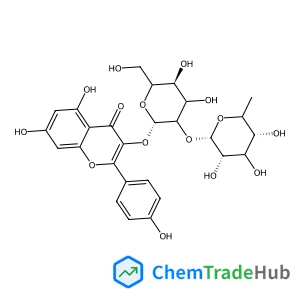
5,7-Dihydroxy-2-(4-hydroxyphenyl)-4-oxo-4H-chromen-3-yl 2-O-(6-deoxy-alpha-L-mannopyranosyl)-beta-D-glucopyranoside
CAS Number:
32602-81-6
Molecular Formula:
C27H30O15
Jocky C. K. Kung, Adam Forman, Rebecca A. Jockusch
The rational design of rhodamines and other fluorescent probes for different functions would benefit from an improved understanding of their photophysics. Key photophysical properties, including fluorescence, depend on the outcome of competing pathways for intra- and intermolecular energy flow within and from excited state molecules. In the work reported here, we simplify this complex landscape by eliminating solvent interactions, revealing intrinsic photophysical effects of systematic structural changes. Selected-ion laser-induced fluorescence (SILIF) is used to examine the effects of stepwise N-methylation on a rhodamine scaffold, starting with the simple rhodamine 123, in the gas phase. Fluorescence excitation and emission spectra together with fluorescence lifetime measurements are reported and discussed. While the systematic decrease in gas-phase 0–0 transition energy by 500 cm−1 per methylation is in line with expectations from solution studies, other trends are observed that are not apparent in solution studies. These include a notable narrowing of spectral profiles, three-fold decrease in Stokes shift and an ∼three-fold increase in brightness as the number of N-methylations rises from zero to four. Most surprising, while rhodamine 123 displays the expected textbook mirror-image symmetry between excitation and emission spectra, the emission spectrum of its tetra N-methylated derivative is ∼30% broader than the excitation spectrum. The likelihood that this difference reflects emission prior to complete vibrational redistribution of energy within the excited state of the larger rhodamines is discussed. This suggestion goes against conventional wisdom about the timescale of energy redistribution within molecules of this size, an understanding which was developed from solution studies. Overall, this study furthers our understanding of energy flow within an important class of fluorophores, highlights the consequences of energy flow between fluorophores and surrounding solvent, and provides benchmark experimental data for solvent-free chromophores to assist and calibrate computational work.
B. B. Xiao, X. B. Jiang, X. L. Yang, Q. Jiang
DOI: 10.1039/C6CP05869H
Mateus A. M. Paiva, Bárbara M. T. C. Peluzo, Jadson C. Belchior, Breno R. L. Galvão
DOI: 10.1039/C6CP05605A
Y. Lu, K. Wang, F.-R. Chen, W. Zhang, M. L. Sui
DOI: 10.1039/C6CP06032C
Sobhit Singh, Wilfredo Ibarra-Hernández, Guillermo Avendaño-Franco, Aldo H. Romero
DOI: 10.1039/C6CP05401C
Lei Chen, Yeonju Park, Qian Cong, Xiaoxia Han, Bing Zhao, Young Mee Jung
DOI: 10.1039/C6CP05978C
Alexander Karabanov, Grzegorz Kwiatkowski, Carlo U. Perotto, Daniel Wiśniewski, Jonathan McMaster, Walter Köckenberger
DOI: 10.1039/C6CP04345C
Yumeng Liu, Xiao Zhang, Junpeng Wang, Ping Yang
DOI: 10.1039/C6CP06371C
Linying Liu, Jianhua Zhang, Xiaowei Zhao, Zheng Mao, Na Liu, Youyu Zhang
DOI: 10.1039/C6CP05998H
Eirik Hjertenæs, Anh Quynh Nguyen
DOI: 10.1039/C6CP06774C
Zhiqiang Wang, Tie-Yu Lü, Yuan Ping Feng
DOI: 10.1039/C6CP06164H
When handling 2-Chloro-1,2-bis(4-methylphenyl)ethanone (CAS: 71193-32-3), it is ...
4-Ethoxy-3-(5-methyl-4-oxo-7-propyl-1,4-dihydroimidazo[5,1-f][1,2,4]triazin-2-yl...
Methyl 3-Oxo-4-Androsten-17-Carboxylate (CAS: 2681-55-2) should be stored in a c...
(R)-3-Amino-4-(3-hexylphenylamino)-4-oxobutylphosphonic acid is primarily used i...
2-Methyl-2-propanyl 3-amino-3-carbamoyl-1-azetidinecarboxylate (CAS: 1254120-14-...
There are alternative reagents that can be used in synthesis instead of (E)-4-(t...
[2-(3-Chlorophenyl)-1,3-thiazol-4-yl]methanol (CAS: 121202-20-8) is a crystallin...
The market and research trends for Methyl (2S)-[(4S)-2,2-dimethyl-1,3-dioxolan-4...
The market for 1-Bromo-2-isocyanatoethane (CAS: 42865-19-0) is driven by its use...
4-Nitro-D-phenylalanine hydrochloride (CAS: 147065-06-3) is primarily used in re...

Physical Chemistry Chemical Physics (PCCP) is an international journal co-owned by 19 physical chemistry and physics societies from around the world. This journal publishes original, cutting-edge research in physical chemistry, chemical physics and biophysical chemistry. To be suitable for publication in PCCP, articles must include significant innovation and/or insight into physical chemistry; this is the most important criterion that reviewers and Editors will judge against when evaluating submissions. The journal has a broad scope and welcomes contributions spanning experiment, theory, computation and data science. Topical coverage includes spectroscopy, dynamics, kinetics, statistical mechanics, thermodynamics, electrochemistry, catalysis, surface science, quantum mechanics, quantum computing and machine learning. Interdisciplinary research areas such as polymers and soft matter, materials, nanoscience, energy, surfaces/interfaces, and biophysical chemistry are welcomed if they demonstrate significant innovation and/or insight into physical chemistry. Joined experimental/theoretical studies are particularly appreciated when complementary and based on up-to-date approaches.
![2-Hydroxy-4-[({[(4-methylphenyl)sulfonyl]oxy}acetyl)amino]benzoic acid structure](https://static.chemtradehub.com/structs/501/501919-59-1-579f.webp "2-Hydroxy-4-[({[(4-methylphenyl)sulfonyl]oxy}acetyl)amino]benzoic acid structure")