













Redox-probe-free scanning electrochemical microscopy combined with fast Fourier transform electrochemical impedance spectroscopy
Literature Information
Publication Date
2019-04-05
DOI
10.1039/C9CP00187E
Impact Factor
3.676
Authors
Aušra Valiūnienė, Jurate Petroniene, Georgi Popkirov, Almira Ramanaviciene, Arunas Ramanavicius
View Original
Abstract
Scanning electrochemical microscopy (SECM) hybridized with fast Fourier transform-based electrochemical impedance spectroscopy (FFT-EIS) seems to be a powerful variation of scanning electrochemical impedance microscopy (SEIM), wherein both state-of-the-art techniques are combined (FFT-SEIM) and can be used for the investigation and treatment of tissues at single cell level. However, in most EIS-based experiments, harmful redox mediators are applied, which affect the functioning of living cells and tissues. Therefore, the development of a redox-probe-free FFT-SEIM is still a very important challenge in electrochemistry. For this reason, in this research, we have demonstrated a redox-probe-free evaluation of conducting and non-conducting surfaces by combining scanning electrochemical microscopy with FFT-EIS. It was demonstrated that using the fast Fourier transform-based FFT-EIS technique, EIS spectra could be registered much faster compared to experiments performed using the conventional EIS equipment. An ultramicroelectrode (UME) was used as a scanning electrode to ensure high spatial resolution. We have performed FFT-SEIM measurements in a redox-probe-free mode (without any additional redox probes) and have investigated several surfaces with different conductivities. The FFT-EIS equipment and the built-in software help to avoid the influence of possible formation of hydrogen bubbles on the UME. This research opens up a new avenue for the application of FFT-SEIM in the investigation of samples that are unstable and very sensitive towards redox mediators (e.g., tissues and/or living cells).
Recommended Journals
Related Literature
Enhancement of memory margins in the polymer composite of [6,6]-phenyl-C61-butyric acid methyl ester and polystyrene
Chunpeng Ai, Dianzhong Wen, Xuduo Bai
2016-10-19
Paper
DOI: 10.1039/C6CP06084F
Pushing the limit for the grid-based treatment of Schrödinger's equation: a sparse Numerov approach for one, two and three dimensional quantum problems
Ulrich Kuenzer, Jan-Andrè Sorarù, Thomas S. Hofer
2016-10-20
Paper
DOI: 10.1039/C6CP06698D
Early events in the photochemistry of 5-diazo Meldrum's acid: formation of a product manifold in C–N bound and pre-dissociated intersection seam regions
Huijing Li, Annapaola Migani, Lluís Blancafort, Quansong Li, Zesheng Li
2016-10-14
Paper
DOI: 10.1039/C6CP06290C
Transferability of a coarse-grained atactic polystyrene model: the non-bonded potential effect
2016-10-04
Paper
DOI: 10.1039/C6CP03753D
Predicted low thermal conductivities in antimony films and the role of chemical functionalization
Tian Zhang, Yuan-Yuan Qi, Xiang-Rong Chen, Ling-Cang Cai
2016-10-24
Paper
DOI: 10.1039/C6CP05908B
A highly efficient g-C3N4/SiO2 heterojunction: the role of SiO2 in the enhancement of visible light photocatalytic activity
Qiang Hao, Xiuxiu Niu, Changshun Nie, Simeng Hao, Wei Zou, Jiangman Ge, Daimei Chen, Wenqing Yao
2016-09-30
Paper
DOI: 10.1039/C6CP06122B
Structure and stability of neutral Al–Mg nanoclusters up to 55 atoms
Mateus A. M. Paiva, Bárbara M. T. C. Peluzo, Jadson C. Belchior, Breno R. L. Galvão
2016-10-20
Paper
DOI: 10.1039/C6CP05605A
In situ growth of sulfide/g-C3N4 nano-heterostructures with an adjusted band gap toward enhanced visible photocatalysis
Yumeng Liu, Xiao Zhang, Junpeng Wang, Ping Yang
2016-10-19
Paper
DOI: 10.1039/C6CP06371C
You might also like
Compound Q&A
What precautions should be taken when handling 2-Chloro-1,2-bis(4-methylphenyl)ethanone (CAS: 71193-32-3)?
When handling 2-Chloro-1,2-bis(4-methylphenyl)ethanone (CAS: 71193-32-3), it is ...
71193-32-32-Chloro-1,2-bis(4-m...
Compound Q&A
What industries use 4-Ethoxy-3-(5-methyl-4-oxo-7-propyl-1,4-dihydroimidazo[5,1-f][1,2,4]triazin-2-yl)benzenesulfonyl chloride (CAS: 224789-26-8)?
4-Ethoxy-3-(5-methyl-4-oxo-7-propyl-1,4-dihydroimidazo[5,1-f][1,2,4]triazin-2-yl...
224789-26-84-Ethoxy-3-(5-methyl...
Compound Q&A
How should Methyl 3-Oxo-4-Androsten-17-Carboxylate (CAS: 2681-55-2) be stored?
Methyl 3-Oxo-4-Androsten-17-Carboxylate (CAS: 2681-55-2) should be stored in a c...
2681-55-2Methyl 3-Oxo-4-Andro...
Compound Q&A
What are the main uses of (R)-3-Amino-4-(3-hexylphenylamino)-4-oxobutylphosphonic acid (CAS: 909725-61-7)?
(R)-3-Amino-4-(3-hexylphenylamino)-4-oxobutylphosphonic acid is primarily used i...
909725-61-7(R)-3-Amino-4-(3-hex...
Compound Q&A
What regulatory guidelines apply to 2-Methyl-2-propanyl 3-amino-3-carbamoyl-1-azetidinecarboxylate (CAS: 1254120-14-3)?
2-Methyl-2-propanyl 3-amino-3-carbamoyl-1-azetidinecarboxylate (CAS: 1254120-14-...
1254120-14-32-Methyl-2-propanyl ...
Compound Q&A
Are there alternatives to (E)-4-(tert-Butoxy)-4-oxobut-2-enoic acid (CAS: 135355-96-3) in synthesis?
There are alternative reagents that can be used in synthesis instead of (E)-4-(t...
135355-96-3(E)-4-(tert-Butoxy)-...
Compound Q&A
What are the physical and chemical properties of [2-(3-Chlorophenyl)-1,3-thiazol-4-yl]methanol (CAS: 121202-20-8)?
[2-(3-Chlorophenyl)-1,3-thiazol-4-yl]methanol (CAS: 121202-20-8) is a crystallin...
121202-20-8[2-(3-Chlorophenyl)-...
Compound Q&A
What is the market or research trend for Methyl (2S)-[(4S)-2,2-dimethyl-1,3-dioxolan-4-yl]{[(4-methylphenyl)sulfonyl]oxy}acetate (CAS: 166249-17-8)?
The market and research trends for Methyl (2S)-[(4S)-2,2-dimethyl-1,3-dioxolan-4...
166249-17-8Methyl (2S)-[(4S)-2,...
Compound Q&A
What is the market or research trend for 1-Bromo-2-isocyanatoethane (CAS: 42865-19-0)?
The market for 1-Bromo-2-isocyanatoethane (CAS: 42865-19-0) is driven by its use...
42865-19-01-Bromo-2-isocyanato...
Compound Q&A
What are the main uses of 4-Nitro-D-phenylalanine hydrochloride (CAS: 147065-06-3)?
4-Nitro-D-phenylalanine hydrochloride (CAS: 147065-06-3) is primarily used in re...
147065-06-34-Nitro-D-phenylalan...
Source Journal
Physical Chemistry Chemical Physics

CiteScore:
5.5
Self-citation Rate:
10.3%
Articles per Year:
3036
Physical Chemistry Chemical Physics (PCCP) is an international journal co-owned by 19 physical chemistry and physics societies from around the world. This journal publishes original, cutting-edge research in physical chemistry, chemical physics and biophysical chemistry. To be suitable for publication in PCCP, articles must include significant innovation and/or insight into physical chemistry; this is the most important criterion that reviewers and Editors will judge against when evaluating submissions. The journal has a broad scope and welcomes contributions spanning experiment, theory, computation and data science. Topical coverage includes spectroscopy, dynamics, kinetics, statistical mechanics, thermodynamics, electrochemistry, catalysis, surface science, quantum mechanics, quantum computing and machine learning. Interdisciplinary research areas such as polymers and soft matter, materials, nanoscience, energy, surfaces/interfaces, and biophysical chemistry are welcomed if they demonstrate significant innovation and/or insight into physical chemistry. Joined experimental/theoretical studies are particularly appreciated when complementary and based on up-to-date approaches.
Recommended Compounds
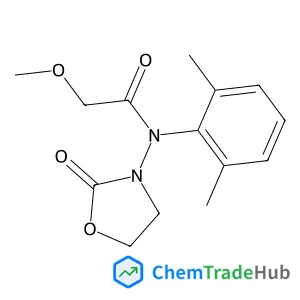
N-(2,6-Dimethylphenyl)-2-methoxy-N-(2-oxo-1,3-oxazolidin-3-yl)acetamide
CAS Number:
77732-09-3
Molecular Formula:
C14H18N2O4
Recommended Suppliers






Disclaimer
This page provides academic journal information for reference and research purposes only. We are not affiliated with any journal publishers and do not handle publication submissions. For publication-related inquiries, please contact the respective journal publishers directly.
If you notice any inaccuracies in the information displayed, please contact us at support@chemtradehub.com. We will promptly review and address your concerns.