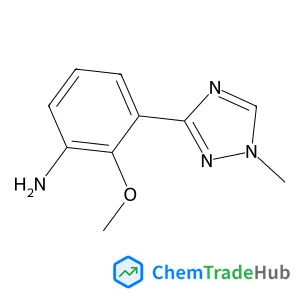
2-Methoxy-3-(1-methyl-1H-1,2,4-triazol-3-yl)aniline
CAS Number:
1609394-10-6
Molecular Formula:
C10H12N4O
C. Chatard, A. Graillot, G. Boutevin, C. Loubat, D. Grosso
Even though the hydrosilylation reaction has been the method of choice to produce organosilicon compounds for 70 years, improving its selectivity still remains a current challenge. In this work, a comprehensive study of the influence of experimental parameters on hydrosilylation side reactions was undertaken by applying a fractional factorial design of experiments. The study was conducted for polyethylene glycol (PEG, 1000 g mol−1) terminated allyl ether, which is commonly employed as a reactive functional group toward hydrosilylation. In addition, the resulting silane-functionalized PEG happens to be a molecule of interest in various domains such as the biomedical, cosmetic or food industry thanks to its properties in accordance with these sectors' requirements. This methodology enables highlighting an optimized combination of experimental parameters as well as a cause–effect relationship between the different side reactions, leading to a better control of the hydrosilylation reaction.
Walter P. D. Wong, Xinyun Wang
DOI: 10.1039/D3TA04568D
Fatemeh Khosravi Esmaeiltarkhani, Mohammad Dinari, Nazanin Mokhtari
DOI: 10.1039/D3NJ04674E
Yanyan Li, Edwin Yue Bun Pun
DOI: 10.1039/D3TA04964G
Haifei Wan, Mengyao Li, Li Wang, Yonghai Song
DOI: 10.1039/D3TA04781D
Zhehao Sun, Kaili Liu, Ary Anggara Wibowo, Julien Langley, Chao Zhang, Sandra E. Saji, Felipe Kremer, Dmitri Golberg, Hieu T. Nguyen, Nicholas Cox
DOI: 10.1039/D3NH00348E
Cheng-Che Wu, Yun-Chung Ho
DOI: 10.1039/D3TA05632E
DOI: 10.1039/D3NH00217A
Guixiang Xu, Kai Liu, Xiangwu Chen, Yang Lin, Cancan Yu, Xinxin Nie, Wenxiu He, Nathan Karin, Yuxia Luan
DOI: 10.1039/D3NH00401E
Jun Guo, Xiaomin Xue, Fangfang Li, Meiting Zhao, Youcong Xing, Yanmin Song, Chang Long, Tingting Zhao, Zhiyong Tang
DOI: 10.1039/D3NH00419H
Mengyang Niu, Zheng Zhao, Baokai Wang, Chang Yu, Mengyi Li, Jiajun Hu, Lifeng Zhu, Xu Hao, Shiqin Wan, Ming Yue, Weiwei Xuan, Qipeng Lu, Wenbin Cao, Kexin Chen, Qi Wang
DOI: 10.1039/D3TA04770A
6-Bromo-2-methylimidazo[1,2-a]pyrimidine (CAS: 1111638-05-1) falls under various...
While there are no direct alternatives, similar compounds like 1-Pyrrolidineetha...
4-Methyl-2,6-bis(2-methyl-2-propanyl)phenyl methylcarbamate (CAS: 1918-11-2) is ...
2-(3-Bromo-4-fluorophenyl)-1,3-dioxolane (CAS: 77771-04-1) should be stored in a...
4,5,6,7-Tetrahydro-1H-indazole hydrochloride is a white crystalline solid with a...
(2R)-1-Methoxy-3-phenyl-2-propanamine is a chiral organic compound with the CAS ...
Ethyl 1-(1-phenylethyl)-1H-imidazole-5-carboxylate is used in various industries...
4-[(1E,3S)-1-(4-Hydroxyphenyl)-1,4-pentadien-3-yl]phenol (CAS: 17676-24-3) falls...
(S)-3-Amino-5-phenylpentanoic acid hydrochloride is primarily used in the pharma...
7-Methoxy-1-benzothiophene-2-carboxylic acid is typically synthesized by reactin...

Reaction Chemistry & Engineering is an interdisciplinary journal reporting cutting-edge research focused on enhancing the understanding and efficiency of reactions. Reaction engineering leverages the interface where fundamental molecular chemistry meets chemical engineering and technology. Challenges in chemistry can be overcome by the application of new technologies, while engineers may find improved solutions for process development from the latest developments in reaction chemistry. Reaction Chemistry & Engineering is a unique forum for researchers whose interests span the broad areas of chemical engineering and chemical sciences to come together in solving problems of importance to wider society. All papers should be written to be approachable by readers across the engineering and chemical sciences. Papers that consider multiple scales, from the laboratory up to and including plant scale, are particularly encouraged.