












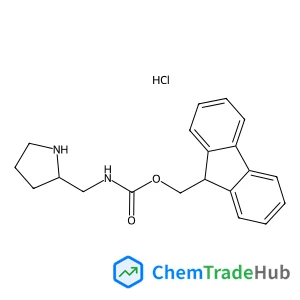
(S)-(9H-Fluoren-9-yl)methyl (pyrrolidin-2-ylmethyl)carbamate hydrochloride
CAS Number:
1217813-15-4
Molecular Formula:
C20H23ClN2O2
Somdeb Jana, Mahammad Anas, Tanmoy Maji, Sanjib Banerjee, Tarun K. Mandal
A new multi-stimuli responsive tryptophan-based styryl homopolymer exhibiting dual upper critical solution temperature (UCST)- and lower critical solution temperature (LCST)-type thermosensitivities under different conditions is presented. The monomer 4-vinylbenzyl N-[(tert-butoxy)carbonyl]-L-tryptophan (Boc-TrpVBz) is prepared by a simple substitution reaction followed by its subsequent RAFT polymerization to produce the poly(Boc-TrpVBz) homopolymer. Poly(Boc-TrpVBz) is not soluble in water, but is soluble in different organic solvents (such as DMSO, DMF and MeOH). An interesting upper critical solution temperature (UCST)-type turbid-to-transparent phase transition is detected for poly(Boc-TrpVBz) in mixed solvents containing any of these three solvents and a minimum percentage of water. The UCST-type cloud point is found to increase upon increasing the percentage of added water and the molecular weight of poly(Boc-TrpVBz). Furthermore, poly(Boc-TrpVBz) is soluble in water at above pH 7.5 and exhibits a lower critical solution temperature (LCST)-type transparent-to-turbid transition upon addition of tetrabutylammonium halide salts with a large organic cation. The LCST-type cloud point is variable with respect to the salt concentration and the nature of the halide ion. The deprotection of the Boc moiety of poly(Boc-TrpVBz) produces zwitterionic poly(TrpVBz) containing –NH2 and –COOH groups, which exhibits dual pH- and thermo-responsiveness in aqueous solution below pH 2. In the cases of UCST- and LCST-type transitions, the turbidity is caused by the formation of spherical polymer aggregates as observed via TEM and FESEM.
Adéla Křepelová, John Newberg, Thomas Huthwelker, Hendrik Bluhm, Markus Ammann
DOI: 10.1039/C0CP00359J
Tangui Le Bahers, Frédéric Labat, Thierry Pauporté, Ilaria Ciofini
DOI: 10.1039/C004358C
Olivier Cairon
DOI: 10.1039/C000991A
Go Kawamura, Shizuka Sato, Toshihiro Kogure, Yusuke Daiko, Hiroyuki Muto, Mototsugu Sakai, Atsunori Matsuda
DOI: 10.1039/B924330E
DOI: 10.1039/B927432D
Vadim V. Yanshole, Peter S. Sherin, Nina P. Gritsan, Olga A. Snytnikova, Victor I. Mamatyuk, Jakob Grilj, Eric Vauthey, Renad Z. Sagdeev, Yuri P. Tsentalovich
DOI: 10.1039/C000735H
Masataka Nagaoka
DOI: 10.1039/C0CP01077D
Atsushi Itadani, Takashi Yumura, Takahiro Ohkubo, Hisayoshi Kobayashi, Yasushige Kuroda
DOI: 10.1039/C000967A
Yingge Du, Nathaniel A. Deskins, Zhenrong Zhang, Zdenek Dohnalek, Michel Dupuis, Igor Lyubinetsky
DOI: 10.1039/C000250J
Graham Hungerford, Marion Toury, David McLoskey, Scott Finnigan, Shaun Gellie, A. Sheila Holmes-Smith
DOI: 10.1039/C0CP01081B
Waste containing N-Methoxy-N-methyl-1,3-thiazole-5-carboxamide (CAS: 898825-89-3...
N-(4-Biphenylyl)dibenzo[b,d]furan-4-amine should be stored in a tightly sealed c...
The market for 3-Acetamido-5-amino-2,4,6-triiodobenzoic acid (CAS: 1713-07-1) is...
Benzyl 2-O-acetyl-3,4,6-tri-O-benzyl-beta-D-galactopyranoside (CAS: 61820-03-9) ...
2-Ethylpiperazine dihydrochloride (CAS: 438050-52-3) is regulated under the Glob...
1,1'-[1,3-Phenylenebis(methylene)]bis(3-methyl-1H-pyrrole-2,5-dione) (CAS: 11946...
Several alternatives can be used in the synthesis of 5-Fluoro-2-(1-pyrrolidinyl)...
Proper personal protective equipment (PPE) must be worn when handling this compo...
When handling 6-Bromoimidazo[1,2-a]pyridin-8-amine, it is important to wear appr...
Alternatives to (2S,4R)-4-(4-Nitrobenzyl)pyrrolidine-2-carboxylic acid hydrochlo...

Polymer Chemistry welcomes submissions in all areas of polymer science that have a strong focus on macromolecular chemistry. Manuscripts may cover a broad range of fields, yet no direct application focus is required.
![[5-fluoro-2-(morpholine-4-carbonyl)phenyl]boronic acid structure](https://static.chemtradehub.com/structs/121/1217501-26-2-505c.webp "[5-fluoro-2-(morpholine-4-carbonyl)phenyl]boronic acid structure")
![[(5-Methyl-1,3,4-thiadiazol-2-yl)sulfanyl]acetic acid structure](https://static.chemtradehub.com/structs/509/50918-26-8-4ce8.webp "[(5-Methyl-1,3,4-thiadiazol-2-yl)sulfanyl]acetic acid structure")



