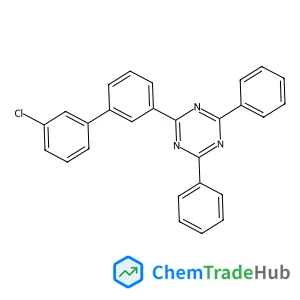
2-(3'-Chlorobiphenyl-3-yl)-4,6-diphenyl-1,3,5-triazine
CAS Number:
1443049-83-9
Molecular Formula:
C27H18ClN3
Yan Li, Zhiqiang Zhang, Changhai Liang
The mechanism and origin of stereoselectivities in N-heterocyclic carbine (NHC)-catalyzed [3 + 2] cycloaddition of 3-bromoenals and isatin N-Boc ketimines have been studied using density functional theory (DFT) calculations. Various possible reaction pathways were examined and analyzed. Our calculation results reveal that the catalytic cycle can be characterized by six steps: nucleophilic attack of a catalyst on 3-bromoenal (step I); [1,2]-proton transfer (step II); addition to the other reactant isatin N-Boc ketimine (step III); debromination (step IV); intramolecular cycloaddition concerted with hydrogen-elimination (step V) and elimination of the NHC catalyst (step VI). For step II, besides the direct [1,2]-proton transfer, the mediator (base and water)-assisted proton transfer has been investigated, and the DFT results show that the 2H2O cluster-mediated proton transfer is most energy favorable. The carbon–carbon bond formation step (step III) is calculated to be the stereoselectivity-determining step and the S-configuration product is the predominant product, which are in good agreement with the experimental observations. The mechanistic insights gained in this work should be helpful for other NHC-catalyzed reactions.
Victor Ekholm, Jochen S. Hub, Malin Wohlert
DOI: 10.1039/D1CP02818A
DOI: 10.1039/D1CP02171K
Hongyan Lu, Yandong Ma
DOI: 10.1039/D1CP01834E
Xiao-Lei Hao, Hao-Yue Guo, Bobo Cao, Guang Mo, Zhi-Hong Li, Zhi-Wu Yu
DOI: 10.1039/D1CP01220G
Alexander E. Khudozhitkov, Sergei S. Arzumanov, Alexander V. Toktarev, Svetlana V. Cherepanova, Anton A. Gabrienko, Daniil I. Kolokolov, Alexander G. Stepanov
DOI: 10.1039/D1CP03060D
Qi An, William L. Johnson, Sydney L. Corona, Yidi Shen, William A. Goddard, III
DOI: 10.1039/D1CP04157F
Qinxi Liu, Yinqiao Liu, Jianpei Xing, Xue Jiang, Jijun Zhao
DOI: 10.1039/D1CP02923A
Shagun Nag, Ranber Singh
DOI: 10.1039/D1CP03988A
Yang Cong, Yu Zhai, Jitai Yang, Adam Grofe, Hui Li
DOI: 10.1039/D1CP04490G
Patrick Kimber, Pooja Goddard, Iain A. Wright, Felix Plasser
DOI: 10.1039/D1CP03792G
When handling 2-Chloro-1,2-bis(4-methylphenyl)ethanone (CAS: 71193-32-3), it is ...
4-Ethoxy-3-(5-methyl-4-oxo-7-propyl-1,4-dihydroimidazo[5,1-f][1,2,4]triazin-2-yl...
Methyl 3-Oxo-4-Androsten-17-Carboxylate (CAS: 2681-55-2) should be stored in a c...
(R)-3-Amino-4-(3-hexylphenylamino)-4-oxobutylphosphonic acid is primarily used i...
2-Methyl-2-propanyl 3-amino-3-carbamoyl-1-azetidinecarboxylate (CAS: 1254120-14-...
There are alternative reagents that can be used in synthesis instead of (E)-4-(t...
[2-(3-Chlorophenyl)-1,3-thiazol-4-yl]methanol (CAS: 121202-20-8) is a crystallin...
The market and research trends for Methyl (2S)-[(4S)-2,2-dimethyl-1,3-dioxolan-4...
The market for 1-Bromo-2-isocyanatoethane (CAS: 42865-19-0) is driven by its use...
4-Nitro-D-phenylalanine hydrochloride (CAS: 147065-06-3) is primarily used in re...

Organic & Biomolecular Chemistry (OBC) publishes original and high impact research and reviews in organic chemistry. We welcome research that shows new or significantly improved protocols or methodologies in total synthesis, synthetic methodology or physical and theoretical organic chemistry as well as research that shows a significant advance in the organic chemistry or molecular design aspects of chemical biology, catalysis, supramolecular and macromolecular chemistry, theoretical chemistry, mechanism-oriented physical organic chemistry, medicinal chemistry or natural products. Articles published in the journal should report new work which makes a highly-significant impact in the field. Routine and incremental work is generally not suitable for publication in the journal. More details about key areas of our scope are below. In all cases authors should include in their article clear rationale for why their research has been carried out.
![(1R)-3-Bromo-1,7,7-trimethylbicyclo[2.2.1]heptan-2-one structure](https://static.chemtradehub.com/structs/102/10293-06-8-dd8a.webp "(1R)-3-Bromo-1,7,7-trimethylbicyclo[2.2.1]heptan-2-one structure")