












1,8-Diamidocarbazoles: an easily tuneable family of fluorescent anion sensors and transporters
Literature Information
Publication Date
2018-06-29
DOI
10.1039/C8OB01031E
Impact Factor
3.876
Authors
Krzysztof M. Bąk, Krzysztof Chabuda, Helena Montes, Roberto Quesada, Michał J. Chmielewski
View Original
Abstract
The synthesis, structure and anion recognition properties of an extensive, rationally designed series of bisamide derivatives of 1,8-diaminocarbazole and 1,8-diamino-3,6-dichlorocarbazole are described. Despite simple structures and the presence of only three hydrogen bond donors, such compounds are remarkably strong and selective receptors for oxyanions in DMSO + 0.5%H2O. Owing to their carbazole fluorophore, they are also sensitive turn-on fluorescent sensors for H2PO4− and AcO−, with a more than 15-fold increase in fluorescence intensity upon binding. Despite relatively weak chloride affinity, some of the diamidocarbazoles have also been shown, for the first time, to be very active chloride transporters through lipid bilayers. The binding, sensing and transport properties of these receptors can be easily modulated by the usually overlooked variations in the length and degree of branching of their alkyl side arms. Overall, this study demonstrates that the 1,8-diamidocarbazole binding unit is a very promising and synthetically versatile platform for the development of fluorescent sensors and transporters for anions.
Recommended Journals
Related Literature
International Union of Chemistry. Tenth Report of the Committee on Atomic Weights
Other
DOI: 10.1039/AN940650415A
You might also like
Compound Q&A
What regulatory guidelines apply to 4-Amino-3-bromophenol (CAS: 74440-80-5)?
4-Amino-3-bromophenol (CAS: 74440-80-5) falls under the classification of a haza...
74440-80-54-Amino-3-bromopheno...
Compound Q&A
How should (17beta)-3-Oxoestr-4-en-17-yl acetate (CAS: 1425-10-1) be stored?
(17beta)-3-Oxoestr-4-en-17-yl acetate should be stored in a cool, dry place away...
1425-10-1(17beta)-3-Oxoestr-4...
Compound Q&A
What are the physical and chemical properties of 2-[(2,2-Diethoxyethyl)disulfanyl]-1,1-diethoxyethane (CAS: 76505-71-0)?
2-[(2,2-Diethoxyethyl)disulfanyl]-1,1-diethoxyethane (CAS: 76505-71-0) is a colo...
76505-71-02-[(2,2-Diethoxyethy...
Compound Q&A
What is the market or research trend for 1-(β-D-ribofuranosyl)-1H-imidazo[4,5-c]pyridin-4-amine?
The market and research for 1-(β-D-ribofuranosyl)-1H-imidazo[4,5-c]pyridin-4-ami...
6736-58-91-(beta-D-Ribofurano...
Compound Q&A
How should waste containing Conjugated Estrogen (CAS: 12126-59-9) be handled?
Waste containing Conjugated Estrogen (CAS: 12126-59-9) should be collected and d...
12126-59-9Conjugated Estrogen
Compound Q&A
What is the market or research trend for Bis(2,2,2-trifluoroethyl) (methoxycarbonylmethyl)phosphonate?
The market for Bis(2,2,2-trifluoroethyl) (methoxycarbonylmethyl)phosphonate (CAS...
88738-78-7Bis(2,2,2-trifluoroe...
Compound Q&A
Are there alternatives to 3,4'-Di-O-methylellagic acid (CAS: 57499-59-9) in synthesis?
There are several alternatives to 3,4'-Di-O-methylellagic acid (CAS: 57499-59-9)...
57499-59-93,4'-Di-O-methylella...
Compound Q&A
What regulatory guidelines apply to 2-Chloro-N,N-dimethylpyridin-4-amine (CAS: 59047-70-0)?
2-Chloro-N,N-dimethylpyridin-4-amine (CAS: 59047-70-0) is regulated under the Gl...
59047-70-02-Chloro-N,N-dimethy...
Compound Q&A
What is cerium(3+);oxygen(2-);vanadium(5+) (CAS: 13597-19-8)?
Cerium(3+);oxygen(2-);vanadium(5+) (CAS: 13597-19-8) is a complex inorganic comp...
13597-19-8cerium(3+);oxygen(2-...
Compound Q&A
Is 7-Chloro-1-iodoisoquinoline (CAS: 1203579-27-4) safe?
7-Chloro-1-iodoisoquinoline (CAS: 1203579-27-4) is generally considered safe whe...
1203579-27-47-Chloro-1-iodoisoqu...
Source Journal
Organic & Biomolecular Chemistry

CiteScore:
3.4
Self-citation Rate:
10.3%
Articles per Year:
1041
Organic & Biomolecular Chemistry (OBC) publishes original and high impact research and reviews in organic chemistry. We welcome research that shows new or significantly improved protocols or methodologies in total synthesis, synthetic methodology or physical and theoretical organic chemistry as well as research that shows a significant advance in the organic chemistry or molecular design aspects of chemical biology, catalysis, supramolecular and macromolecular chemistry, theoretical chemistry, mechanism-oriented physical organic chemistry, medicinal chemistry or natural products. Articles published in the journal should report new work which makes a highly-significant impact in the field. Routine and incremental work is generally not suitable for publication in the journal. More details about key areas of our scope are below. In all cases authors should include in their article clear rationale for why their research has been carried out.
Recommended Compounds
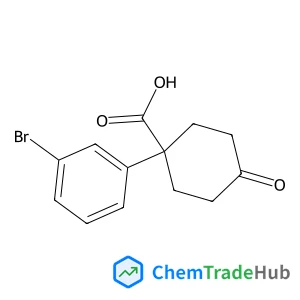
1-(3-Bromophenyl)-4-oxocyclohexanecarboxylic acid
CAS Number:
1385694-53-0
Molecular Formula:
C13H13BrO3
![[3-Formyl-5-(trifluoromethoxy)phenyl]boronic acid structure](https://static.chemtradehub.com/structs/145/1451393-39-7-aebb.webp "[3-Formyl-5-(trifluoromethoxy)phenyl]boronic acid structure")
[3-Formyl-5-(trifluoromethoxy)phenyl]boronic acid
CAS Number:
1451393-39-7
Molecular Formula:
C8H6BF3O4
![Ethyl 5-[({[(2-methyl-2-propanyl)oxy]carbonyl}amino)methyl]-1,2-oxazole-3-carboxylate structure](https://static.chemtradehub.com/structs/253/253196-37-1-8450.webp "Ethyl 5-[({[(2-methyl-2-propanyl)oxy]carbonyl}amino)methyl]-1,2-oxazole-3-carboxylate structure")
Ethyl 5-[({[(2-methyl-2-propanyl)oxy]carbonyl}amino)methyl]-1,2-oxazole-3-carboxylate
CAS Number:
253196-37-1
Molecular Formula:
C12H18N2O5
Recommended Suppliers





Disclaimer
This page provides academic journal information for reference and research purposes only. We are not affiliated with any journal publishers and do not handle publication submissions. For publication-related inquiries, please contact the respective journal publishers directly.
If you notice any inaccuracies in the information displayed, please contact us at support@chemtradehub.com. We will promptly review and address your concerns.