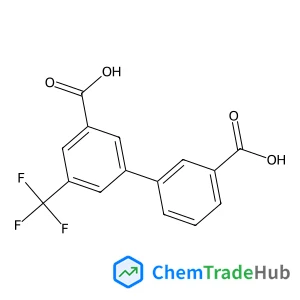
3-(3-Carboxyphenyl)-5-(trifluoromethyl)benzoic acid
CAS Number:
1261930-96-4
Molecular Formula:
C15H9F3O4
Poojan Milan Gharat, Dilip Kumar Maity
This study explores the interesting effect of p-sulfonatocalix[n]arene hosts (SCXn) on the excited-state tautomeric equilibrium of Chrysazine (CZ), a model antitumour drug molecule. Detailed photophysical investigations reveal that conversion of CZ from its more dipolar, excited normal form (N*) to the less dipolar, tautomeric form (T*) is hindered in SCXn-CZ host–guest complexes, which is quite unexpected considering the nonpolar cavity of the hosts. The atypical effect of SCXn is proposed to arise due to the partial inclusion or external binding of CZ with the hosts, which facilitates H-bonding interactions between CZ and the sulfonate groups present at the portals of the hosts. The intermolecular H-bonding subsequently leads to weakening of the pre-existing intramolecular H-bond network within CZ, and thus hinders the tautomerizaion process. Our results suggest that rather than the binding affinity, it is the orientation of CZ in the SCXn-CZ complexes, and its proximity to the portals of the host that plays a predominant role in influencing the tautomeric equilibrium. These observations are supported by quantum chemical calculations. Thermodynamic studies validate that SCXn-CZ interaction is essentially enthalpy driven and accompanied by small entropy loss, which is consistent with the binding mechanisms.
DOI: 10.1039/AN940650568A
DOI: 10.1039/AN940650359A
DOI: 10.1039/AN941660334A
4-Amino-3-bromophenol (CAS: 74440-80-5) falls under the classification of a haza...
(17beta)-3-Oxoestr-4-en-17-yl acetate should be stored in a cool, dry place away...
2-[(2,2-Diethoxyethyl)disulfanyl]-1,1-diethoxyethane (CAS: 76505-71-0) is a colo...
The market and research for 1-(β-D-ribofuranosyl)-1H-imidazo[4,5-c]pyridin-4-ami...
Waste containing Conjugated Estrogen (CAS: 12126-59-9) should be collected and d...
The market for Bis(2,2,2-trifluoroethyl) (methoxycarbonylmethyl)phosphonate (CAS...
There are several alternatives to 3,4'-Di-O-methylellagic acid (CAS: 57499-59-9)...
2-Chloro-N,N-dimethylpyridin-4-amine (CAS: 59047-70-0) is regulated under the Gl...
Cerium(3+);oxygen(2-);vanadium(5+) (CAS: 13597-19-8) is a complex inorganic comp...
7-Chloro-1-iodoisoquinoline (CAS: 1203579-27-4) is generally considered safe whe...

Organic & Biomolecular Chemistry (OBC) publishes original and high impact research and reviews in organic chemistry. We welcome research that shows new or significantly improved protocols or methodologies in total synthesis, synthetic methodology or physical and theoretical organic chemistry as well as research that shows a significant advance in the organic chemistry or molecular design aspects of chemical biology, catalysis, supramolecular and macromolecular chemistry, theoretical chemistry, mechanism-oriented physical organic chemistry, medicinal chemistry or natural products. Articles published in the journal should report new work which makes a highly-significant impact in the field. Routine and incremental work is generally not suitable for publication in the journal. More details about key areas of our scope are below. In all cases authors should include in their article clear rationale for why their research has been carried out.
![4-{2-[(9H-Fluoren-9-ylmethoxy)carbonyl]hydrazino}benzoic acid structure](https://static.chemtradehub.com/structs/214/214475-53-3-bf36.webp "4-{2-[(9H-Fluoren-9-ylmethoxy)carbonyl]hydrazino}benzoic acid structure")
![[3-Formyl-5-(trifluoromethoxy)phenyl]boronic acid structure](https://static.chemtradehub.com/structs/145/1451393-39-7-aebb.webp "[3-Formyl-5-(trifluoromethoxy)phenyl]boronic acid structure")