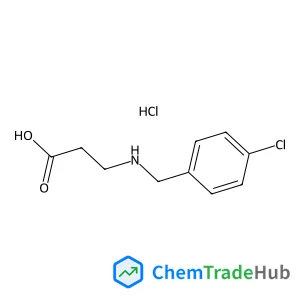
N-(4-Chlorobenzyl)-beta-alanine hydrochloride (1:1)
CAS Number:
1172479-10-5
Molecular Formula:
C10H13Cl2NO2
Sahin Uyaver, Helen W. Hernandez, M. Gokhan Habiboglu
The self assembly processes of aromatic amino acids, phenylalanine, tyrosine, and tryptophan have been simulated and were observed to form fibril-like aggregates linked to certain rare diseases and instances of biological membrane disruption. Pure systems and their mixtures were studied systematically at constant temperatures and free energy landscapes were produced describing the height and the number of assembled monomers associated with lower energy structures. Consistent with some previous work, aromatic amino acid monomers display a tendency to arrange with a four-fold symmetry. The occurrence of this and other ordered structures increases at higher temperatures. At lower temperatures our binary mixture simulations indicate that increasing tryptophan content drives the assembly process away from the formation of distinct nanostructures and toward disordered aggregates which is in line with experimental observations of pure tryptophan solutions. This work provides molecular level insight to a variety of different physical phenomena relevant to fields including human disease.
DOI: 10.1039/D3NP00011G
Zhen Zhang, Linyan Zhao, Lin Cui, DongMei Li, Xing Tian, Zhiyong Liu, Shenglin Liu
DOI: 10.1039/D3NJ05042D
Anna V. Korotina, Svetlana G. Tolshchina, Denis A. Gazizov, Alexander S. Steparuk, Nadezhda S. Demina, Ilya N. Ganebnykh, Pavel A. Slepukhin, Alexey E. Aleksandrov, Alexey R. Tameev, Gennady L. Rusinov
DOI: 10.1039/D3NJ05306G
Subramaniyan Prasanna Kumari, Subbiah Thamotharan, Subramaniapillai Selva Ganesan
DOI: 10.1039/D3NJ05462D
Rui Zhang, Xishang Song, Han Wu, Yunqi Zhai, Yina Qiao, Zhihao Yu, Jian Xiong, Xuebin Lu
DOI: 10.1039/D3NJ04771G
Yixin Hong, Jianyu Han, Zhi Wang, Xiaofei Gu, Tianyi Huang, Yafeng Wu, Songqin Liu
DOI: 10.1039/D3TA04556K
Musa Dirak, Jefferson Chan, Safacan Kolemen
DOI: 10.1039/D3TB02468G
Iranna Udachyan, Jayesh T. Bhanushali, Tomer Zidki, Amir Mizrahi
DOI: 10.1039/D3TA90234J
Waste containing N-Methoxy-N-methyl-1,3-thiazole-5-carboxamide (CAS: 898825-89-3...
N-(4-Biphenylyl)dibenzo[b,d]furan-4-amine should be stored in a tightly sealed c...
The market for 3-Acetamido-5-amino-2,4,6-triiodobenzoic acid (CAS: 1713-07-1) is...
Benzyl 2-O-acetyl-3,4,6-tri-O-benzyl-beta-D-galactopyranoside (CAS: 61820-03-9) ...
2-Ethylpiperazine dihydrochloride (CAS: 438050-52-3) is regulated under the Glob...
1,1'-[1,3-Phenylenebis(methylene)]bis(3-methyl-1H-pyrrole-2,5-dione) (CAS: 11946...
Several alternatives can be used in the synthesis of 5-Fluoro-2-(1-pyrrolidinyl)...
Proper personal protective equipment (PPE) must be worn when handling this compo...
When handling 6-Bromoimidazo[1,2-a]pyridin-8-amine, it is important to wear appr...
Alternatives to (2S,4R)-4-(4-Nitrobenzyl)pyrrolidine-2-carboxylic acid hydrochlo...

Physical Chemistry Chemical Physics (PCCP) is an international journal co-owned by 19 physical chemistry and physics societies from around the world. This journal publishes original, cutting-edge research in physical chemistry, chemical physics and biophysical chemistry. To be suitable for publication in PCCP, articles must include significant innovation and/or insight into physical chemistry; this is the most important criterion that reviewers and Editors will judge against when evaluating submissions. The journal has a broad scope and welcomes contributions spanning experiment, theory, computation and data science. Topical coverage includes spectroscopy, dynamics, kinetics, statistical mechanics, thermodynamics, electrochemistry, catalysis, surface science, quantum mechanics, quantum computing and machine learning. Interdisciplinary research areas such as polymers and soft matter, materials, nanoscience, energy, surfaces/interfaces, and biophysical chemistry are welcomed if they demonstrate significant innovation and/or insight into physical chemistry. Joined experimental/theoretical studies are particularly appreciated when complementary and based on up-to-date approaches.
![2-Methylbenzo[h]quinoline structure](https://static.chemtradehub.com/structs/605/605-88-9-ac43.webp "2-Methylbenzo[h]quinoline structure")