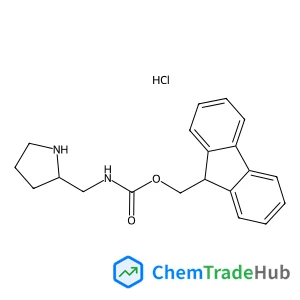
(S)-(9H-Fluoren-9-yl)methyl (pyrrolidin-2-ylmethyl)carbamate hydrochloride
CAS Number:
1217813-15-4
Molecular Formula:
C20H23ClN2O2
Supersolidity of ice, which was proposed in 2013 and intensively verified since then [C. Q. Sun et al., Density, Elasticity, and Stability Anomalies of Water Molecules with Fewer than Four Neighbors, J. Phys. Chem. Lett., 2013, 4, 2565–2570; C. Q. Sun et al., Density and phonon-stiffness anomalies of water and ice in the full temperature range, J. Phys. Chem. Lett., 2013, 4, 3238–3244], refers to the water molecules being polarized by molecular undercoordination, which is associated with the skin of bulk ice, nanobubbles, and nanodroplets (often called confinement), or by the electrostatic field of ions in salt solutions [X. Zhang et al., Mediating relaxation and polarization of hydrogen-bonds in water by NaCl salting and heating, Phys. Chem. Chem. Phys., 2014, 16(45), 24666–24671; C. Q. Sun et al., (H, Li)Br and LiOH solvation bonding dynamics: molecular nonbond interactions and solute extraordinary capabilities, J. Phys. Chem. B, 2018, 122(3), 1228–1238]. From the perspective of hydrogen bond (O:H–O or HB with “:” representing the lone pairs on O2−) cooperative relaxation and polarization, this review features the recent progress and recommends future trends in understanding the bond-electron–phonon correlation in the supersolid phase. Supersolidity is characterized by a shorter and stiffer H–O bond, longer and softer O:H nonbond, deeper O 1s energy band, and longer photoelectron and phonon lifetimes. The supersolid phase is less dense, viscoelastic, and mechanically and thermally more stable. Furthermore, O:H–O bond cooperative relaxation offsets the boundaries of structural phases and increases the melting point while lowering the freezing temperature of ice, which is known as supercooling and superheating.
Rui Zhang, Xishang Song, Han Wu, Yunqi Zhai, Yina Qiao, Zhihao Yu, Jian Xiong, Xuebin Lu
DOI: 10.1039/D3NJ04771G
DOI: 10.1039/D3NP00011G
Xu Huang, Hui Sun, Xuewei He, Yunkai Ruan, Lizhen Gan
DOI: 10.1039/D3NJ04854C
Yansheng Liu, Xiaobo Jia, Jin Zhou, Hongli Li, Xiaohong Wang, Yating Chen, Zhenle Qin, Zhichen Jin, Guofu Wang
DOI: 10.1039/D3NJ05083A
DOI: 10.1039/D3NP00025G
DOI: 10.1039/D3NJ03991A
Wenming Ding, Shengbo Yuan, Yang Yang, Xiaoman Li, Min Luo
DOI: 10.1039/D3TA04947G
Rachita Panigrahi, Bhabani S. Mallik
DOI: 10.1039/D3NJ04685K
Waste containing N-Methoxy-N-methyl-1,3-thiazole-5-carboxamide (CAS: 898825-89-3...
N-(4-Biphenylyl)dibenzo[b,d]furan-4-amine should be stored in a tightly sealed c...
The market for 3-Acetamido-5-amino-2,4,6-triiodobenzoic acid (CAS: 1713-07-1) is...
Benzyl 2-O-acetyl-3,4,6-tri-O-benzyl-beta-D-galactopyranoside (CAS: 61820-03-9) ...
2-Ethylpiperazine dihydrochloride (CAS: 438050-52-3) is regulated under the Glob...
1,1'-[1,3-Phenylenebis(methylene)]bis(3-methyl-1H-pyrrole-2,5-dione) (CAS: 11946...
Several alternatives can be used in the synthesis of 5-Fluoro-2-(1-pyrrolidinyl)...
Proper personal protective equipment (PPE) must be worn when handling this compo...
When handling 6-Bromoimidazo[1,2-a]pyridin-8-amine, it is important to wear appr...
Alternatives to (2S,4R)-4-(4-Nitrobenzyl)pyrrolidine-2-carboxylic acid hydrochlo...

Physical Chemistry Chemical Physics (PCCP) is an international journal co-owned by 19 physical chemistry and physics societies from around the world. This journal publishes original, cutting-edge research in physical chemistry, chemical physics and biophysical chemistry. To be suitable for publication in PCCP, articles must include significant innovation and/or insight into physical chemistry; this is the most important criterion that reviewers and Editors will judge against when evaluating submissions. The journal has a broad scope and welcomes contributions spanning experiment, theory, computation and data science. Topical coverage includes spectroscopy, dynamics, kinetics, statistical mechanics, thermodynamics, electrochemistry, catalysis, surface science, quantum mechanics, quantum computing and machine learning. Interdisciplinary research areas such as polymers and soft matter, materials, nanoscience, energy, surfaces/interfaces, and biophysical chemistry are welcomed if they demonstrate significant innovation and/or insight into physical chemistry. Joined experimental/theoretical studies are particularly appreciated when complementary and based on up-to-date approaches.