











Tuning polaronic redox behavior in olivine phosphate
Literature Information
Publication Date
2019-01-31
DOI
10.1039/C8CP06083E
Impact Factor
3.676
Authors
Yue Gu, Mouyi Weng, Gaofeng Teng, Hua Zeng, Jianshu Jie, Weiji Xiao, Jiaxin Zheng, Feng Pan
View Original
Abstract
In order to understand and improve the conductivity of LiFePO4, lots of attempts have been made both experimentally and theoretically. Here we performed hybrid density functional theory calculations to systematically investigate the electronic structures with polaronic redox behavior of polyanionic intercalation compounds similar to LiFePO4, such as in XMPO4 (X = Li, Na; M = Mn, Fe, Co, Ni). It is proved that the replacement of Li ions does not eliminate the polaronic redox behavior of Fe ions during delithiation and hence does not lead to a significant improvement in electronic conductivity. By contrast, replacing Fe with Mn, Co or Ni can tune the polaronic redox behavior during delithiation by varying degrees. For Ni, the polaronic redox behavior has almost disappeared, and band gaps disappear during delithiation, indicating a better electronic conductivity. For Mn or Co, the polaronic redox behavior is still obvious with little improvement in the electronic conductivity. This study provides important clues to improve the electronic conductivity of LiFePO4-like cathode materials.
Related Literature
From non-conductive MOF to proton-conducting metal-HOFs: a new class of reversible transformations induced by solvent-free mechanochemistry
Marcin Oszajca, Dariusz Matoga
2023-11-27
Edge Article
DOI: 10.1039/D3SC04401G
Atomically accurate site-specific ligand tailoring of highly acid- and alkali-resistant Ti(iv)-based metallamacrocycle for enhanced CO2 photoreduction
Yi-Qi Tian, Lin-Fang Dai, Wen-Lei Mu, Wei-Dong Yu, Jun Yan, Chao Liu
2023-11-30
Edge Article
DOI: 10.1039/D3SC06046B
Lewis acid catalysed polymerisation of cyclopentenone
Deepamali Dissanayake, Alysia Draper, Neelofur Jaunnoo, Joris J. Haven, Craig Forsyth, Alasdair I. McKay, Tanja Junkers, Dragoslav Vidović
2023-12-02
Edge Article
DOI: 10.1039/D3SC05186B
Supramolecular “baking powder”: a hexameric halogen-bonded phosphonium salt cage encapsulates and functionalises small-molecule carbonyl compounds
Hatem M. Titi, Yong Teoh
2023-11-28
Edge Article
DOI: 10.1039/D2SC04615F
Cooperatively designed aptamer-PROTACs for spatioselective degradation of nucleocytoplasmic shuttling protein for enhanced combinational therapy
Ran Liu, Zheng Liu, Mohan Chen, Hang Xing, Penghui Zhang, Jingjing Zhang
2023-11-29
Edge Article
DOI: 10.1039/D3SC04249A
Plasmon-mediated dehydrogenation of the aromatic methyl group and benzyl radical formation
Govinda Ghimire, Alexander M. Mebel, Shuai Chang
2023-11-28
Edge Article
DOI: 10.1039/D3SC05847F
Mutual induced fit transition structure stabilization of corannulene's bowl-to-bowl inversion in a perylene bisimide cyclophane
Manuel Weh, Olga Anhalt
2023-11-27
Edge Article
DOI: 10.1039/D3SC05341E
Native mass spectrometry of proteoliposomes containing integral and peripheral membrane proteins
Yun Zhu, Sangho D. Yun, Tianqi Zhang, Jing-Yuan Chang, Lauren Stover, Arthur Laganowsky
2023-11-21
Edge Article
DOI: 10.1039/D3SC04938H
You might also like
Compound Q&A
What precautions should be taken when handling 4-(2-Furylmethyl)thiomorpholine 1,1-dioxide (CAS: 79206-94-3)?
When handling 4-(2-Furylmethyl)thiomorpholine 1,1-dioxide (CAS: 79206-94-3), it ...
79206-94-34-(2-Furylmethyl)thi...
Compound Q&A
What precautions should be taken when handling 4-Chloro-N-[2-(4-morpholinyl)ethyl]benzamide (CAS: 71320-77-9)?
When handling 4-Chloro-N-[2-(4-morpholinyl)ethyl]benzamide (CAS: 71320-77-9), it...
71320-77-94-Chloro-N-[2-(4-mor...
Compound Q&A
How should waste containing 2-[2-(2-Methoxyethoxy)ethoxy]ethyl 4-methylbenzenesulfonate (CAS: 62921-74-8) be handled?
Waste containing this compound (CAS: 62921-74-8) should be handled according to ...
62921-74-82-[2-(2-Methoxyethox...
Compound Q&A
How should waste containing (S)-Methyl 2-amino-3-cyclohexylpropanoate be handled?
Waste containing (S)-Methyl 2-amino-3-cyclohexylpropanoate should be collected i...
40056-18-6(S)-Methyl 2-amino-3...
Compound Q&A
How is 5-({4-[(2S,4R)-4-Hydroxy-2-methyltetrahydro-2H-pyran-4-yl]-2-thienyl}sulfanyl)-1-methyl-1,3-dihydro-2H-indol-2-one (CAS: 166882-70-8) typically synthesized?
This compound can be synthesized using a multi-step process involving the conjug...
166882-70-85-({4-[(2S,4R)-4-Hyd...
Compound Q&A
Are there alternatives to (2E)-3-(3,4-Dichlorophenyl)acrylic acid (CAS: 7312-27-8) in synthesis?
There are several alternatives to (2E)-3-(3,4-Dichlorophenyl)acrylic acid in syn...
7312-27-8(2E)-3-(3,4-Dichloro...
Compound Q&A
How should Ethyl 6-(2-nitrophenyl)imidazo[2,1-b][1,3]thiazole-3-carboxylate (CAS: 925437-84-9) be stored?
Ethyl 6-(2-nitrophenyl)imidazo[2,1-b][1,3]thiazole-3-carboxylate (CAS: 925437-84...
925437-84-9Ethyl 6-(2-nitrophen...
Compound Q&A
How should waste containing 2-(1,3-Thiazol-2-yl)ethanamine (CAS: 18453-07-1) be handled?
Waste containing 2-(1,3-Thiazol-2-yl)ethanamine (CAS: 18453-07-1) should be coll...
18453-07-12-(1,3-Thiazol-2-yl)...
Compound Q&A
How is Methyl 5-iodo-2-methylbenzoate (CAS: 103440-54-6) typically synthesized?
Methyl 5-iodo-2-methylbenzoate can be synthesized through the iodination of meth...
103440-54-6Methyl 5-iodo-2-meth...
Compound Q&A
How is 5-Chloro[1,2,4]triazolo[1,5-a]pyridine (CAS: 1427399-34-5) typically synthesized?
5-Chloro[1,2,4]triazolo[1,5-a]pyridine is commonly synthesized via the condensat...
1427399-34-55-Chloro[1,2,4]triaz...
Source Journal
Physical Chemistry Chemical Physics

CiteScore:
5.5
Self-citation Rate:
10.3%
Articles per Year:
3036
Physical Chemistry Chemical Physics (PCCP) is an international journal co-owned by 19 physical chemistry and physics societies from around the world. This journal publishes original, cutting-edge research in physical chemistry, chemical physics and biophysical chemistry. To be suitable for publication in PCCP, articles must include significant innovation and/or insight into physical chemistry; this is the most important criterion that reviewers and Editors will judge against when evaluating submissions. The journal has a broad scope and welcomes contributions spanning experiment, theory, computation and data science. Topical coverage includes spectroscopy, dynamics, kinetics, statistical mechanics, thermodynamics, electrochemistry, catalysis, surface science, quantum mechanics, quantum computing and machine learning. Interdisciplinary research areas such as polymers and soft matter, materials, nanoscience, energy, surfaces/interfaces, and biophysical chemistry are welcomed if they demonstrate significant innovation and/or insight into physical chemistry. Joined experimental/theoretical studies are particularly appreciated when complementary and based on up-to-date approaches.
Recommended Compounds
![4-Chloro-3-(trifluoromethyl)-1H-pyrrolo[2,3-b]pyridine structure](https://static.chemtradehub.com/structs/869/869335-75-1-a9d0.webp "4-Chloro-3-(trifluoromethyl)-1H-pyrrolo[2,3-b]pyridine structure")
4-Chloro-3-(trifluoromethyl)-1H-pyrrolo[2,3-b]pyridine
CAS Number:
869335-75-1
Molecular Formula:
C8H4ClF3N2
![tert-Butyl N-[(2-chloropyridin-4-yl)methyl]carbamate structure](https://static.chemtradehub.com/structs/916/916210-27-0-9f95.webp "tert-Butyl N-[(2-chloropyridin-4-yl)methyl]carbamate structure")
tert-Butyl N-[(2-chloropyridin-4-yl)methyl]carbamate
CAS Number:
916210-27-0
Molecular Formula:
C11H15ClN2O2
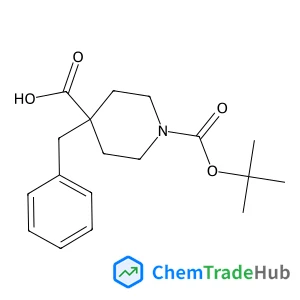
4-Benzyl-1-(tert-butoxycarbonyl)piperidine-4-carboxylic acid
CAS Number:
170838-87-6
Molecular Formula:
C18H25NO4
![Methyl 4-({[(2-methyl-2-propanyl)oxy]carbonyl}amino)bicyclo[2.2.2]octane-1-carboxylate structure](https://static.chemtradehub.com/structs/943/943845-74-7-b7e5.webp "Methyl 4-({[(2-methyl-2-propanyl)oxy]carbonyl}amino)bicyclo[2.2.2]octane-1-carboxylate structure")
Methyl 4-({[(2-methyl-2-propanyl)oxy]carbonyl}amino)bicyclo[2.2.2]octane-1-carboxylate
CAS Number:
943845-74-7
Molecular Formula:
C15H25NO4
Recommended Suppliers






Disclaimer
This page provides academic journal information for reference and research purposes only. We are not affiliated with any journal publishers and do not handle publication submissions. For publication-related inquiries, please contact the respective journal publishers directly.
If you notice any inaccuracies in the information displayed, please contact us at support@chemtradehub.com. We will promptly review and address your concerns.