


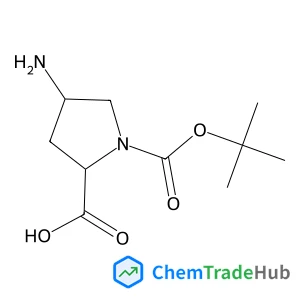
(2R,4R)-1-Boc-4-Aminopyrrolidine-2-carboxylic acid
CAS Number:
132622-98-1
Molecular Formula:
C10H18N2O4
Jessica Patel, Mihirsinh Chauhan, Nikita Vashistha, Mahesh Kumar, Brijesh Tripathi, Manoj Kumar Pandey
In organic semiconductors, optical absorption is pivotal for the performance of optoelectronic devices. The absorption by the semiconductors generates excitons which dissociate into free charge carriers, resulting in energy conversion. Although high performance has been achieved in non-fullerene organic solar cells, their charge generation behavior is far from being well understood. Keeping this in view, we have employed optical spectroscopic tools to study the charge generation mechanism in FLR (1,6,7,10-tetramethylfluoranthene) as a non-fullerene electron acceptor blended with P3HT (poly(3-hexylthiophene)) as an electron donor in five different solvents. Through steady state UV-visible and photoluminescence spectroscopy, we provide a basic understanding of charge transport by enlightening the influence of solvents on the aggregation behavior and exciton bandwidth. Furthermore, for the first time, by employing ultrafast vis-NIR transient absorption spectroscopy, we address the ultrafast charge generation and charge separation mechanism with systematic variation in solvent polarity by incorporating the time evolution of the transient species under various pump–probe wavelengths in the range of 450 nm to 1600 nm. For the different excitation wavelengths, the lifetime kinetics have been depicted by their multiexponential fits. The results show a fast decay term at a lifetime of a few picoseconds (ps) (∼1 to 5 ps) and a slow decay term at a lifetime of ∼500 ps. The charge generation in the P3HT:FLR blend proceeds on a ps time scale, which implies good intermixing of the components. It is clearly established that the non-halogenated solvents influence this aggregation behavior and higher conjugation lengths with higher photoluminescence quenching contribute to the higher charge generation. The enhanced polaron population in P3HT with the addition of FLR illustrates the importance of this acceptor material in the blend because a good solvent-material combination is essential to enhance the charge generation. As such, this comprehensive study explicitly shows the role of FLR as an emerging efficient non-fullerene acceptor for further improving the performance of devices.

Journal of Peptide Science

Crystallography Reports

Current Opinion in Solid State & Materials Science

Current Opinion in Colloid & Interface Science

Russian Chemical Bulletin

Journal of Saudi Chemical Society

Saudi Pharmaceutical Journal

Journal of Natural Medicines

Chemistry Education Research and Practice

Nature Medicine
Jining Li, Wenxin Lu
DOI: 10.1039/D3CP04746F
Chaoqun Zhang, Phelan Yu, Chandler J. Conn, Nicholas R. Hutzler, Lan Cheng
DOI: 10.1039/D3CP04040B
Yao Guo, Qiang Li, Xiaojing Bai, Yuanbin Xue, Changwei Lai, Yuhua Wang
DOI: 10.1039/D3CP04090A
Ganchang Lei, Sihui Qi, Haiyan Li, Yinjiang Xue, Xiaohai Zheng, Shiping Wang, Yanning Cao, Yingying Zhan
DOI: 10.1039/D3CP04495E
Yang Sun, Renhai Wang, Yimei Fang, Shunqing Wu, Qiubao Lin, Kai-Ming Ho
DOI: 10.1039/D3CP03844K
Jack Hemingway, Xiaojiao Liu, Adam A. L. Michalchuk, Carole A. Morrison, Colin R. Pulham
DOI: 10.1039/D3CP04526A
Branislav Milovanović, Milena Petković
DOI: 10.1039/D3CP03991A
When considering alternatives to 1-(4-Chlorophenyl)-N-hydroxymethanimine (CAS: 3...
This compound should be stored in a cool, dry place away from direct sunlight. I...
3-(4-Bromophenyl)-5-(2-fluorophenyl)-1,2,4-oxadiazole is synthesized through a m...
5-Chloro-2-(4-chlorophenyl)-4-methyl-6-[3-(1-piperidinyl)propoxy]pyrimidine (CAS...
2-Chloro-4-(difluoromethoxy)pyridine is used in the pharmaceutical industry for ...
3-Chloro-6-methylpyridazine (CAS: 1121-79-5) is classified under the Globally Ha...
Several alternatives can be used in the synthesis of Methyl 4,5-dimethyl-2-nitro...
Alternatives to (2E,2'E)-3,3'-(1,4-Phenylene)bisacrylaldehyde include other acry...
3-Amino-5-chloropyridin-2-ol hydrochloride is an organic compound with the CAS n...
When handling 6,7-Difluoro-2,3-dihydro-4H-chromen-4-one, it is essential to wear...

Physical Chemistry Chemical Physics (PCCP) is an international journal co-owned by 19 physical chemistry and physics societies from around the world. This journal publishes original, cutting-edge research in physical chemistry, chemical physics and biophysical chemistry. To be suitable for publication in PCCP, articles must include significant innovation and/or insight into physical chemistry; this is the most important criterion that reviewers and Editors will judge against when evaluating submissions. The journal has a broad scope and welcomes contributions spanning experiment, theory, computation and data science. Topical coverage includes spectroscopy, dynamics, kinetics, statistical mechanics, thermodynamics, electrochemistry, catalysis, surface science, quantum mechanics, quantum computing and machine learning. Interdisciplinary research areas such as polymers and soft matter, materials, nanoscience, energy, surfaces/interfaces, and biophysical chemistry are welcomed if they demonstrate significant innovation and/or insight into physical chemistry. Joined experimental/theoretical studies are particularly appreciated when complementary and based on up-to-date approaches.
![6-Bromo-2,3-dihydro-1H-pyrido[2,3-b][1,4]oxazine structure](https://static.chemtradehub.com/structs/120/1203499-17-5-b4d1.webp "6-Bromo-2,3-dihydro-1H-pyrido[2,3-b][1,4]oxazine structure")
![(2S)-2-{[(9H-Fluoren-9-ylmethoxy)carbonyl]amino}-4-(methylselanyl)butanoic acid structure](https://static.chemtradehub.com/structs/121/1217852-49-7-f252.webp "(2S)-2-{[(9H-Fluoren-9-ylmethoxy)carbonyl]amino}-4-(methylselanyl)butanoic acid structure")
![[4-(Isobutyrylamino)phenyl]boronic acid structure](https://static.chemtradehub.com/structs/874/874219-50-8-6ab5.webp "[4-(Isobutyrylamino)phenyl]boronic acid structure")



