












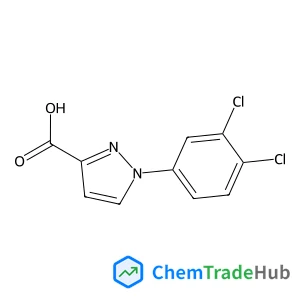
1-(3,4-Dichlorophenyl)-1H-pyrazole-3-carboxylic acid
CAS Number:
1152949-12-6
Molecular Formula:
C10H6Cl2N2O2
Natália T. Correia, Nicolas Couvrat, Frédéric Affouard, Gérard Coquerel, Eric Dargent, Allisson Saiter
The present work focusses on the molecular mobility characterization of amorphous N-acetyl-α-methylbenzylamine (Nac-MBA) by Broadband Dielectric Relaxation Spectroscopy (DRS) coupled with Fast Scanning Calorimetry (FSC) and Molecular Dynamics (MD) simulations covering over 12 decades in the frequency range. This study reveals another example of a secondary amide that shows a very intense Debye-like contribution (almost 90% of the global dielectric intensity) in addition to the structural α-relaxation and secondary Johari–Goldstein β-relaxation. The D- and α-relaxations are separated by about one decade (in frequency) and their relaxation times follow a near parallel temperature evolution (Vogel–Fulcher–Tammann–Hesse). The micro-structure of Nac-MBA has been investigated from MD simulations. It is shown that the intense Debye-like process emanates from the formation of linear intermolecular H-bonding aggregates (precursors of the crystalline structure) generating super-dipole moments.
Zhiye Wang, Yunchuan Li, Mingjun Sun
DOI: 10.1039/D3CP04593E
Yan Sun, Zhongzhu Jiang, Yang Li, Lanxin Liu, Hui Liang, Yiyan Wang, Dandan Wu, Na Li, Ying Zhou, Qiuju Li, Xiaoyu Yue, Wei Tong, Xuan Luo, Jianghe Lan, Xuefeng Sun
DOI: 10.1039/D3CP03854H
DOI: 10.1039/D3CP03393G
Qian Wang, Yu Zhuang, Abuduwayiti Aierken, Qiaogang Song, Qin Zhang, Youbo Dou, Qiuli Zhang, Shuyi Zhang
DOI: 10.1039/D3CP05309A
Abhishek Kalpattu, Tristan Dilbeck, Kenneth Hanson
DOI: 10.1039/D3CP90241B
Zhifeng Lin, Xueding Jiang, Weicheng Xu, Fuhua Li, Xin Chen, Si Liu, Xihong Lu
DOI: 10.1039/D3CP04350A
Raquel Yanes-Rodríguez, Rita Prosmiti
DOI: 10.1039/D3CP05410A
Mohamed Ben Bechir, Faisal Alresheedi
DOI: 10.1039/D3CP04645A
Jiali Nie, Ying Li, Dongyue Gao, Yi Fang, Jing Lin, Chengchun Tang, Zhonglu Guo
DOI: 10.1039/D3CP04718K
Jing Xie, Dongni Wu, Yangfang Liao, Xiaolong Cao, Shiyou Zhou
DOI: 10.1039/D3CP04382G
Waste containing N-Methoxy-N-methyl-1,3-thiazole-5-carboxamide (CAS: 898825-89-3...
N-(4-Biphenylyl)dibenzo[b,d]furan-4-amine should be stored in a tightly sealed c...
The market for 3-Acetamido-5-amino-2,4,6-triiodobenzoic acid (CAS: 1713-07-1) is...
Benzyl 2-O-acetyl-3,4,6-tri-O-benzyl-beta-D-galactopyranoside (CAS: 61820-03-9) ...
2-Ethylpiperazine dihydrochloride (CAS: 438050-52-3) is regulated under the Glob...
1,1'-[1,3-Phenylenebis(methylene)]bis(3-methyl-1H-pyrrole-2,5-dione) (CAS: 11946...
Several alternatives can be used in the synthesis of 5-Fluoro-2-(1-pyrrolidinyl)...
Proper personal protective equipment (PPE) must be worn when handling this compo...
When handling 6-Bromoimidazo[1,2-a]pyridin-8-amine, it is important to wear appr...
Alternatives to (2S,4R)-4-(4-Nitrobenzyl)pyrrolidine-2-carboxylic acid hydrochlo...

Physical Chemistry Chemical Physics (PCCP) is an international journal co-owned by 19 physical chemistry and physics societies from around the world. This journal publishes original, cutting-edge research in physical chemistry, chemical physics and biophysical chemistry. To be suitable for publication in PCCP, articles must include significant innovation and/or insight into physical chemistry; this is the most important criterion that reviewers and Editors will judge against when evaluating submissions. The journal has a broad scope and welcomes contributions spanning experiment, theory, computation and data science. Topical coverage includes spectroscopy, dynamics, kinetics, statistical mechanics, thermodynamics, electrochemistry, catalysis, surface science, quantum mechanics, quantum computing and machine learning. Interdisciplinary research areas such as polymers and soft matter, materials, nanoscience, energy, surfaces/interfaces, and biophysical chemistry are welcomed if they demonstrate significant innovation and/or insight into physical chemistry. Joined experimental/theoretical studies are particularly appreciated when complementary and based on up-to-date approaches.
![[5-fluoro-2-(morpholine-4-carbonyl)phenyl]boronic acid structure](https://static.chemtradehub.com/structs/121/1217501-26-2-505c.webp "[5-fluoro-2-(morpholine-4-carbonyl)phenyl]boronic acid structure")

![4-[(2-{2-[2-(2-Aminoethoxy)ethoxy]ethoxy}ethyl)amino]-2-(2,6-dioxo-3-piperidinyl)-1H-isoindole-1,3(2H)-dione structure](https://static.chemtradehub.com/structs/209/2093416-31-8-3162.webp "4-[(2-{2-[2-(2-Aminoethoxy)ethoxy]ethoxy}ethyl)amino]-2-(2,6-dioxo-3-piperidinyl)-1H-isoindole-1,3(2H)-dione structure")
![tert-Butyl 6-chloro-4-oxospiro[chroman-2,4'-piperidine]-1'-carboxylate structure](https://static.chemtradehub.com/structs/101/1011482-37-3-88a5.webp "tert-Butyl 6-chloro-4-oxospiro[chroman-2,4'-piperidine]-1'-carboxylate structure")





