











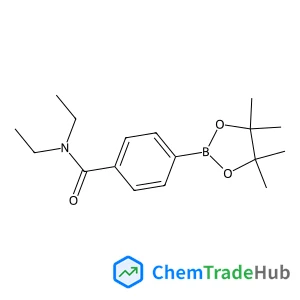
N,N-Diethyl-4-(4,4,5,5-tetramethyl-1,3,2-dioxaborolan-2-yl)benzamide
CAS Number:
325142-99-2
Molecular Formula:
C17H26BNO3
Arijit Gupta, Rishabh Gupta
Motivated by the very recent investigations of neutral noble gas compounds in the open-shell configuration, we explored a new series of noble gas hydrides in the triplet state. The possible existence of noble gas-inserted ketenyl cations, HNgCCO+ (Ng = He, Ne, Ar, Kr, and Xe), in their triplet electronic state has been predicted by various ab initio quantum chemical techniques. Density functional theory (DFT), second-order Møller–Plesset perturbation theory (MP2), and coupled-cluster theory (CCSD(T)) based methods have been employed to investigate the structures, energetics, harmonic vibrational frequencies, and charge distribution analysis of these ions. The aforementioned ions have been found to be thermodynamically stable with respect to all plausible 2-body and 3-body dissociation channels, except the 2-body dissociation pathway leading to the formation of global minima products (Ng + HCCO+). Nevertheless, each of the predicted HNgCCO+ ions is connected to the global minima products through a transition state with a finite barrier height on the potential energy surface, which confirms the kinetic stability of the metastable species. Detailed analysis of the optimized structural parameters, energetics, and harmonic vibrational frequencies of the predicted species clearly indicated that a strong covalent bond exists between H and Ng atoms, while a comparatively weak interaction is found between Ng and C atoms. Moreover, charge distribution and atoms-in-molecules (AIM) analysis strongly concurred with the above inferences and also suggested that the predicted metastable ions should exist essentially in the form of [HNg]+[CCO] complex. These results ultimately indicate that these predicted species may be prepared and characterized by suitable experimental technique(s) under a cryogenic environment.
Subhankar Sahu, Lokesh Kumar, Sumita Das, Dipti Gupta, Ruchi Anand
DOI: 10.1039/D3SC03509C
Bryan E. Metze, Riley A. Roberts, Aleksandra Nilova, David R. Stuart
DOI: 10.1039/D3SC05429B
Dan Ouyang, Chuanzhe Wang, Chao Zhong, Juan Lin, Gang Xu, Guane Wang, Zian Lin
DOI: 10.1039/D3SC05633C
Yujin Li, Yu Mei, Roya Momen, Bai Song, Yujie Huang, Xue Zhong, Hanrui Ding, Wentao Deng, Guoqiang Zou, Hongshuai Hou, Xiaobo Ji
DOI: 10.1039/D3SC05593K
Dmitry L. Lipilin, Mikhail O. Zubkov, Mikhail D. Kosobokov, Alexander D. Dilman
DOI: 10.1039/D3SC05513B
Roman M. Mironenko
DOI: 10.1039/D3SC04691E
Aleksandr Denisenko, Pavel Garbuz, Yelyzaveta Makovetska, Dmytro Lesyk, Rodion Korzh, Iryna V. Sadkova, Pavel K. Mykhailiuk
DOI: 10.1039/D3SC05121H
Yeongseo An, Sayak Banerjee
DOI: 10.1039/D3SC02913A
Peter M. Waddell, Lei Tian, Anthony R. Scavuzzo, Lalu Venigalla, Gregory D. Scholes, Brad P. Carrow
DOI: 10.1039/D3SC02588H
Heyin Li, Mengjun Huang, Zhenlei Zou, Zhen Wang, Yifan Li, Chao Sun, Wangzhe Chen, Yi Pan, Weigang Zhang, Yi Wang
DOI: 10.1039/D3SC03101B
When handling 4-(2-Furylmethyl)thiomorpholine 1,1-dioxide (CAS: 79206-94-3), it ...
When handling 4-Chloro-N-[2-(4-morpholinyl)ethyl]benzamide (CAS: 71320-77-9), it...
Waste containing this compound (CAS: 62921-74-8) should be handled according to ...
Waste containing (S)-Methyl 2-amino-3-cyclohexylpropanoate should be collected i...
This compound can be synthesized using a multi-step process involving the conjug...
There are several alternatives to (2E)-3-(3,4-Dichlorophenyl)acrylic acid in syn...
Ethyl 6-(2-nitrophenyl)imidazo[2,1-b][1,3]thiazole-3-carboxylate (CAS: 925437-84...
Waste containing 2-(1,3-Thiazol-2-yl)ethanamine (CAS: 18453-07-1) should be coll...
Methyl 5-iodo-2-methylbenzoate can be synthesized through the iodination of meth...
5-Chloro[1,2,4]triazolo[1,5-a]pyridine is commonly synthesized via the condensat...

Physical Chemistry Chemical Physics (PCCP) is an international journal co-owned by 19 physical chemistry and physics societies from around the world. This journal publishes original, cutting-edge research in physical chemistry, chemical physics and biophysical chemistry. To be suitable for publication in PCCP, articles must include significant innovation and/or insight into physical chemistry; this is the most important criterion that reviewers and Editors will judge against when evaluating submissions. The journal has a broad scope and welcomes contributions spanning experiment, theory, computation and data science. Topical coverage includes spectroscopy, dynamics, kinetics, statistical mechanics, thermodynamics, electrochemistry, catalysis, surface science, quantum mechanics, quantum computing and machine learning. Interdisciplinary research areas such as polymers and soft matter, materials, nanoscience, energy, surfaces/interfaces, and biophysical chemistry are welcomed if they demonstrate significant innovation and/or insight into physical chemistry. Joined experimental/theoretical studies are particularly appreciated when complementary and based on up-to-date approaches.
![Pyrazolo[1,5-a]pyridine-3-carbothioamide structure](https://static.chemtradehub.com/structs/885/885275-44-5-aae0.webp "Pyrazolo[1,5-a]pyridine-3-carbothioamide structure")
![Methyl 4-({[(2-methyl-2-propanyl)oxy]carbonyl}amino)bicyclo[2.2.2]octane-1-carboxylate structure](https://static.chemtradehub.com/structs/943/943845-74-7-b7e5.webp "Methyl 4-({[(2-methyl-2-propanyl)oxy]carbonyl}amino)bicyclo[2.2.2]octane-1-carboxylate structure")






