











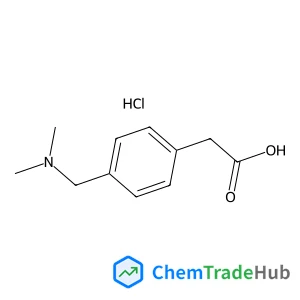
4-(Dimethylaminomethyl)phenylacetic acid hydrochloride
CAS Number:
99985-52-1
Molecular Formula:
C11H16ClNO2
Leonardo A. Cunha, Luiz F. A. Ferrão, Francisco B. C. Machado, Max Pinheiro, Jr
Membrane-based gas separation technology is of crucial importance in the current economy and nanoporous graphene, given its single-atomic layer, is an essential building-block material to achieve efficiency towards permeability and selectivity for such processes. Classically, pore size is the main feature that governs the diffusion energy barrier. Its nature, nevertheless, is also affected by other non-negligible physical mechanisms not yet discussed. Here we propose a theoretical study on the role of non-covalent interactions towards H2 diffusion through two graphene-based membranes. Symmetry-Adapted Perturbation Theory (SAPT) was used to investigate the total interaction energy and its physically meaningful components (electrostatics, exchange, induction and dispersion). The study reveals the importance of quantum effects such as polarization and electron delocalization in order to counterbalance the abiding idea of pore size being the dominant factor accounting for the energy barrier. These results have important implications for the rational design of efficient nanoporous devices for separation applications.
Jorge M. del Campo, Joel Ireta
DOI: 10.1039/D0CP06018F
Edurne Avellanal-Zaballa, Alejandro Prieto-Castañeda, Carolina Díaz-Norambuena, Jorge Bañuelos, Antonia R. Agarrabeitia, Inmaculada García-Moreno, Santiago de la Moya, María J. Ortiz
DOI: 10.1039/D1CP00991E
Ryuta X. Suzuki, Hikari Tada, Sae Hirano, Takahiko Ban, Manoranjan Mishra, Risa Takeda, Yuichiro Nagatsu
DOI: 10.1039/D0CP05810F
Ren-Hao Cheng, Honghao Cai, Yu-Ren Huang, Xiaohong Cui, Zhong Chen, Hsuan-Ying Chen, Shangwu Ding
DOI: 10.1039/C9CP05978D
Y. Belkhodja, J. Loreau, A. van der Avoird, Y. Berger, P. Asselin
DOI: 10.1039/D1CP00316J
Nikoleta Kotsina
DOI: 10.1039/D1CP00933H
Rohit Yadav, Prerna Joshi, Masanori Hara, Masamichi Yoshimura
DOI: 10.1039/D1CP00248A
Asmida Herawati, Hui-Ching Lin, Shun-Hsiang Chan, Tsong-Shin Lim, Forest Shih-Sen Chien
DOI: 10.1039/D1CP00974E
Michael J. Van Stipdonk, Evan H. Perez, Luke J. Metzler, Amanda R. Bubas, Theodore Corcovilos, Arpad Somogyi
DOI: 10.1039/D1CP01520F
Waste containing N-Methoxy-N-methyl-1,3-thiazole-5-carboxamide (CAS: 898825-89-3...
N-(4-Biphenylyl)dibenzo[b,d]furan-4-amine should be stored in a tightly sealed c...
The market for 3-Acetamido-5-amino-2,4,6-triiodobenzoic acid (CAS: 1713-07-1) is...
Benzyl 2-O-acetyl-3,4,6-tri-O-benzyl-beta-D-galactopyranoside (CAS: 61820-03-9) ...
2-Ethylpiperazine dihydrochloride (CAS: 438050-52-3) is regulated under the Glob...
1,1'-[1,3-Phenylenebis(methylene)]bis(3-methyl-1H-pyrrole-2,5-dione) (CAS: 11946...
Several alternatives can be used in the synthesis of 5-Fluoro-2-(1-pyrrolidinyl)...
Proper personal protective equipment (PPE) must be worn when handling this compo...
When handling 6-Bromoimidazo[1,2-a]pyridin-8-amine, it is important to wear appr...
Alternatives to (2S,4R)-4-(4-Nitrobenzyl)pyrrolidine-2-carboxylic acid hydrochlo...

Physical Chemistry Chemical Physics (PCCP) is an international journal co-owned by 19 physical chemistry and physics societies from around the world. This journal publishes original, cutting-edge research in physical chemistry, chemical physics and biophysical chemistry. To be suitable for publication in PCCP, articles must include significant innovation and/or insight into physical chemistry; this is the most important criterion that reviewers and Editors will judge against when evaluating submissions. The journal has a broad scope and welcomes contributions spanning experiment, theory, computation and data science. Topical coverage includes spectroscopy, dynamics, kinetics, statistical mechanics, thermodynamics, electrochemistry, catalysis, surface science, quantum mechanics, quantum computing and machine learning. Interdisciplinary research areas such as polymers and soft matter, materials, nanoscience, energy, surfaces/interfaces, and biophysical chemistry are welcomed if they demonstrate significant innovation and/or insight into physical chemistry. Joined experimental/theoretical studies are particularly appreciated when complementary and based on up-to-date approaches.
![[5-fluoro-2-(morpholine-4-carbonyl)phenyl]boronic acid structure](https://static.chemtradehub.com/structs/121/1217501-26-2-505c.webp "[5-fluoro-2-(morpholine-4-carbonyl)phenyl]boronic acid structure")
![4-[(2-{2-[2-(2-Aminoethoxy)ethoxy]ethoxy}ethyl)amino]-2-(2,6-dioxo-3-piperidinyl)-1H-isoindole-1,3(2H)-dione structure](https://static.chemtradehub.com/structs/209/2093416-31-8-3162.webp "4-[(2-{2-[2-(2-Aminoethoxy)ethoxy]ethoxy}ethyl)amino]-2-(2,6-dioxo-3-piperidinyl)-1H-isoindole-1,3(2H)-dione structure")





