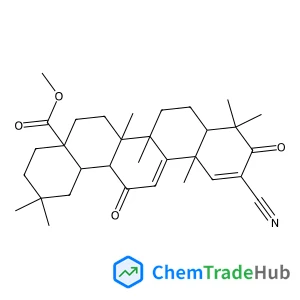
Methyl 2-cyano-3,12-dioxooleana-1,9(11)-dien-28-oate
CAS Number:
218600-53-4
Molecular Formula:
C32H43NO4
Qiao Wang, Peng Xu, Guangshan Zhang, Wen Zhang, Limin Hu, Peng Wang
A series of Fe-doped ZnS (Fex-ZnS) photocatalysts were synthesized using a one-pot hydrothermal method. The physicochemical properties of the as-prepared Fex-ZnS microspheres were characterized by different microscopic and spectroscopic techniques. Fe doping did not obviously change the morphology and crystallinity of ZnS, but effectively broadened the light response range into the visible-light region. Degradation of p-nitrophenol (PNP) was used to evaluate the photocatalytic performance of the Fex-ZnS catalysts under visible light irradiation with the addition of H2O2 to facilitate photo-Fenton-like reactions. The highest PNP removal rate of 83.8% after 180 min of irradiation was achieved under the optimal conditions, including a doping ratio of 6%, a H2O2 concentration of 3 mmol L−1 and a catalyst dosage of 0.8 g L−1. The effects of aqueous/solid mass transfer and intraparticle mass transfer limitations on the PNP degradation reactions were analyzed, indicating that the variations of catalyst size caused by different Fe doping ratios did not affect the photocatalytic reactions in this study. The PNP removal mechanism of the Fex-ZnS photocatalyst with H2O2 addition under visible light irradiation was proposed.
Jie Gao, Yingxu Chen, Weihao Ji, Zhonghong Gao, Jingdong Zhang
DOI: 10.1039/C9AN01606F
Jing Han, Zhihua Wang, Lihui Yin, Wei Zhang, You Peng, Zongxiu Nie
DOI: 10.1039/C9AN01612K
Tripti Ahuja, Atanu Ghosh, Sandip Mondal, Pallab Basuri, Shantha Kumar Jenifer, Pillalamarri Srikrishnarka, Jyoti Sarita Mohanty, Sandeep Bose, Thalappil Pradeep
DOI: 10.1039/C9AN01700C
Lifang Guo, Ruoyao Zhang, Yuming Sun, Minggang Tian, Ge Zhang, Ruiqing Feng, Xuechen Li, Xiaoqiang Yu, Xiuquan He
DOI: 10.1039/C6AN00147E
Wen Chen, Mei Yang, Na Luo, Fenglin Wang, Ru-Qin Yu, Jian-Hui Jiang
DOI: 10.1039/C9AN01778J
Heike Hardelauf‡, Sarah Waide‡, Julia Sisnaiske, Peter Jacob, Vanessa Hausherr, Nicole Schöbel, Dirk Janasek, Christoph van Thriel
DOI: 10.1039/C6AN90037B
Yijia Wang, Shiwu Zhang, Chunze Zhang, Zhenying Zhao, Xiaoli Zheng, Lihua Xue, Jun Liu, X.-C. Yuan
DOI: 10.1039/C6AN00264A
Nikola Mielniczek, Magdalena Jarosz, Joanna Denbigh, Renata Budzynska
DOI: 10.1039/C9AN01456J
When handling 4-(2-Furylmethyl)thiomorpholine 1,1-dioxide (CAS: 79206-94-3), it ...
When handling 4-Chloro-N-[2-(4-morpholinyl)ethyl]benzamide (CAS: 71320-77-9), it...
Waste containing this compound (CAS: 62921-74-8) should be handled according to ...
Waste containing (S)-Methyl 2-amino-3-cyclohexylpropanoate should be collected i...
This compound can be synthesized using a multi-step process involving the conjug...
There are several alternatives to (2E)-3-(3,4-Dichlorophenyl)acrylic acid in syn...
Ethyl 6-(2-nitrophenyl)imidazo[2,1-b][1,3]thiazole-3-carboxylate (CAS: 925437-84...
Waste containing 2-(1,3-Thiazol-2-yl)ethanamine (CAS: 18453-07-1) should be coll...
Methyl 5-iodo-2-methylbenzoate can be synthesized through the iodination of meth...
5-Chloro[1,2,4]triazolo[1,5-a]pyridine is commonly synthesized via the condensat...

Physical Chemistry Chemical Physics (PCCP) is an international journal co-owned by 19 physical chemistry and physics societies from around the world. This journal publishes original, cutting-edge research in physical chemistry, chemical physics and biophysical chemistry. To be suitable for publication in PCCP, articles must include significant innovation and/or insight into physical chemistry; this is the most important criterion that reviewers and Editors will judge against when evaluating submissions. The journal has a broad scope and welcomes contributions spanning experiment, theory, computation and data science. Topical coverage includes spectroscopy, dynamics, kinetics, statistical mechanics, thermodynamics, electrochemistry, catalysis, surface science, quantum mechanics, quantum computing and machine learning. Interdisciplinary research areas such as polymers and soft matter, materials, nanoscience, energy, surfaces/interfaces, and biophysical chemistry are welcomed if they demonstrate significant innovation and/or insight into physical chemistry. Joined experimental/theoretical studies are particularly appreciated when complementary and based on up-to-date approaches.