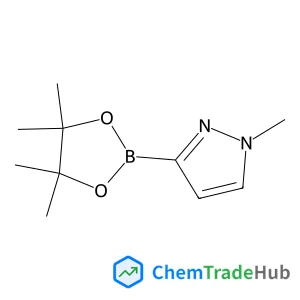
1-Methyl-3-(4,4,5,5-tetramethyl-1,3,2-dioxaborolan-2-yl)-1H-pyrazole
CAS Number:
1020174-04-2
Molecular Formula:
C10H17BN2O2
Onkar Nath Verma, Vandna Tomar, Manish Kumar, Kamal K. Srivastav, Vasant Sathe, Priyanka A. Jha, Prabhakar Singh
A piezoelectric material KNbO3 has been co-substituted with the magnetic ions Sm3+ and Fe3+ in order to explore the relation between piezoelectricity and magnetism. The samples K1−xSmxNb1−xFexO3 [x = 0.0–0.1] were synthesized using a solid state reaction route, after estimating the structural stability with the substitution. Structural studies were employed using XRD with Rietveld refinement and Raman analysis suggesting Amm2 symmetry. Also, the transition temperature was observed to change with the increase in Sm and Fe content. This transition temperature was also confirmed through high temperature XRD and high temperature Raman results. The dielectric and piezoelectric properties were found to be in correlation with the intensity of Raman modes for substituted samples, indicating better ferroelectricity at x = 0.05. A correlation between piezoelectric and magnetic properties was established in terms of the coercive field and exchange energy.
Madalena C. C. Areias, Kenichi Shimizu, Richard G. Compton
DOI: 10.1039/C6AN00550K
Areti Strati, Martha Zavridou, Evangelos Bournakis, Sophia Mastoraki, Evi Lianidou
DOI: 10.1039/C9AN00999J
Hiroki Segawa, Takao Fukuoka, Tamitake Itoh, Yuichi Imai, Yuko T. Iwata, Tadashi Yamamuro, Kenji Kuwayama, Kenji Tsujikawa, Tatsuyuki Kanamori, Hiroyuki Inoue
DOI: 10.1039/C9AN01512D
Sebastian Tassoti, Martin Walenta, Alexander Pöcheim, Kathrin Buchberger, Olaf Kunert, Klaus Zangger
DOI: 10.1039/C9AN01364D
Elena Tsolaki, Louis Didierlaurent, Samuel Staubli, Robert Zboray, Antonia Neels, Dörthe Dietrich, Pius Manser, Lotus May Desbiolles, Sebastian Leschka, Simon Wildermuth, Sandro Lehner, Pascale Chavatte-Palmer, Wolfram Jochum, Peter Wick, Tina Bürki-Turnherr, Tina Fischer, René Hornung, Sergio Bertazzo
DOI: 10.1039/C9AN01312A
Xian Wang, Quan-Lan Liao, Shuai Zhao, Wei-Hua Huang, Yu-Qi Feng
DOI: 10.1039/C9AN01566C
Yijia Wang, Shiwu Zhang, Chunze Zhang, Zhenying Zhao, Xiaoli Zheng, Lihua Xue, Jun Liu, X.-C. Yuan
DOI: 10.1039/C6AN00264A
Wen Chen, Mei Yang, Na Luo, Fenglin Wang, Ru-Qin Yu, Jian-Hui Jiang
DOI: 10.1039/C9AN01778J
Lixia Lu, Minglu Wang, Dan Zhang, Hongyan Zhang
DOI: 10.1039/C9AN01495K
A. Bondarenko, Y. Zhu, L. Qiao, F. Cortés Salazar, H. Pick, H. H. Girault
DOI: 10.1039/C6AN00126B
When handling 4-(2-Furylmethyl)thiomorpholine 1,1-dioxide (CAS: 79206-94-3), it ...
When handling 4-Chloro-N-[2-(4-morpholinyl)ethyl]benzamide (CAS: 71320-77-9), it...
Waste containing this compound (CAS: 62921-74-8) should be handled according to ...
Waste containing (S)-Methyl 2-amino-3-cyclohexylpropanoate should be collected i...
This compound can be synthesized using a multi-step process involving the conjug...
There are several alternatives to (2E)-3-(3,4-Dichlorophenyl)acrylic acid in syn...
Ethyl 6-(2-nitrophenyl)imidazo[2,1-b][1,3]thiazole-3-carboxylate (CAS: 925437-84...
Waste containing 2-(1,3-Thiazol-2-yl)ethanamine (CAS: 18453-07-1) should be coll...
Methyl 5-iodo-2-methylbenzoate can be synthesized through the iodination of meth...
5-Chloro[1,2,4]triazolo[1,5-a]pyridine is commonly synthesized via the condensat...

Physical Chemistry Chemical Physics (PCCP) is an international journal co-owned by 19 physical chemistry and physics societies from around the world. This journal publishes original, cutting-edge research in physical chemistry, chemical physics and biophysical chemistry. To be suitable for publication in PCCP, articles must include significant innovation and/or insight into physical chemistry; this is the most important criterion that reviewers and Editors will judge against when evaluating submissions. The journal has a broad scope and welcomes contributions spanning experiment, theory, computation and data science. Topical coverage includes spectroscopy, dynamics, kinetics, statistical mechanics, thermodynamics, electrochemistry, catalysis, surface science, quantum mechanics, quantum computing and machine learning. Interdisciplinary research areas such as polymers and soft matter, materials, nanoscience, energy, surfaces/interfaces, and biophysical chemistry are welcomed if they demonstrate significant innovation and/or insight into physical chemistry. Joined experimental/theoretical studies are particularly appreciated when complementary and based on up-to-date approaches.

![N-[(Benzyloxy)carbonyl]serine structure](https://static.chemtradehub.com/structs/276/2768-56-1-77f7.webp "N-[(Benzyloxy)carbonyl]serine structure")