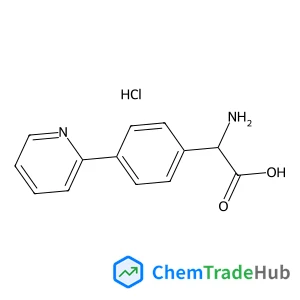
2-Amino-2-(4-(pyridin-2-YL)phenyl)acetic acid hydrochloride
CAS Number:
1135818-89-1
Molecular Formula:
C13H13ClN2O2
Marek Moczulski, Piotr Drelich, Łukasz Albrecht
This study demonstrates that the annulation of a tetrahydro-1,2-oxazine ring can be realized via bifunctional catalysis, employing nitroolefins and a recently introduced group of aminooxylating reagents as starting materials. The developed cascade reactivity proceeds in a sequence aza-Michael–Michael reaction. The target products, bearing three contiguous stereocenters, have been obtained with high yields (up to 97%) and excellent stereocontrol (>20 : 1 dr, up to 99.5 : 0.5 er).
Tamar L. Greaves, Celesta Fong, Calum J. Drummond
DOI: 10.1039/C2CP23698B
Olivier Balmes, Andrea Resta, Didier Wermeille, Roberto Felici, Maria E. Messing, Knut Deppert, Zhi Liu, Michael E. Grass, Hendrik Bluhm, Richard van Rijn, Joost W. M. Frenken, Rasmus Westerström, Sara Blomberg, Johan Gustafson, Jesper N. Andersen, Edvin Lundgren
DOI: 10.1039/C2CP22873D
Oleg Opanasyuk, Lennart B.-Å. Johansson
DOI: 10.1039/C1CP22483B
Yi Ding, Yanli Wang
DOI: 10.1039/C2CP22905F
Bjørn Kvamme, Tatiana Kuznetsova, Pilvi-Helina Kivelæ
DOI: 10.1039/C2CP23810A
Lisandro Buljubasich, Laura M. Schreiber, Hans W. Spiess, Kerstin Münnemann
DOI: 10.1039/C2CP22822J
Bin Zhang, Xudong Chen, Zhenguo Chi, Jin Yang, Jiemei Ou, Ming Qiu Zhang, Dehao Li, Dong Wang, Mingkai Liu, Juying Zhou
DOI: 10.1039/C2CP23953A
Thomas Steinbrecher, Mario S. Mommer, Yuki Nagata, Marcus Elstner
DOI: 10.1039/C2CP23489K
O. Kroutil, M. Předota, F. Lankaš, M. Šíp
DOI: 10.1039/C2CP23540D
Richard J. Wheatley, Angelica A. Gopal
DOI: 10.1039/C2CP23504H
(3.beta.)-3-Hydroxy-N,N-dimethyl-chol-5-en-24-amide (CAS: 79066-03-8) is primari...
5-(Aminomethyl)-2-methoxyphenol (CAS: 89702-89-6) is classified under GHS as a s...
Thieno[2,3-c]pyridin-7(6H)-one (CAS: 28981-13-7) is a heterocyclic organic compo...
1-[(6-Methoxy-3-pyridinyl)methyl]-4-piperidinamine dihydrochloride is generally ...
[(2E)-3-Phenyl-2-propen-1-yl]phosphonic acid (CAS: 146404-58-2) is regulated und...
6-Bromo-7-methoxyquinoline (CAS: 1620515-86-7) falls under the scope of the Glob...
This compound is primarily used in the pharmaceutical industry for the developme...
1-Ethyl-7-[2-methyl-6-(4H-1,2,4-triazol-3-yl)-3-pyridinyl]-3,5-dihydropyrazino[2...
Alternative reagents such as 2-[(dimethylamino)methyl]phenylboronic acid or rela...
3-(Piperidin-4-yloxy)pyridine (CAS: 310881-48-2) is an organic compound with the...

Organic & Biomolecular Chemistry (OBC) publishes original and high impact research and reviews in organic chemistry. We welcome research that shows new or significantly improved protocols or methodologies in total synthesis, synthetic methodology or physical and theoretical organic chemistry as well as research that shows a significant advance in the organic chemistry or molecular design aspects of chemical biology, catalysis, supramolecular and macromolecular chemistry, theoretical chemistry, mechanism-oriented physical organic chemistry, medicinal chemistry or natural products. Articles published in the journal should report new work which makes a highly-significant impact in the field. Routine and incremental work is generally not suitable for publication in the journal. More details about key areas of our scope are below. In all cases authors should include in their article clear rationale for why their research has been carried out.
amine structure](https://static.chemtradehub.com/structs/629/62924-61-2-0728.webp "[(2-chlorophenyl)methyl](ethyl)amine structure")