


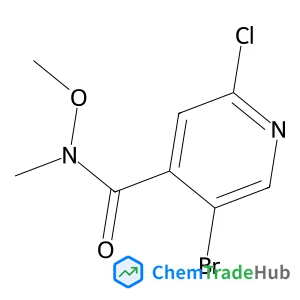
5-Bromo-2-chloro-N-methoxy-N-methylisonicotinamide
CAS Number:
1256790-08-5
Molecular Formula:
C8H8BrClN2O2
Margherita Barbero, Stefano Dughera
Diazonium salts, and precisely arenediazonium o-benzenedisulfonimides, have been used for the first time as efficient electrophilic partners in gold catalyzed Heck-coupling reactions. The synthetic protocol was general, easy and gave the target products in satisfactory yields. Mechanistic insights revealed the fundamental roles of the o-benzenedisulfonimide anion as an electron transfer agent thath promotes a radical pathway that does not require the presence of photocatalysts or external oxidants.

Russian Chemical Bulletin

Current Opinion in Colloid & Interface Science

Russian Journal of Coordination Chemistry

Current Opinion in Solid State & Materials Science

Crystallography Reports

Drug Discovery Today

Nature Medicine

Russian Journal of Bioorganic Chemistry

Chemical Communications

New Journal of Chemistry
Stéphane Aloïse, Zuzanna Pawlowska, Cyril Ruckebusch, Michel Sliwa, Julien Dubois, Olivier Poizat, Guy Buntinx, Aurélie Perrier, François Maurel, Patrice Jacques, Jean-Pierre Malval, Lionel Poisson, Giovanni Piani, Jiro Abe
DOI: 10.1039/C2CP22254J
Sebastian Weibels, Adrian Syguda, Christian Herrmann, Hermann Weingärtner
DOI: 10.1039/C2CP24041F
Stefaan Vandendriessche, Ventsislav K. Valev, Thierry Verbiest
DOI: 10.1039/C2CP23311H
Annemarie Huijser, Michał F. Rode, Alice Corani, Andrzej L. Sobolewski, Villy Sundström
DOI: 10.1039/C2CP22958G
Yuanhao Tang, Hua Zhang, Louis G. Hector, Jr., Chuying Ouyang, Hong Li, Liquan Chen
DOI: 10.1039/C2CP22720G
Shuirong Li, Chengxi Zhang, Peng Zhang, Gaowei Wu, Xinbin Ma, Jinlong Gong
DOI: 10.1039/C2CP24089K
Bjørn Kvamme, Tatiana Kuznetsova, Pilvi-Helina Kivelæ
DOI: 10.1039/C2CP23810A
Eugenii Ya. Misochko, Alexander V. Akimov, Denis V. Korchagin, Artem A. Masitov, Konstantin N. Shavrin
DOI: 10.1039/C2CP22853J
Stijn Schaltin, Neil R. Brooks, Linda Stappers, Kristof Van Hecke, Luc Van Meervelt, Koen Binnemans, Jan Fransaer
DOI: 10.1039/C2CP22987K
(3.beta.)-3-Hydroxy-N,N-dimethyl-chol-5-en-24-amide (CAS: 79066-03-8) is primari...
5-(Aminomethyl)-2-methoxyphenol (CAS: 89702-89-6) is classified under GHS as a s...
Thieno[2,3-c]pyridin-7(6H)-one (CAS: 28981-13-7) is a heterocyclic organic compo...
1-[(6-Methoxy-3-pyridinyl)methyl]-4-piperidinamine dihydrochloride is generally ...
[(2E)-3-Phenyl-2-propen-1-yl]phosphonic acid (CAS: 146404-58-2) is regulated und...
6-Bromo-7-methoxyquinoline (CAS: 1620515-86-7) falls under the scope of the Glob...
This compound is primarily used in the pharmaceutical industry for the developme...
1-Ethyl-7-[2-methyl-6-(4H-1,2,4-triazol-3-yl)-3-pyridinyl]-3,5-dihydropyrazino[2...
Alternative reagents such as 2-[(dimethylamino)methyl]phenylboronic acid or rela...
3-(Piperidin-4-yloxy)pyridine (CAS: 310881-48-2) is an organic compound with the...

Organic & Biomolecular Chemistry (OBC) publishes original and high impact research and reviews in organic chemistry. We welcome research that shows new or significantly improved protocols or methodologies in total synthesis, synthetic methodology or physical and theoretical organic chemistry as well as research that shows a significant advance in the organic chemistry or molecular design aspects of chemical biology, catalysis, supramolecular and macromolecular chemistry, theoretical chemistry, mechanism-oriented physical organic chemistry, medicinal chemistry or natural products. Articles published in the journal should report new work which makes a highly-significant impact in the field. Routine and incremental work is generally not suitable for publication in the journal. More details about key areas of our scope are below. In all cases authors should include in their article clear rationale for why their research has been carried out.
![5,7-Dihydroxy-3-(4-hydroxyphenyl)-6-[(1R,6R)-3-methyl-6-prop-1-en-2-ylcyclohex-2-en-1-yl]chromen-4-one structure](https://static.chemtradehub.com/structs/191/1914963-20-4-2b05.webp "5,7-Dihydroxy-3-(4-hydroxyphenyl)-6-[(1R,6R)-3-methyl-6-prop-1-en-2-ylcyclohex-2-en-1-yl]chromen-4-one structure")
![Bis(N,N''-dimethylpiperazine)tetra[copper(I) iodide] structure](https://static.chemtradehub.com/structs/140/1401708-91-5-2b86.webp "Bis(N,N''-dimethylpiperazine)tetra[copper(I) iodide] structure")





