












Rhodium-catalyzed benzoisothiazole synthesis by tandem annulation reactions of sulfoximines and activated olefins
Literature Information
Publication Date
2017-11-16
DOI
10.1039/C7OB02586F
Impact Factor
3.876
Authors
Yang Li, Lin Dong
View Original
Abstract
Rhodium(III)-catalyzed N-directed ortho C–H activation reactions have been developed for the synthesis of unique heterocyclic benzoisothiazoles. Herein, this novel tandem annulation approach can efficiently construct benzoisothiazole compounds from free NH-sulfoximines and alkenes via C–H activation, olefination and subsequent intramolecular aza-Michael cyclization.
Related Literature
Y-shaped two-photon absorbing molecules with an imidazole–thiazole core
Ke Feng, Leonardo De Boni, Lino Misoguti, C. R. Mendonça, Michael Meador, Fu-Lian Hsu, Xiu R. Bu
2004-04-21
Communication
DOI: 10.1039/B402019G
Double asymmetric induction as a mechanistic probe: conjugate addition for the asymmetric synthesis of a pseudotripeptide
Stephen G. Davies, Gesine J. Hermann, Miles J. Sweet, Andrew D. Smith
2004-04-08
Communication
DOI: 10.1039/B401293C
A bidentate borane as colorimetric fluoride ion sensor
Stéphane Solé, François P. Gabbaï
2004-04-28
Communication
DOI: 10.1039/B403596H
Thin Pd membrane prepared on macroporous stainless steel tube filter by an in-situ multi-dimensional plating mechanism
Jianhua Tong, Yasuyuki Matsumura
2004-09-20
Communication
DOI: 10.1039/B406975G
Halide anion directed assembly of luminescent pseudorotaxanes
David Curiel, Paul D. Beer, Rowena L. Paul, Andrew Cowley, Mark R. Sambrook, Fridrich Szemes
2004-04-22
Communication
DOI: 10.1039/B401900H
Transformation of highly ordered large pore silica mesophases (Fm3m, Im3m and p6mm) in a ternary triblock copolymer–butanol–water system
Freddy Kleitz, Leonid A. Solovyov, Gopinathan M. Anilkumar, Shin Hei Choi, Ryong Ryoo
2004-06-02
Communication
DOI: 10.1039/B403903C
Shuttling through reversible covalent chemistry
David A. Leigh, Emilio M. Pérez
2004-09-23
Communication
DOI: 10.1039/B412570C
Bond energy, aromatic stabilization energy and strain in IPR fullerenes
Michał K. Cyrański, Siân T. Howard, Michał L. Chodkiewicz
2004-09-21
Communication
DOI: 10.1039/B408903K
Stereospecific peptide folds. A rationally designed molecular bracelet
Soumendra Rana, Bijoy Kundu, Susheel Durani
2004-09-20
Communication
DOI: 10.1039/B410532J
H2–O2 atmosphere increases the activity of Pt/TiO2 for benzene photocatalytic oxidation by two orders of magnitude
Yilin Chen, Danzhen Li, Xinchen Wang, Xuxu Wang, Xianzhi Fu
2004-09-02
Communication
DOI: 10.1039/B408187K
You might also like
Compound Q&A
What precautions should be taken when handling 2-Chloro-1,2-bis(4-methylphenyl)ethanone (CAS: 71193-32-3)?
When handling 2-Chloro-1,2-bis(4-methylphenyl)ethanone (CAS: 71193-32-3), it is ...
71193-32-32-Chloro-1,2-bis(4-m...
Compound Q&A
What industries use 4-Ethoxy-3-(5-methyl-4-oxo-7-propyl-1,4-dihydroimidazo[5,1-f][1,2,4]triazin-2-yl)benzenesulfonyl chloride (CAS: 224789-26-8)?
4-Ethoxy-3-(5-methyl-4-oxo-7-propyl-1,4-dihydroimidazo[5,1-f][1,2,4]triazin-2-yl...
224789-26-84-Ethoxy-3-(5-methyl...
Compound Q&A
How should Methyl 3-Oxo-4-Androsten-17-Carboxylate (CAS: 2681-55-2) be stored?
Methyl 3-Oxo-4-Androsten-17-Carboxylate (CAS: 2681-55-2) should be stored in a c...
2681-55-2Methyl 3-Oxo-4-Andro...
Compound Q&A
What are the main uses of (R)-3-Amino-4-(3-hexylphenylamino)-4-oxobutylphosphonic acid (CAS: 909725-61-7)?
(R)-3-Amino-4-(3-hexylphenylamino)-4-oxobutylphosphonic acid is primarily used i...
909725-61-7(R)-3-Amino-4-(3-hex...
Compound Q&A
What regulatory guidelines apply to 2-Methyl-2-propanyl 3-amino-3-carbamoyl-1-azetidinecarboxylate (CAS: 1254120-14-3)?
2-Methyl-2-propanyl 3-amino-3-carbamoyl-1-azetidinecarboxylate (CAS: 1254120-14-...
1254120-14-32-Methyl-2-propanyl ...
Compound Q&A
Are there alternatives to (E)-4-(tert-Butoxy)-4-oxobut-2-enoic acid (CAS: 135355-96-3) in synthesis?
There are alternative reagents that can be used in synthesis instead of (E)-4-(t...
135355-96-3(E)-4-(tert-Butoxy)-...
Compound Q&A
What are the physical and chemical properties of [2-(3-Chlorophenyl)-1,3-thiazol-4-yl]methanol (CAS: 121202-20-8)?
[2-(3-Chlorophenyl)-1,3-thiazol-4-yl]methanol (CAS: 121202-20-8) is a crystallin...
121202-20-8[2-(3-Chlorophenyl)-...
Compound Q&A
What is the market or research trend for Methyl (2S)-[(4S)-2,2-dimethyl-1,3-dioxolan-4-yl]{[(4-methylphenyl)sulfonyl]oxy}acetate (CAS: 166249-17-8)?
The market and research trends for Methyl (2S)-[(4S)-2,2-dimethyl-1,3-dioxolan-4...
166249-17-8Methyl (2S)-[(4S)-2,...
Compound Q&A
What is the market or research trend for 1-Bromo-2-isocyanatoethane (CAS: 42865-19-0)?
The market for 1-Bromo-2-isocyanatoethane (CAS: 42865-19-0) is driven by its use...
42865-19-01-Bromo-2-isocyanato...
Compound Q&A
What are the main uses of 4-Nitro-D-phenylalanine hydrochloride (CAS: 147065-06-3)?
4-Nitro-D-phenylalanine hydrochloride (CAS: 147065-06-3) is primarily used in re...
147065-06-34-Nitro-D-phenylalan...
Source Journal
Organic & Biomolecular Chemistry

CiteScore:
3.4
Self-citation Rate:
10.3%
Articles per Year:
1041
Organic & Biomolecular Chemistry (OBC) publishes original and high impact research and reviews in organic chemistry. We welcome research that shows new or significantly improved protocols or methodologies in total synthesis, synthetic methodology or physical and theoretical organic chemistry as well as research that shows a significant advance in the organic chemistry or molecular design aspects of chemical biology, catalysis, supramolecular and macromolecular chemistry, theoretical chemistry, mechanism-oriented physical organic chemistry, medicinal chemistry or natural products. Articles published in the journal should report new work which makes a highly-significant impact in the field. Routine and incremental work is generally not suitable for publication in the journal. More details about key areas of our scope are below. In all cases authors should include in their article clear rationale for why their research has been carried out.
Recommended Compounds
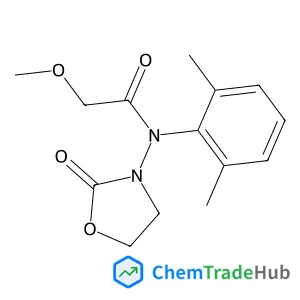
N-(2,6-Dimethylphenyl)-2-methoxy-N-(2-oxo-1,3-oxazolidin-3-yl)acetamide
CAS Number:
77732-09-3
Molecular Formula:
C14H18N2O4
Recommended Suppliers





Disclaimer
This page provides academic journal information for reference and research purposes only. We are not affiliated with any journal publishers and do not handle publication submissions. For publication-related inquiries, please contact the respective journal publishers directly.
If you notice any inaccuracies in the information displayed, please contact us at support@chemtradehub.com. We will promptly review and address your concerns.