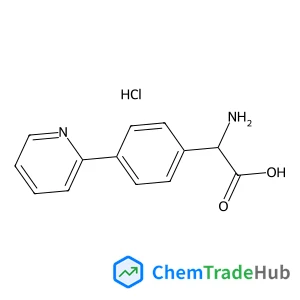
2-Amino-2-(4-(pyridin-2-YL)phenyl)acetic acid hydrochloride
CAS Number:
1135818-89-1
Molecular Formula:
C13H13ClN2O2
Sisheng Hu, Liang Lu, Tongyang Zhu, Qian Wu, Ying Chen, Jie Jack Li
A Rh(III)-catalyzed C–H alkynylation of substituted N-phenoxyacetamides has been developed with the aid of hypervalent iodine-alkyne reagents. Complementary to the Sonogashira coupling reaction, this protocol provides an efficient and straightforward method to access aryl alkynes at room temperature. The multifunctional directing group is preserved which can be further employed for ortho-directed functionalizations to obtain additional new complex products.
Geoffrey Rojas, Scott Simpson, Xumin Chen, Donna A. Kunkel, Justin Nitz, Jie Xiao, Peter A. Dowben, Eva Zurek, Axel Enders
DOI: 10.1039/C2CP40254H
Celia Blanco, David Hochberg
DOI: 10.1039/C2CP22813K
Jesus E. Zerpa Unda, Emil Roduner
DOI: 10.1039/C2CP23140A
Xiaoming Zhu, Michael M. Fryd, Jung-Ren Huang
DOI: 10.1039/C2CP23007K
Akira Yamada, Ken Miyajima, Fumitaka Mafuné
DOI: 10.1039/C2CP24036J
Diego A. Gomez, Aldo F. Combariza, German Sastre
DOI: 10.1039/C2CP23146H
Amel Tabet-Aoul, Mohamed Mohamedi
DOI: 10.1039/C2CP24069F
(3.beta.)-3-Hydroxy-N,N-dimethyl-chol-5-en-24-amide (CAS: 79066-03-8) is primari...
5-(Aminomethyl)-2-methoxyphenol (CAS: 89702-89-6) is classified under GHS as a s...
Thieno[2,3-c]pyridin-7(6H)-one (CAS: 28981-13-7) is a heterocyclic organic compo...
1-[(6-Methoxy-3-pyridinyl)methyl]-4-piperidinamine dihydrochloride is generally ...
[(2E)-3-Phenyl-2-propen-1-yl]phosphonic acid (CAS: 146404-58-2) is regulated und...
6-Bromo-7-methoxyquinoline (CAS: 1620515-86-7) falls under the scope of the Glob...
This compound is primarily used in the pharmaceutical industry for the developme...
1-Ethyl-7-[2-methyl-6-(4H-1,2,4-triazol-3-yl)-3-pyridinyl]-3,5-dihydropyrazino[2...
Alternative reagents such as 2-[(dimethylamino)methyl]phenylboronic acid or rela...
3-(Piperidin-4-yloxy)pyridine (CAS: 310881-48-2) is an organic compound with the...

Organic & Biomolecular Chemistry (OBC) publishes original and high impact research and reviews in organic chemistry. We welcome research that shows new or significantly improved protocols or methodologies in total synthesis, synthetic methodology or physical and theoretical organic chemistry as well as research that shows a significant advance in the organic chemistry or molecular design aspects of chemical biology, catalysis, supramolecular and macromolecular chemistry, theoretical chemistry, mechanism-oriented physical organic chemistry, medicinal chemistry or natural products. Articles published in the journal should report new work which makes a highly-significant impact in the field. Routine and incremental work is generally not suitable for publication in the journal. More details about key areas of our scope are below. In all cases authors should include in their article clear rationale for why their research has been carried out.
![Bis(N,N''-dimethylpiperazine)tetra[copper(I) iodide] structure](https://static.chemtradehub.com/structs/140/1401708-91-5-2b86.webp "Bis(N,N''-dimethylpiperazine)tetra[copper(I) iodide] structure")
![4,4-Difluoro-2-methyl-1-{[(2-methyl-2-propanyl)oxy]carbonyl}-L-proline structure](https://static.chemtradehub.com/structs/119/1194032-23-9-f426.webp "4,4-Difluoro-2-methyl-1-{[(2-methyl-2-propanyl)oxy]carbonyl}-L-proline structure")