













Tricyclanos: conformationally constrained nucleoside analogues with a new heterotricycle obtained from a d-ribofuranose unit
Literature Information
Publication Date
2017-10-17
DOI
10.1039/C7OB02296D
Impact Factor
3.876
Authors
Máté Kicsák, Attila Mándi, Szabolcs Varga, Mihály Herczeg, Gyula Batta, Attila Bényei, Anikó Borbás, Pál Herczegh
View Original
Abstract
A novel type of nucleoside analogue in which the sugar part is replaced by a new tricycle, 3,7,10-trioxa-11-azatricyclo[5.3.1.05,11]undecane has been prepared by substrate-controlled asymmetric synthesis. 1,5-Dialdehydes obtained from properly protected or unprotected uridine, ribothymidine, cytidine, inosine, adenosine and guanosine by metaperiodate oxidation reacted readily with tris(hydroxymethyl)aminomethane to provide the corresponding tricyclic derivatives with three new stereogenic centers. Through a double cyclisation cascade process the tricyclic compounds were obtained in good to high yields, with very high diastereoselectivity. Formation of one stereoisomer, out of the eight possible, was observed in all cases. The absolute configuration of the new stereotriad-containing tricyclic systems was aided by conventional NMR experiments followed by chemical shift calculations using an X-ray crystal structure as reference that was in good agreement with H–H distances obtained from a new ROESY NMR method. The synthesis was compatible with silyl, trityl and dimethoxytrityl protecting groups. A new reagent mixture containing ZnCl2, Et3SiH and hexafluoroisopropanol was developed for detritylation of the acid-sensitive tricyclano nucleosides.
Related Literature
Fabrication of color changeable CO2 sensitive nanofibers
Jiaojiao Shang, Shaojian Lin, Patrick Theato
2017-11-16
Communication
DOI: 10.1039/C7PY01628J
New electroactive macromonomers and multi-responsive PEDOT graft copolymers
Sara Marina, Daniele Mantione, Kasina ManojKumar, Vijayakrishna Kari, Agnieszka Tercjak, Ana Sanchez-Sanchez
2018-06-15
Paper
DOI: 10.1039/C8PY00680F
CuAAC click chemistry: a versatile approach towards PVDF-based block copolymers
I. Terzic, N. L. Meereboer, K. Loos
2018-06-25
Communication
DOI: 10.1039/C8PY00742J
Designing a main-chain visible-light-labile picolinium-caged polymer and its biological applications
Tongtong Zhou, Tao Liu, Yu Bao, Ping Zhang, Casey Yan, Fujun Yao, Shuxun Cui, Yongming Chen, Xin Chen, You Yu
2017-12-01
Paper
DOI: 10.1039/C7PY01844D
Simultaneous superior lubrication and high load bearing by the dynamic weak interaction of a lubricant with mechanically strong bilayer porous hydrogels
Meirong Cai, Bo Yu, Feng Zhou
2017-10-03
Communication
DOI: 10.1039/C7PY01532A
Highly efficient luminescent side-chain polymers with short-spacer attached tetraphenylethylene AIEgens via RAFT polymerization capable of naked eye explosive detection
Qian Li, Xiao Li, Zhongying Wu, Yuhao Sun, Jianglin Fang, Dongzhong Chen
2018-07-02
Paper
DOI: 10.1039/C8PY00710A
Branching and molar mass analysis of low density polyethylene using the multiple preparative fractionation concept
P. S. Eselem Bungu, H. Pasch
2018-02-08
Paper
DOI: 10.1039/C7PY02076G
You might also like
Compound Q&A
What are the main uses of (3.beta.)-3-Hydroxy-N,N-dimethyl-chol-5-en-24-amide (CAS: 79066-03-8)?
(3.beta.)-3-Hydroxy-N,N-dimethyl-chol-5-en-24-amide (CAS: 79066-03-8) is primari...
79066-03-8(3.beta.)-3-Hydroxy-...
Compound Q&A
What regulatory guidelines apply to 5-(aminomethyl)-2-methoxyphenol (CAS: 89702-89-6)?
5-(Aminomethyl)-2-methoxyphenol (CAS: 89702-89-6) is classified under GHS as a s...
89702-89-65-(aminomethyl)-2-me...
Compound Q&A
What is Thieno[2,3-c]pyridin-7(6H)-one (CAS: 28981-13-7)?
Thieno[2,3-c]pyridin-7(6H)-one (CAS: 28981-13-7) is a heterocyclic organic compo...
28981-13-7Thieno[2,3-c]pyridin...
Compound Q&A
Is 1-[(6-Methoxy-3-pyridinyl)methyl]-4-piperidinamine dihydrochloride (CAS: 1185311-28-7) safe?
1-[(6-Methoxy-3-pyridinyl)methyl]-4-piperidinamine dihydrochloride is generally ...
1185311-28-71-[(6-Methoxy-3-pyri...
Compound Q&A
What regulatory guidelines apply to [(2E)-3-Phenyl-2-propen-1-yl]phosphonic acid (CAS: 146404-58-2)?
[(2E)-3-Phenyl-2-propen-1-yl]phosphonic acid (CAS: 146404-58-2) is regulated und...
146404-58-2[(2E)-3-Phenyl-2-pro...
Compound Q&A
What regulatory guidelines apply to 6-Bromo-7-methoxyquinoline (CAS: 1620515-86-7)?
6-Bromo-7-methoxyquinoline (CAS: 1620515-86-7) falls under the scope of the Glob...
1620515-86-76-Bromo-7-methoxyqui...
Compound Q&A
What industries use (2R)-1-(1-Benzofuran-2-yl)-N-propyl-2-pentanamine (CAS: 260550-89-8)?
This compound is primarily used in the pharmaceutical industry for the developme...
260550-89-8(2R)-1-(1-Benzofuran...
Compound Q&A
What are the main uses of 1-Ethyl-7-[2-methyl-6-(4H-1,2,4-triazol-3-yl)-3-pyridinyl]-3,5-dihydropyrazino[2,3-b]pyrazin-2(1H)-one (CAS: 1228013-15-7)?
1-Ethyl-7-[2-methyl-6-(4H-1,2,4-triazol-3-yl)-3-pyridinyl]-3,5-dihydropyrazino[2...
1228013-15-71-Ethyl-7-[2-methyl-...
Compound Q&A
Are there alternatives to {5-(Acryloylamino)-2-[(dimethylamino)methyl]phenyl}boronic acid (CAS: 1217500-78-1) in synthesis?
Alternative reagents such as 2-[(dimethylamino)methyl]phenylboronic acid or rela...
1217500-78-1{5-(Acryloylamino)-2...
Compound Q&A
What is 3-(Piperidin-4-yloxy)pyridine (CAS: 310881-48-2)?
3-(Piperidin-4-yloxy)pyridine (CAS: 310881-48-2) is an organic compound with the...
310881-48-23-(Piperidin-4-yloxy...
Source Journal
Organic & Biomolecular Chemistry

CiteScore:
3.4
Self-citation Rate:
10.3%
Articles per Year:
1041
Organic & Biomolecular Chemistry (OBC) publishes original and high impact research and reviews in organic chemistry. We welcome research that shows new or significantly improved protocols or methodologies in total synthesis, synthetic methodology or physical and theoretical organic chemistry as well as research that shows a significant advance in the organic chemistry or molecular design aspects of chemical biology, catalysis, supramolecular and macromolecular chemistry, theoretical chemistry, mechanism-oriented physical organic chemistry, medicinal chemistry or natural products. Articles published in the journal should report new work which makes a highly-significant impact in the field. Routine and incremental work is generally not suitable for publication in the journal. More details about key areas of our scope are below. In all cases authors should include in their article clear rationale for why their research has been carried out.
Recommended Compounds
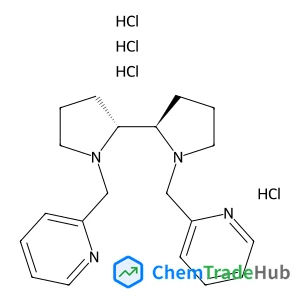
(2R,2'R)-1,1'-Bis(2-pyridinylmethyl)-2,2'-bipyrrolidine tetrahydrochloride
CAS Number:
1228077-88-0
Molecular Formula:
C20H30Cl4N4

Recommended Suppliers




Disclaimer
This page provides academic journal information for reference and research purposes only. We are not affiliated with any journal publishers and do not handle publication submissions. For publication-related inquiries, please contact the respective journal publishers directly.
If you notice any inaccuracies in the information displayed, please contact us at support@chemtradehub.com. We will promptly review and address your concerns.