












Polyaniline decorated Bi2MoO6 nanosheets with effective interfacial charge transfer as photocatalysts and optical limiters
Literature Information
Publication Date
2017-10-09
DOI
10.1039/C7CP06320B
Impact Factor
3.676
Authors
Wei Zhao, Cheng Li, Aijian Wang, Cuncai Lv, Weihua Zhu, Shengping Dou, Qian Wang, Qin Zhong
View Original
Abstract
Polyaniline (PANI)-decorated Bi2MoO6 nanosheets (BMO/PANI) were prepared by a facile solvothermal method. Different characterization techniques, including X-ray powder diffraction, scanning electron microscopy, transmission electron microscopy, Raman spectroscopy, Fourier transform infrared spectroscopy, X-ray photoelectron spectroscopy, diffuse reflectance ultraviolet-visible spectroscopy, photoluminescence spectroscopy, electrochemical impedance spectroscopy, photocurrent spectroscopy, and nanosecond time-resolved emission studies, have been employed to investigate the structure, optical and electrical properties of the BMO/PANI composites. The wide absorption of the samples in the visible light region makes them suitable for nonlinear transmission and photocatalytic activity studies. The associated photocatalytic activity and optical nonlinearities for the BMO/PANI composites are shown to be dependent on the PANI loadings. The rational mechanisms responsible for deteriorating pollutants and improving optical nonlinearities were also proposed, which could be mainly attributed to the efficient interfacial charge transfer and the interfacial electronic interactions between PANI and Bi2MoO6. The photoluminescence spectroscopy, electrochemical impedance spectroscopy, and photocurrent spectroscopy studies confirmed that the interface charge separation efficiency was greatly improved by coupling Bi2MoO6 with PANI. The tuning of photocatalysis and nonlinear optical behaviors with variation in the content of PANI provides an easy way to attain tunable properties, which are exceedingly required in optoelectronics applications.
Recommended Journals
Related Literature
Detection and evaluation of polymer–polymer interactions in dilute solutions of associating polymers
Georges M. Pavlov, Anna A. Gosteva, Olga V. Okatova, Olga A. Dommes, Irina I. Gavrilova
2021-03-22
Paper
DOI: 10.1039/D0PY01725F
Polymers and boron neutron capture therapy (BNCT): a potent combination
Anaïs Pitto-Barry
2021-03-23
Review Article
DOI: 10.1039/D0PY01392G
Synthetic approaches for copolymers containing nucleic acids and analogues: challenges and opportunities
Hao Lu, Jiansong Cai, Ke Zhang
2021-03-29
Review Article
DOI: 10.1039/D0PY01707H
Composition processing property relationship of vitrimers Based on polyethyleneimine
Natanel Jarach, Daniel Golani, Ofer Asaf, Hanna Dodiuk, Yoav Shamir, Amir Goldbourt, Samuel Kenig, Naum Naveh
2021-04-06
Paper
DOI: 10.1039/D1PY00116G
Morphological modulation of azobenzene-containing tubular polymersomes
Lishan Li, Yiwen Li, Shuyuan Wang, Liandong Ye, Wei Zhang, Nianchen Zhou, Zhengbiao Zhang, Xiulin Zhu
2021-04-26
Paper
DOI: 10.1039/D1PY00099C
Engineering of pH-triggered nanoplatforms based on novel poly(2-methyl-2-oxazoline)-b-poly[2-(diisopropylamino)ethyl methacrylate] diblock copolymers with tunable morphologies for biomedical applications
Peter Černoch, Alessandro Jager, Zulfiya Černochová, Vladimir Sincari, Lindomar J. C. Albuquerque, Rafal Konefal, Ewa Pavlova, Fernando C. Giacomelli, Eliezer Jager
2021-04-14
Paper
DOI: 10.1039/D1PY00141H
You might also like
Compound Q&A
How should waste containing 2-Ethyl-4-Methyl-1H-Imidazole-5-Carbaldehyde (CAS: 88634-80-4) be handled?
Waste containing 2-Ethyl-4-Methyl-1H-Imidazole-5-Carbaldehyde (CAS: 88634-80-4) ...
88634-80-42-Ethyl-4-Methyl-1H-...
Compound Q&A
What industries use Triethoxy(octyl)silane (CAS: 1385031-14-0)?
Triethoxy(octyl)silane (CAS: 1385031-14-0) is widely used in the pharmaceuticals...
1385031-14-0Triethoxy(octyl)sila...
Compound Q&A
Are there alternatives to 3-iodo-7-nitro-1H-indazole (CAS: 864724-64-1) in synthesis?
Several alternatives to 3-iodo-7-nitro-1H-indazole (CAS: 864724-64-1) exist in t...
864724-64-13-iodo-7-nitro-1H-in...
Compound Q&A
Are there alternatives to Benzene, bis[(trimethoxysilyl)ethyl] (CAS: 266317-71-9) in synthesis?
Yes, there are alternatives to Benzene, bis[(trimethoxysilyl)ethyl] (CAS: 266317...
266317-71-9Benzene, bis[(trimet...
Compound Q&A
Is Isothiazole-3-carbonitrile (CAS: 1452-17-1) safe?
Isothiazole-3-carbonitrile (CAS: 1452-17-1) is generally considered safe when us...
1452-17-1Isothiazole-3-carbon...
Compound Q&A
Is (3-Chlorophenyl)methanol (CAS: 873-63-2) safe?
(3-Chlorophenyl)methanol (CAS: 873-63-2) is considered low to moderately toxic. ...
873-63-2(3-Chlorophenyl)meth...
Compound Q&A
How is (2S,3S)-2-Hydroxy-3-({[(2-methyl-2-propanyl)oxy]carbonyl}amino)-3-(2-naphthyl)propanoic acid (CAS: 959583-98-3) typically synthesized?
(2S,3S)-2-Hydroxy-3-({[(2-methyl-2-propanyl)oxy]carbonyl}amino)-3-(2-naphthyl)pr...
959583-98-3(2S,3S)-2-Hydroxy-3-...
Compound Q&A
What precautions should be taken when handling Methyl 2-(bromomethyl)-5-methoxybenzoate (CAS: 788081-99-2)?
Proper handling of methyl 2-(bromomethyl)-5-methoxybenzoate requires the use of ...
788081-99-2Methyl 2-(bromomethy...
Compound Q&A
What is 6,8-Dibromoimidazo[1,2-a]pyridine-2-carboxylic acid (CAS: 904805-36-3)?
6,8-Dibromoimidazo[1,2-a]pyridine-2-carboxylic acid (CAS: 904805-36-3) is an aro...
904805-36-36,8-Dibromoimidazo[1...
Compound Q&A
Is 3-Amino-5-bromo-2-pyridinecarbonitrile (CAS: 573675-27-1) safe?
3-Amino-5-bromo-2-pyridinecarbonitrile is considered safe when handled under pro...
573675-27-13-Amino-5-bromo-2-py...
Source Journal
Physical Chemistry Chemical Physics

CiteScore:
5.5
Self-citation Rate:
10.3%
Articles per Year:
3036
Physical Chemistry Chemical Physics (PCCP) is an international journal co-owned by 19 physical chemistry and physics societies from around the world. This journal publishes original, cutting-edge research in physical chemistry, chemical physics and biophysical chemistry. To be suitable for publication in PCCP, articles must include significant innovation and/or insight into physical chemistry; this is the most important criterion that reviewers and Editors will judge against when evaluating submissions. The journal has a broad scope and welcomes contributions spanning experiment, theory, computation and data science. Topical coverage includes spectroscopy, dynamics, kinetics, statistical mechanics, thermodynamics, electrochemistry, catalysis, surface science, quantum mechanics, quantum computing and machine learning. Interdisciplinary research areas such as polymers and soft matter, materials, nanoscience, energy, surfaces/interfaces, and biophysical chemistry are welcomed if they demonstrate significant innovation and/or insight into physical chemistry. Joined experimental/theoretical studies are particularly appreciated when complementary and based on up-to-date approaches.
Recommended Compounds
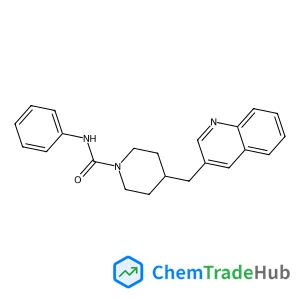
N-phenyl-4-(quinolin-3-ylmethyl)piperidine-1-carboxamide
CAS Number:
959151-50-9
Molecular Formula:
C22H23N3O


Recommended Suppliers





Disclaimer
This page provides academic journal information for reference and research purposes only. We are not affiliated with any journal publishers and do not handle publication submissions. For publication-related inquiries, please contact the respective journal publishers directly.
If you notice any inaccuracies in the information displayed, please contact us at support@chemtradehub.com. We will promptly review and address your concerns.