













Atomistic observation of the collision and migration of Li on MoSe2 and WS2 surfaces through ab initio molecular dynamics
Literature Information
Publication Date
2017-09-15
DOI
10.1039/C7CP05847K
Impact Factor
3.676
Authors
Viet Q. Bui, Thang Bach Phan, Yoshiyuki Kawazoe
View Original
Abstract
We present in this study a theoretical investigation of the collision of Li with the MX2 surface (MoSe2 or WS2) by employing the Born–Oppenheimer molecular dynamics (MD) approach. In each trajectory, atomic Li is fired toward the two-dimensional monolayer with an inletting kinetic energy of 0.2 eV or 2.0 eV and a chosen striking angle. In total, 84 MD trajectories are analyzed. We observe that Li has a high tendency to migrate on WS2 in most investigated cases (20/21 cases at 0.2 eV inletting kinetic energy and 21/21 cases at 2.0 eV inletting kinetic energy), while the migration probability on MoSe2 is much lower (only 5/21 cases with the inletting kinetic energy of 0.2 eV and 15/21 cases with the inletting kinetic energy of 2.0 eV). Interestingly, our finding shows that the migration probability does not depend on the binding energies of Li–MoSe2 (1.61 eV) and Li–WS2 (1.77 eV), but it is in good agreement with the nudged-elastic-band prediction of migration barriers. In fact, it is the intensity of elastic vibration of the transition metal dichalcogenide layer that plays a very significant role in the migration of Li. During the collision process, Li is able to absorb energy from the layer vibration to jump out from one X–X–X trap to another. Consequently, with the assistance from intensive vibration of WS2, Li would possess higher migration probability on the layer surface. Finally, electronic structure analysis on various interacting Li–MX2 configurations is performed. From Bader charge estimation, we observe that WS2 tends to establish more charge transferability with Li. Moreover, when Li approaches closer to the S/Se layer, the hybridization of Li-2s and Mo-4d (or W-5d) orbitals results in a magnetic moment (up to ∼1 μB).
Related Literature
Optimization of Pavlova gyrans biomass production and the fatty acid profile using a two-step approach
Filipe Maciel, Hugo Pereira, Joana Silva
2023-09-25
Paper
DOI: 10.1039/D3FB00110E
Assessing weight loss control strategies in pomegranate (Punica granatum L.) fruit: plastic packaging and surface waxing
Alemayehu Ambaw
2023-09-30
Paper
DOI: 10.1039/D3FB00089C
Digitalization of the agro-food sector for achieving sustainable development goals: a review
Adithya Sridhar, Muthamilselvi Ponnuchamy, P. Senthil Kumar, Ashish Kapoor, Dai-Viet Nguyen Vo
2023-10-27
Review Article
DOI: 10.1039/D3FB00124E
Elucidating multiple reaction pathways for the degradation of antibiotics in water by a self-active single-atom zinc catalyst on biochar
Jieming Yuan, Yunkyoung Han, Krishnamoorthy Sathiyan, Virender K. Sharma, Abdol Hadi Mokarizadeh, Mesfin Tsige, Jiechao Jiang, Xingmao Ma
2023-10-17
Paper
DOI: 10.1039/D3SU00265A
A novel shape-stabilized phase change material with tunable thermal conductivity for cold chain applications
Apoorv Balwani, Tridib Ambardar, Adarsh Kumar Pandey, Aravind Dasari, Sujay Chattopadhyay
2023-10-16
Paper
DOI: 10.1039/D3SU00289F
Cholinium-based ionic liquid catalysts for polyethylene terephthalate glycolysis: understanding the role of solvent and a reappraisal of the cation contribution
Diana Bura, Lorenzo Pedrini, Stephen J. Connon
2023-10-19
Communication
DOI: 10.1039/D3SU00336A
Life cycle optimisation tool development for process systems and centralised supply chain design
Xinyang Sun, Alex Durkin, Miao Guo
2023-10-16
Paper
DOI: 10.1039/D3SU00251A
Insects as a sustainable source of emerging proteins and their processing to obtain bioactive compounds: an updated review
Francielle Miranda de Matos, Gabriela Boscariol Rasera, Ruann Janser Soares de Castro
2023-11-07
Review Article
DOI: 10.1039/D3FB00097D
Effects of different microwave power on the drying kinetics and physicochemical quality of brown shrimp (Metapenaeus dobsoni)
Sumit Kumar Verma, Remya Sasikala, Pankaj Kishore, C. O. Mohan, P. Ganesan, Pandurengan Padmavathy, Nagarajan Muralidharan, Bindu Jaganath, Soottawat Benjakul
2023-10-17
Paper
DOI: 10.1039/D3FB00144J
You might also like
Compound Q&A
What industries use (1R,3S)-1,3-Cyclopentanediol (CAS: 16326-97-9)?
(1R,3S)-1,3-Cyclopentanediol finds applications in various industries. In the ph...
16326-97-9(1R,3S)-1,3-Cyclopen...
Compound Q&A
What precautions should be taken when handling N'-[4-(Dimethylamino)phenyl]-N,N-dimethyl-1,4-benzenediamine (CAS: 637-31-0)?
When handling N'-[4-(Dimethylamino)phenyl]-N,N-dimethyl-1,4-benzenediamine, it i...
637-31-0N'-[4-(Dimethylamino...
Compound Q&A
Are there alternatives to 5-(2,4-Difluorophenyl)-2-methoxypyrimidine (CAS: 1352318-16-1) in synthesis?
There are several alternatives to 5-(2,4-Difluorophenyl)-2-methoxypyrimidine in ...
1352318-16-15-(2,4-Difluoropheny...
Compound Q&A
What regulatory guidelines apply to 1-(3-Methoxyphenoxy)propan-2-ol (CAS: 382141-68-6)?
1-(3-Methoxyphenoxy)propan-2-ol (CAS: 382141-68-6) must comply with the Globally...
382141-68-61-(3-Methoxyphenoxy)...
Compound Q&A
Is Tetrodotoxin Citrate (CAS: 18660-81-6) safe?
Tetrodotoxin Citrate is extremely dangerous and should be handled with extreme c...
18660-81-6Tetrodotoxin Citrate
Compound Q&A
What are the main uses of 2-Methyl-2-propanyl [(1R,3S)-3-hydroxycyclopentyl]carbamate (CAS: 225641-84-9)?
2-Methyl-2-propanyl [(1R,3S)-3-hydroxycyclopentyl]carbamate (CAS: 225641-84-9) i...
225641-84-92-Methyl-2-propanyl ...
Compound Q&A
How should waste containing 4-(2-Hydroxyhexafluoroisopropyl)Benzoic Acid (CAS: 16261-80-6) be handled?
Waste containing 4-(2-Hydroxyhexafluoroisopropyl)Benzoic Acid (CAS: 16261-80-6) ...
16261-80-64-(2-Hydroxyhexafluo...
Compound Q&A
How is 2-Methyl-2-proanyl {(2S)-1-[(benzyloxy)amino]-3-hydroxy-3-methyl-1-oxo-2-butanyl}carbamate (CAS: 102507-19-7) typically synthesized?
2-Methyl-2-proanyl {(2S)-1-[(benzyloxy)amino]-3-hydroxy-3-methyl-1-oxo-2-butanyl...
102507-19-72-Methyl-2-propanyl ...
Compound Q&A
What is Benzeneethanamine, α-ethyl-, hydrochloride (1:1) (CAS: 20735-15-3)?
Benzeneethanamine, α-ethyl-, hydrochloride (1:1) is an organic compound with the...
20735-15-3Benzeneethanamine, α...
Compound Q&A
Are there alternatives to 3-{(E)-[4-(Dimethylamino)phenyl]diazenyl}benzoic acid (CAS: 20691-84-3) in synthesis?
In the synthesis of compounds similar to 3-{(E)-[4-(Dimethylamino)phenyl]diazeny...
20691-84-33-{(E)-[4-(Dimethyla...
Source Journal
Physical Chemistry Chemical Physics

CiteScore:
5.5
Self-citation Rate:
10.3%
Articles per Year:
3036
Physical Chemistry Chemical Physics (PCCP) is an international journal co-owned by 19 physical chemistry and physics societies from around the world. This journal publishes original, cutting-edge research in physical chemistry, chemical physics and biophysical chemistry. To be suitable for publication in PCCP, articles must include significant innovation and/or insight into physical chemistry; this is the most important criterion that reviewers and Editors will judge against when evaluating submissions. The journal has a broad scope and welcomes contributions spanning experiment, theory, computation and data science. Topical coverage includes spectroscopy, dynamics, kinetics, statistical mechanics, thermodynamics, electrochemistry, catalysis, surface science, quantum mechanics, quantum computing and machine learning. Interdisciplinary research areas such as polymers and soft matter, materials, nanoscience, energy, surfaces/interfaces, and biophysical chemistry are welcomed if they demonstrate significant innovation and/or insight into physical chemistry. Joined experimental/theoretical studies are particularly appreciated when complementary and based on up-to-date approaches.
Recommended Compounds
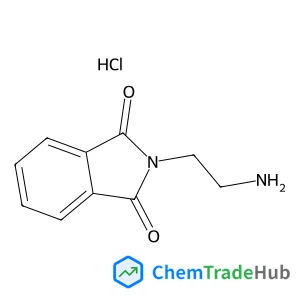
2-(2-Aminoethyl)-1H-isoindole-1,3(2H)-dione hydrochloride (1:1)
CAS Number:
30250-67-0
Molecular Formula:
C10H11ClN2O2



Recommended Suppliers





Disclaimer
This page provides academic journal information for reference and research purposes only. We are not affiliated with any journal publishers and do not handle publication submissions. For publication-related inquiries, please contact the respective journal publishers directly.
If you notice any inaccuracies in the information displayed, please contact us at support@chemtradehub.com. We will promptly review and address your concerns.