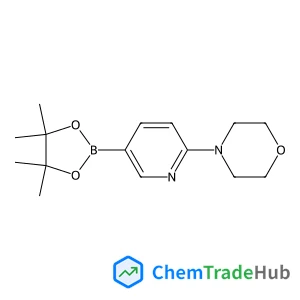
4-(5-(4,4,5,5-tetramethyl-1,3,2-dioxaborolan-2-yl)pyridin-2-yl)morpholine
CAS Number:
485799-04-0
Molecular Formula:
C15H23BN2O3
Hanlin Gan, Liang Peng, Feng Long Gu
Density functional theory calculations are employed to study the mechanism of photoselective catalytic reduction of 4-bromobenzaldehyde (4-BBA) in acetonitrile and in ethanol solvents. A totally relaxed Ti3O9H6 cluster model is proposed to represent titanium dioxide (TiO2) surfaces. The reduction selectivity of an adsorbed 4-BBA molecule on Ti3O9H6 has been investigated. Owing to the difference in the proton and H atom donating capabilities between explicit CH3CN and C2H5OH solvent molecules, the photocatalytic reduction of 4-BBA is the debromination process in acetonitrile, whereas in ethanol it is the carbonyl reduction process. Therefore 4-BBA can be selectively reduced to benzaldehyde in acetonitrile and 4-bromobenzyl alcohol in ethanol, respectively. Our computational results have verified the reaction mechanism proposed by experiments and show that the debromination of 4-BBA would be efficient if both 4-BBA and Ti3O9H6 have an extra photoelectron. The Ti3O9H6 cluster, playing a role as a hydrogen source and a bridge to transfer photoelectrons from bulk TiO2, would have potential to be an ideal molecular model for understanding photocatalytic reactions on the TiO2 surface.
Satish Bolloju, Eleni Fiamegkou, Nickil Shah, Mateusz Jan Zuba, Tien-Lin Lee, Pardeep K. Thakur, Melanie J. Loveridge
DOI: 10.1039/D3LF00093A
Gouri Sankar Das, Manish Srivastava, Kumud Malika Tripathi
DOI: 10.1039/D3SU00328K
Natalia Obrzut, Rob Hickmott, Lily Shure, Kimberly A. Gray
DOI: 10.1039/D3SU00262D
Ganeswar Dalei, Swagat Kumar Das, Susri Sangita Mohapatra
DOI: 10.1039/D3FB00096F
Fumihiko Ogata, Kazuki Sugimura, Noriaki Nagai, Keiji Nishiwaki
DOI: 10.1039/D3SU00342F
Xinyang Sun, Alex Durkin, Miao Guo
DOI: 10.1039/D3SU00251A
Afroza Sultana, Shuji Adachi, Hidefumi Yoshii
DOI: 10.1039/D3FB00099K
Amalia Piscopo, Simone Santacaterina, Elisa Imeneo, Alessandra De Bruno, Marco Poiana
DOI: 10.1039/D3FB00125C
Dhanya R., Abhirami Panoth, N. Venkatachalapathy
DOI: 10.1039/D3FB00146F
Francielle Miranda de Matos, Gabriela Boscariol Rasera, Ruann Janser Soares de Castro
DOI: 10.1039/D3FB00097D
(1R,3S)-1,3-Cyclopentanediol finds applications in various industries. In the ph...
When handling N'-[4-(Dimethylamino)phenyl]-N,N-dimethyl-1,4-benzenediamine, it i...
There are several alternatives to 5-(2,4-Difluorophenyl)-2-methoxypyrimidine in ...
1-(3-Methoxyphenoxy)propan-2-ol (CAS: 382141-68-6) must comply with the Globally...
Tetrodotoxin Citrate is extremely dangerous and should be handled with extreme c...
2-Methyl-2-propanyl [(1R,3S)-3-hydroxycyclopentyl]carbamate (CAS: 225641-84-9) i...
Waste containing 4-(2-Hydroxyhexafluoroisopropyl)Benzoic Acid (CAS: 16261-80-6) ...
2-Methyl-2-proanyl {(2S)-1-[(benzyloxy)amino]-3-hydroxy-3-methyl-1-oxo-2-butanyl...
Benzeneethanamine, α-ethyl-, hydrochloride (1:1) is an organic compound with the...
In the synthesis of compounds similar to 3-{(E)-[4-(Dimethylamino)phenyl]diazeny...

Physical Chemistry Chemical Physics (PCCP) is an international journal co-owned by 19 physical chemistry and physics societies from around the world. This journal publishes original, cutting-edge research in physical chemistry, chemical physics and biophysical chemistry. To be suitable for publication in PCCP, articles must include significant innovation and/or insight into physical chemistry; this is the most important criterion that reviewers and Editors will judge against when evaluating submissions. The journal has a broad scope and welcomes contributions spanning experiment, theory, computation and data science. Topical coverage includes spectroscopy, dynamics, kinetics, statistical mechanics, thermodynamics, electrochemistry, catalysis, surface science, quantum mechanics, quantum computing and machine learning. Interdisciplinary research areas such as polymers and soft matter, materials, nanoscience, energy, surfaces/interfaces, and biophysical chemistry are welcomed if they demonstrate significant innovation and/or insight into physical chemistry. Joined experimental/theoretical studies are particularly appreciated when complementary and based on up-to-date approaches.