


A high performance and low-cost hole transporting layer for efficient and stable perovskite solar cells
Literature Information
Publication Date
2017-07-12
DOI
10.1039/C7CP03551A
Impact Factor
3.676
Authors
Md Arafat Mahmud, Naveen Kumar Elumalai, Mushfika Baishakhi Upama, Dian Wang, Vinicius R. Gonçales, Matthew Wright, Cheng Xu, Faiazul Haque, Ashraf Uddin
View Original
Abstract
Here we report a small molecule oxidant 2,3,5,6-tetrafluoro-7,7,8,8-tetracyano-quinodimethane (F4TCNQ) doped, low cost 2′,7′-bis(bis(4-methoxyphenyl)amino)spiro[cyclopenta[2,1-b:3,4-b′]dithiophene-4,9′-fluorene] (FDT) hole transporting layer (HTL) for efficient mixed organic cation based MA0.6FA0.4PbI3 (MA = methyl ammonium, FA = formamidinium) perovskite solar cells (PSCs), fabricated via a highly reproducible controlled nucleation assisted restricted volume solvent annealing method, having full temperature compatibility with flexible substrates. The optimized (1 wt%) F4TCNQ doped FDT HTL based devices (F-FDT devices) demonstrate simultaneous enhancement of photovoltaic performance and device stability as well as significant reduction in photo-current hysteresis, as compared to conventional bis(trifluoromethylsulfonyl)amine lithium (Li-TFSI) additive based FDT HTL devices (L-FDT devices). Adding to the merits, F-FDT PSCs exhibit about 75% higher device stability compared to conventional L-FDT devices during the course of three weeks. Mott–Schottky analysis and in-depth charge transport characterization were carried out using electrochemical impedance spectroscopy (EIS) of the fabricated devices to understand the superior performance of the F-FDT devices. In addition, detailed polaronic intensity characterization of the doped HTL films was performed via ultraviolet-visible near-infrared (UV-vis-NIR) spectroscopy to investigate the underlying mechanism. Mitigated photocurrent hysteresis in the F-FDT devices has also been examined in terms of the inherent electrode polarization phenomenon. Furthermore, the superior device stability of the F-FDT PSCs has been probed in terms of variation in electronic properties, surface wettability, crystallinity, and microstrain dislocation density, and a detailed picture of the underlying mechanism behind stability enhancement is presented.
Recommended Journals

Journal of the Indian Institute of Science

Atomization and Sprays

Medicinal Chemistry Research

Herald of the Russian Academy of Sciences

Biocatalysis and Biotransformation

Acta Metallurgica Sinica-English Letters

NDT & E International

Cellulose

Critical Reviews in Solid State and Materials Sciences

Polycyclic Aromatic Compounds
Related Literature
Dielectric studies of freezing behavior in porous materials: Water and methanol in activated carbon fibres
K. E. Gubbins, R. Radhakrishnan
2001-03-13
Paper
DOI: 10.1039/B009792F
Kinetic stability of metallofullerenes as predicted by the bond resonance energy model
2001-03-19
Paper
DOI: 10.1039/B100238O
Equilibrium adsorption of linear and branched C6 alkanes on silicalite-1 studied by the tapered element oscillating microbalance
W. Zhu, F. Kapteijn, B. van der Linden, J. A. Moulijn
2001-03-22
Paper
DOI: 10.1039/B100941I
A π-electron donor–acceptor complex C2H4···Br2 characterised by its rotational spectrum
A. C. Legon, J. M. A. Thumwood
2001-03-23
Paper
DOI: 10.1039/B100414J
Tannin polymerization: an overview
Myleidi Vera, Bruno F. Urbano
2021-07-14
Review Article
DOI: 10.1039/D1PY00542A
Photophysics on surfaces: Absorption and luminescence properties of Pheophorbide-a on cellulose
M. Gabriela Lagorio, Enrique San Román, André Zeug, Jörg Zimmermann, Beate Röder
2001-03-19
Paper
DOI: 10.1039/B100077M
Network formation in polyethyleneglycol solutions. An intradiffusion study
Paper
DOI: 10.1039/A905035C
Facile synthesis of GalNAc monomers and block polycations for hepatocyte gene delivery
Matthew R. Bockman, Rishad J. Dalal, Ramya Kumar, Theresa M. Reineke
2021-06-29
Paper
DOI: 10.1039/D1PY00250C
You might also like
Compound Q&A
What are the main uses of (3.beta.)-3-Hydroxy-N,N-dimethyl-chol-5-en-24-amide (CAS: 79066-03-8)?
(3.beta.)-3-Hydroxy-N,N-dimethyl-chol-5-en-24-amide (CAS: 79066-03-8) is primari...
79066-03-8(3.beta.)-3-Hydroxy-...
Compound Q&A
What regulatory guidelines apply to 5-(aminomethyl)-2-methoxyphenol (CAS: 89702-89-6)?
5-(Aminomethyl)-2-methoxyphenol (CAS: 89702-89-6) is classified under GHS as a s...
89702-89-65-(aminomethyl)-2-me...
Compound Q&A
What is Thieno[2,3-c]pyridin-7(6H)-one (CAS: 28981-13-7)?
Thieno[2,3-c]pyridin-7(6H)-one (CAS: 28981-13-7) is a heterocyclic organic compo...
28981-13-7Thieno[2,3-c]pyridin...
Compound Q&A
Is 1-[(6-Methoxy-3-pyridinyl)methyl]-4-piperidinamine dihydrochloride (CAS: 1185311-28-7) safe?
1-[(6-Methoxy-3-pyridinyl)methyl]-4-piperidinamine dihydrochloride is generally ...
1185311-28-71-[(6-Methoxy-3-pyri...
Compound Q&A
What regulatory guidelines apply to [(2E)-3-Phenyl-2-propen-1-yl]phosphonic acid (CAS: 146404-58-2)?
[(2E)-3-Phenyl-2-propen-1-yl]phosphonic acid (CAS: 146404-58-2) is regulated und...
146404-58-2[(2E)-3-Phenyl-2-pro...
Compound Q&A
What regulatory guidelines apply to 6-Bromo-7-methoxyquinoline (CAS: 1620515-86-7)?
6-Bromo-7-methoxyquinoline (CAS: 1620515-86-7) falls under the scope of the Glob...
1620515-86-76-Bromo-7-methoxyqui...
Compound Q&A
What industries use (2R)-1-(1-Benzofuran-2-yl)-N-propyl-2-pentanamine (CAS: 260550-89-8)?
This compound is primarily used in the pharmaceutical industry for the developme...
260550-89-8(2R)-1-(1-Benzofuran...
Compound Q&A
What are the main uses of 1-Ethyl-7-[2-methyl-6-(4H-1,2,4-triazol-3-yl)-3-pyridinyl]-3,5-dihydropyrazino[2,3-b]pyrazin-2(1H)-one (CAS: 1228013-15-7)?
1-Ethyl-7-[2-methyl-6-(4H-1,2,4-triazol-3-yl)-3-pyridinyl]-3,5-dihydropyrazino[2...
1228013-15-71-Ethyl-7-[2-methyl-...
Compound Q&A
Are there alternatives to {5-(Acryloylamino)-2-[(dimethylamino)methyl]phenyl}boronic acid (CAS: 1217500-78-1) in synthesis?
Alternative reagents such as 2-[(dimethylamino)methyl]phenylboronic acid or rela...
1217500-78-1{5-(Acryloylamino)-2...
Compound Q&A
What is 3-(Piperidin-4-yloxy)pyridine (CAS: 310881-48-2)?
3-(Piperidin-4-yloxy)pyridine (CAS: 310881-48-2) is an organic compound with the...
310881-48-23-(Piperidin-4-yloxy...
Source Journal
Physical Chemistry Chemical Physics

CiteScore:
5.5
Self-citation Rate:
10.3%
Articles per Year:
3036
Physical Chemistry Chemical Physics (PCCP) is an international journal co-owned by 19 physical chemistry and physics societies from around the world. This journal publishes original, cutting-edge research in physical chemistry, chemical physics and biophysical chemistry. To be suitable for publication in PCCP, articles must include significant innovation and/or insight into physical chemistry; this is the most important criterion that reviewers and Editors will judge against when evaluating submissions. The journal has a broad scope and welcomes contributions spanning experiment, theory, computation and data science. Topical coverage includes spectroscopy, dynamics, kinetics, statistical mechanics, thermodynamics, electrochemistry, catalysis, surface science, quantum mechanics, quantum computing and machine learning. Interdisciplinary research areas such as polymers and soft matter, materials, nanoscience, energy, surfaces/interfaces, and biophysical chemistry are welcomed if they demonstrate significant innovation and/or insight into physical chemistry. Joined experimental/theoretical studies are particularly appreciated when complementary and based on up-to-date approaches.
Recommended Compounds
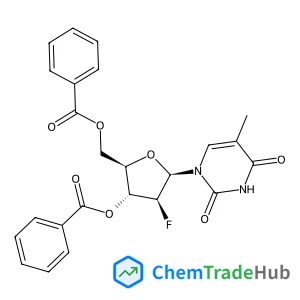
1-(3',5'-Di-O-benzoyl-2'-deoxy-2'-fluoro-b-D-arabinofuranosyl)thymine
CAS Number:
97614-47-6
Molecular Formula:
C24H21FN2O7
Recommended Suppliers






Disclaimer
This page provides academic journal information for reference and research purposes only. We are not affiliated with any journal publishers and do not handle publication submissions. For publication-related inquiries, please contact the respective journal publishers directly.
If you notice any inaccuracies in the information displayed, please contact us at support@chemtradehub.com. We will promptly review and address your concerns.