












Effects of atomic vacancies and temperature on the tensile properties of single-walled MoS2 nanotubes
Literature Information
Publication Date
2017-07-03
DOI
10.1039/C7CP02667F
Impact Factor
3.676
Authors
Jin Zhang
View Original
Abstract
Using molecular dynamics simulations, we study the effects of Mo and S atomic vacancies and different temperatures on the tensile properties of single-walled MoS2 nanotubes through a series of tensile tests. Both armchair and zigzag MoS2 nanotubes under uniaxial tensions show phase transitions. Two types of Mo–S bonds play different roles in this phase transition of MoS2 nanotubes. Moreover, the influences of Mo and S atomic vacancies and temperature on the Young’s modulus, ultimate strength and fracture strain of single-walled MoS2 nanotubes are investigated systematically. The results show that Mo and S atomic vacancies have no influence on the Young's modulus of MoS2 nanotubes. However, Mo atomic vacancies result in a significant decrease of ultimate strength and fracture strain of MoS2 nanotubes, while S atomic vacancies have a relatively small influence on the fracture properties of MoS2 nanotubes. With an increase in temperature, the Young's modulus and ultimate strength decrease. When the temperature is higher than 300 K, the fracture is changed from brittle to ductile together with an enhanced fracture strain.
Recommended Journals
Related Literature
Dynamics of the OH( = 1,2,4) + O3 atmospheric reaction
L. Zhang, A. J. C. Varandas
2001-03-20
Paper
DOI: 10.1039/B010149O
Redox behaviour of SnO2 nanoparticles encapsulated in the pores of zeolites towards reductive gas atmospheres studied by in situ diffuse reflectance UV/Vis and Mössbauer spectroscopy
Meike Warnken, Karoly Lázár, Michael Wark
2001-04-10
Paper
DOI: 10.1039/B009045J
Disappearance of oscillations in the Brusselator on the mesoscopic scale
2001-03-14
Paper
DOI: 10.1039/B100192M
Discrimination of functional groups with scanning tunneling microscopy using chemically modified tips: Recognition of ether oxygens through hydrogen bond interactions
Tomoaki Nishino, Philippe Bühlmann, Takashi Ito, Yoshio Umezawa
2001-04-12
Paper
DOI: 10.1039/B100685L
Synthesis of ethylene–norbornene–1-octene terpolymers with high 1-octene contents, molar masses, and tunable Tg values, in high yields using half-titanocene catalysts
Laura Boggioni, Hitoshi Harakawa, Simona Losio, Kotohiro Nomura, Incoronata Tritto
2021-07-02
Paper
DOI: 10.1039/D1PY00647A
Synthesis and self-aggregated nanostructures of hydrogen-bonding polydimethylsiloxane
Senbin Chen, Yanggui Wu, Huiying Wang, Bengao Zhu, Bijing Xiong, Wolfgang H. Binder, Jintao Zhu
2021-06-25
Paper
DOI: 10.1039/D1PY00513H
Molecular oxygen interaction with Bi2O3 : a spectroscopic and spectromagnetic investigation
Davide Barreca, Franca Morazzoni, Gian Andrea Rizzi, Roberto Scotti, Eugenio Tondello
2001-03-29
Paper
DOI: 10.1039/B009482J
You might also like
Compound Q&A
What are the main uses of (3.beta.)-3-Hydroxy-N,N-dimethyl-chol-5-en-24-amide (CAS: 79066-03-8)?
(3.beta.)-3-Hydroxy-N,N-dimethyl-chol-5-en-24-amide (CAS: 79066-03-8) is primari...
79066-03-8(3.beta.)-3-Hydroxy-...
Compound Q&A
What regulatory guidelines apply to 5-(aminomethyl)-2-methoxyphenol (CAS: 89702-89-6)?
5-(Aminomethyl)-2-methoxyphenol (CAS: 89702-89-6) is classified under GHS as a s...
89702-89-65-(aminomethyl)-2-me...
Compound Q&A
What is Thieno[2,3-c]pyridin-7(6H)-one (CAS: 28981-13-7)?
Thieno[2,3-c]pyridin-7(6H)-one (CAS: 28981-13-7) is a heterocyclic organic compo...
28981-13-7Thieno[2,3-c]pyridin...
Compound Q&A
Is 1-[(6-Methoxy-3-pyridinyl)methyl]-4-piperidinamine dihydrochloride (CAS: 1185311-28-7) safe?
1-[(6-Methoxy-3-pyridinyl)methyl]-4-piperidinamine dihydrochloride is generally ...
1185311-28-71-[(6-Methoxy-3-pyri...
Compound Q&A
What regulatory guidelines apply to [(2E)-3-Phenyl-2-propen-1-yl]phosphonic acid (CAS: 146404-58-2)?
[(2E)-3-Phenyl-2-propen-1-yl]phosphonic acid (CAS: 146404-58-2) is regulated und...
146404-58-2[(2E)-3-Phenyl-2-pro...
Compound Q&A
What regulatory guidelines apply to 6-Bromo-7-methoxyquinoline (CAS: 1620515-86-7)?
6-Bromo-7-methoxyquinoline (CAS: 1620515-86-7) falls under the scope of the Glob...
1620515-86-76-Bromo-7-methoxyqui...
Compound Q&A
What industries use (2R)-1-(1-Benzofuran-2-yl)-N-propyl-2-pentanamine (CAS: 260550-89-8)?
This compound is primarily used in the pharmaceutical industry for the developme...
260550-89-8(2R)-1-(1-Benzofuran...
Compound Q&A
What are the main uses of 1-Ethyl-7-[2-methyl-6-(4H-1,2,4-triazol-3-yl)-3-pyridinyl]-3,5-dihydropyrazino[2,3-b]pyrazin-2(1H)-one (CAS: 1228013-15-7)?
1-Ethyl-7-[2-methyl-6-(4H-1,2,4-triazol-3-yl)-3-pyridinyl]-3,5-dihydropyrazino[2...
1228013-15-71-Ethyl-7-[2-methyl-...
Compound Q&A
Are there alternatives to {5-(Acryloylamino)-2-[(dimethylamino)methyl]phenyl}boronic acid (CAS: 1217500-78-1) in synthesis?
Alternative reagents such as 2-[(dimethylamino)methyl]phenylboronic acid or rela...
1217500-78-1{5-(Acryloylamino)-2...
Compound Q&A
What is 3-(Piperidin-4-yloxy)pyridine (CAS: 310881-48-2)?
3-(Piperidin-4-yloxy)pyridine (CAS: 310881-48-2) is an organic compound with the...
310881-48-23-(Piperidin-4-yloxy...
Source Journal
Physical Chemistry Chemical Physics

CiteScore:
5.5
Self-citation Rate:
10.3%
Articles per Year:
3036
Physical Chemistry Chemical Physics (PCCP) is an international journal co-owned by 19 physical chemistry and physics societies from around the world. This journal publishes original, cutting-edge research in physical chemistry, chemical physics and biophysical chemistry. To be suitable for publication in PCCP, articles must include significant innovation and/or insight into physical chemistry; this is the most important criterion that reviewers and Editors will judge against when evaluating submissions. The journal has a broad scope and welcomes contributions spanning experiment, theory, computation and data science. Topical coverage includes spectroscopy, dynamics, kinetics, statistical mechanics, thermodynamics, electrochemistry, catalysis, surface science, quantum mechanics, quantum computing and machine learning. Interdisciplinary research areas such as polymers and soft matter, materials, nanoscience, energy, surfaces/interfaces, and biophysical chemistry are welcomed if they demonstrate significant innovation and/or insight into physical chemistry. Joined experimental/theoretical studies are particularly appreciated when complementary and based on up-to-date approaches.
Recommended Compounds
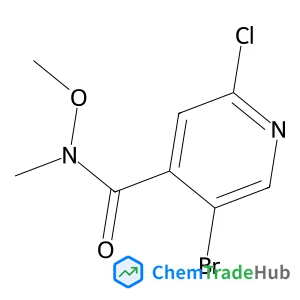
5-Bromo-2-chloro-N-methoxy-N-methylisonicotinamide
CAS Number:
1256790-08-5
Molecular Formula:
C8H8BrClN2O2
![5,7-Dihydroxy-3-(4-hydroxyphenyl)-6-[(1R,6R)-3-methyl-6-prop-1-en-2-ylcyclohex-2-en-1-yl]chromen-4-one structure](https://static.chemtradehub.com/structs/191/1914963-20-4-2b05.webp "5,7-Dihydroxy-3-(4-hydroxyphenyl)-6-[(1R,6R)-3-methyl-6-prop-1-en-2-ylcyclohex-2-en-1-yl]chromen-4-one structure")
5,7-Dihydroxy-3-(4-hydroxyphenyl)-6-[(1R,6R)-3-methyl-6-prop-1-en-2-ylcyclohex-2-en-1-yl]chromen-4-one
CAS Number:
1914963-20-4
Molecular Formula:
C25H24O5
Recommended Suppliers





Disclaimer
This page provides academic journal information for reference and research purposes only. We are not affiliated with any journal publishers and do not handle publication submissions. For publication-related inquiries, please contact the respective journal publishers directly.
If you notice any inaccuracies in the information displayed, please contact us at support@chemtradehub.com. We will promptly review and address your concerns.