


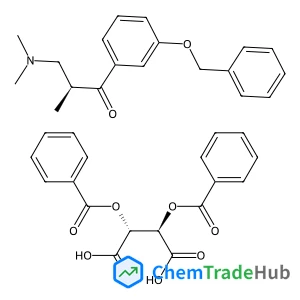
(S)-1-(3-(Benzyloxy)phenyl)-3-(dimethylamino)-2-methylpropan-1-one (2r,3r)-2,3-bis(benzoyloxy)succinate
CAS Number:
1004315-81-4
Molecular Formula:
C37H37NO10
Fabio Landuzzi, Pier Luca Palla, Fabrizio Cleri
Damage to the DNA backbone occurs from natural sources, and with exceedingly large density during radiotherapy, as typically used for cancer treatment. Here, we focus on the molecular-scale dynamics of the events immediately following the production of single- and double-strand breaks, since this early-stage evolution of the damage is crucial to determine the subsequent fate of the DNA fragment. While multiple cleavage of phosphodiester bonds is the first step, however the remaining hydrogen-bond and π-stacking interactions maintain a considerable DNA cohesion, and determine further defect evolution. We use all-atom molecular dynamics to simulate the force spectra and thermal stability of different single- and multiple-defect configurations, in a random 31 bp DNA sequence. Simulations reveal a complex dynamical behaviour of the defects, where collective bond-rearrangement phenomena dominate with respect to simple bond cleavage. Defects are stable against thermal disruption, unless very closely spaced. We establish the necessary conditions for the events ultimately leading to DNA fragmentation. Such findings impact the early stages of damage recognition and signalling by specialised proteins, also implying that the identification and counting of DSBs by different experimental methods is non-unique.

Russian Journal of General Chemistry

Current Opinion in Solid State & Materials Science

Acta Materialia

Drug Discovery Today

Russian Chemical Bulletin

Organic Process Research & Development

Journal of Peptide Science

Chemistry Education Research and Practice

Chemical Communications

Russian Journal of Coordination Chemistry
Asis K. Jana, Jaya C. Jose, Neelanjana Sengupta
DOI: 10.1039/C2CP42933K
Stanislav Pařez, Milan Předota
DOI: 10.1039/C2CP22136E
B. M. Weckhuysen, A. Zecchina
DOI: 10.1039/C2CP90005J
Laura Prati, Alberto Villa, Andrew R. Lupini, Gabriel M. Veith
DOI: 10.1039/C2CP23405J
Ilja Ignatjev, Edyta Proniewicz, Leonard M. Proniewicz, Gediminas Niaura
DOI: 10.1039/C2CP42077E
J. C. Pérez-Flores, C. Baehtz, M. Hoelzel, A. Kuhn, F. García-Alvarado
DOI: 10.1039/C2CP23741E
Norihiro Suzuki, Shosuke Kiba, Yuichiro Kamachi, Nobuyoshi Miyamoto
DOI: 10.1039/C2CP23864K
J. Aldegunde, F. J. Aoiz, L. González-Sánchez, M. P. de Miranda, V. Sáez-Rábanos
DOI: 10.1039/C2CP23252A
Daniel A. Clayton, Tyler E. McPherson, Shanlin Pan, Mingyang Chen, David A. Dixon, Dehong Hu
DOI: 10.1039/C2CP43424E
2-Methylbenzene-1,4-diamine dihydrochloride (CAS: 615-45-2) should be stored in ...
(1S,4S)-2,5-Diazabicyclo[2.2.1]heptane dihydrobromide is generally considered sa...
(6-Chloropyridazin-3-YL)methanamine finds applications in the pharmaceutical ind...
2-Fluoro-3-methylphenol is primarily used in the synthesis of pharmaceuticals, p...
When handling 3-Methoxy-4-nitrobenzonitrile, it is important to wear appropriate...
When handling 1,3-Oxazolo[4,5-b]pyridine-2(3H)-thione (CAS: 211949-57-4), it is ...
4-Ethynylbenzamide (CAS: 90347-86-7) falls under various regulatory guidelines i...
3-(2-Ethylphenyl)-2-thioxo-4-imidazolidinone is primarily used as an intermediat...
(2-Fluoro-6-methoxyphenyl)acetic acid, also known as 4-fluoro-3-methoxybenzoic a...
Market trends for 2-[4-(Hydroxymethyl)phenoxy]ethanol (CAS: 102196-18-9) indicat...

Physical Chemistry Chemical Physics (PCCP) is an international journal co-owned by 19 physical chemistry and physics societies from around the world. This journal publishes original, cutting-edge research in physical chemistry, chemical physics and biophysical chemistry. To be suitable for publication in PCCP, articles must include significant innovation and/or insight into physical chemistry; this is the most important criterion that reviewers and Editors will judge against when evaluating submissions. The journal has a broad scope and welcomes contributions spanning experiment, theory, computation and data science. Topical coverage includes spectroscopy, dynamics, kinetics, statistical mechanics, thermodynamics, electrochemistry, catalysis, surface science, quantum mechanics, quantum computing and machine learning. Interdisciplinary research areas such as polymers and soft matter, materials, nanoscience, energy, surfaces/interfaces, and biophysical chemistry are welcomed if they demonstrate significant innovation and/or insight into physical chemistry. Joined experimental/theoretical studies are particularly appreciated when complementary and based on up-to-date approaches.
![(1R,6R)-6-({[(2-Methyl-2-propanyl)oxy]carbonyl}amino)-3-cyclohexene-1-carboxylic acid structure](https://static.chemtradehub.com/structs/865/865689-24-3-5fef.webp "(1R,6R)-6-({[(2-Methyl-2-propanyl)oxy]carbonyl}amino)-3-cyclohexene-1-carboxylic acid structure")






