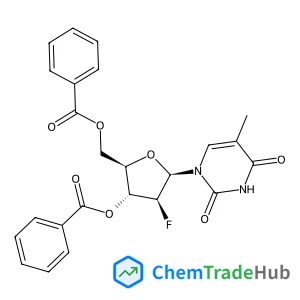
1-(3',5'-Di-O-benzoyl-2'-deoxy-2'-fluoro-b-D-arabinofuranosyl)thymine
CAS Number:
97614-47-6
Molecular Formula:
C24H21FN2O7
Methods using a swarm of Gaussian basis functions to represent the nuclear wavefunction are a very appealing way to solve the time-dependent Schrödinger equation (TDSE) as they avoid the conventional scaling bottleneck of grid-based methods and provide a grid-free trajectory representation of the dynamics understudy. When coupled with direct (on-the-fly) dynamics, these methods offer the ability to simulate quantum dynamics of larger systems in full nuclear configuration space and avoid the requirement of a priori fitting of a potential energy surface. During such simulations, it is often assumed that the limiting factor is the computational cost of the quantum chemistry calculations. To combat this, in the present paper the direct dynamics variational multi-configurational Gaussian (DD-vMCG) method is combined with electronic structure calculations accelerated by Graphical Processing Units (GPUs). For the systems studied, a protonated ammonia dimer and the imidazole dimer, it is shown that the cost of the term responsible for the quantum behaviour of the nuclear dynamics means that the computational time associated with the quantum chemistry quickly becomes a small part of the overall computational time. Using these simulations, an estimated scaling of the vMCG method, with respect to the number of Gaussian basis functions is reported. This can be used to identify when quantum chemistry is the limiting factor and when GPU acceleration will have a significant effect for both ground and excited state simulations.

Bioorganic & Medicinal Chemistry Letters

Biocatalysis and Biotransformation

Journal of Chemical Sciences

Atomization and Sprays

Main Group Chemistry

Critical Reviews in Solid State and Materials Sciences

Acta Metallurgica Sinica-English Letters

Colloid Journal

Bioorganic & Medicinal Chemistry

Polycyclic Aromatic Compounds
Thomas Bräuniger, Raphy Poupko, Zeev Luz, Detlef Reichert, Herbert Zimmermann, Heike Schmitt, Ulrich Haeberlen
DOI: 10.1039/B008999K
DOI: 10.1039/B010029N
DOI: 10.1039/B100238O
Narcís Homs, Jordi Llorca, Pilar Ramírez de la Piscina, Francisco Rodríguez-Reinoso, Antonio Sepúlveda-Escribano, Joaquín Silvestre-Albero
DOI: 10.1039/B100770J
Zoltán Paál, Tamás Koltai, (the late) Károly Matusek, Jean-Marie Manoli, Claude Potvin, Martin Muhler, Ute Wild, Pál Tétényi
DOI: 10.1039/B009047F
Jaroslaw Sadlo, Marek Danilczuk, Jacek Michalik
DOI: 10.1039/B008246P
Mauricia Schettino, Rosana M. Romano, Alexander Yu. Makarov, Andrey V. Zibarev
DOI: 10.1039/B009433L
DOI: 10.1039/A906191F
(3.beta.)-3-Hydroxy-N,N-dimethyl-chol-5-en-24-amide (CAS: 79066-03-8) is primari...
5-(Aminomethyl)-2-methoxyphenol (CAS: 89702-89-6) is classified under GHS as a s...
Thieno[2,3-c]pyridin-7(6H)-one (CAS: 28981-13-7) is a heterocyclic organic compo...
1-[(6-Methoxy-3-pyridinyl)methyl]-4-piperidinamine dihydrochloride is generally ...
[(2E)-3-Phenyl-2-propen-1-yl]phosphonic acid (CAS: 146404-58-2) is regulated und...
6-Bromo-7-methoxyquinoline (CAS: 1620515-86-7) falls under the scope of the Glob...
This compound is primarily used in the pharmaceutical industry for the developme...
1-Ethyl-7-[2-methyl-6-(4H-1,2,4-triazol-3-yl)-3-pyridinyl]-3,5-dihydropyrazino[2...
Alternative reagents such as 2-[(dimethylamino)methyl]phenylboronic acid or rela...
3-(Piperidin-4-yloxy)pyridine (CAS: 310881-48-2) is an organic compound with the...

Physical Chemistry Chemical Physics (PCCP) is an international journal co-owned by 19 physical chemistry and physics societies from around the world. This journal publishes original, cutting-edge research in physical chemistry, chemical physics and biophysical chemistry. To be suitable for publication in PCCP, articles must include significant innovation and/or insight into physical chemistry; this is the most important criterion that reviewers and Editors will judge against when evaluating submissions. The journal has a broad scope and welcomes contributions spanning experiment, theory, computation and data science. Topical coverage includes spectroscopy, dynamics, kinetics, statistical mechanics, thermodynamics, electrochemistry, catalysis, surface science, quantum mechanics, quantum computing and machine learning. Interdisciplinary research areas such as polymers and soft matter, materials, nanoscience, energy, surfaces/interfaces, and biophysical chemistry are welcomed if they demonstrate significant innovation and/or insight into physical chemistry. Joined experimental/theoretical studies are particularly appreciated when complementary and based on up-to-date approaches.