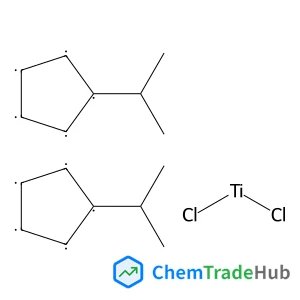
BIS(I-PROPYLCYCLOPENTADIENYL)TITANIUM DICHLORIDE
CAS Number:
12130-65-3
Molecular Formula:
C16H22Cl2Ti
Mark A. Blitz, Michael J. Pilling, Struan H. Robertson
Unimolecular reactions play an important role in combustion kinetics. An important task of reaction kinetic analysis is to obtain the phenomenological rate coefficients for unimolecular reactions based on the master equation approach. In most cases, the eigenvalues of the transition matrix describing collisional internal energy relaxation are of much larger magnitude than and well separated from the chemically significant eigenvalues, so that phenomenological rate coefficients may be unequivocally derived for incorporation in combustion mechanisms. However, when dealing with unimolecular reactions for a large molecule, especially at high temperatures, the large densities of states of the reactant cause the majority of the population distribution to lie at very high energy levels where the microcanonical reaction rate constants are large and the relaxation and chemical eigenvalues overlap, so that well-defined phenomenological rate coefficients cannot be determined. This work attempts to analyze the effect of overlapping eigenvalues on the high-temperature kinetics of a large oxyradical, based on microcanonical reaction rates and population distributions as well as the eigenvalue spectrum of the transition matrix from the master equation. The aim is to provide a pragmatic method for obtaining the most effective rate coefficients for competing elimination, dissociation, and bimolecular reactions for incorporation in combustion mechanisms. Our approach is demonstrated with a representative example, thermal decomposition and H addition reactions of the corannulene oxyradical.

Journal of Saudi Chemical Society

Drug Discovery Today

Crystallography Reports

Russian Journal of Coordination Chemistry

Chemical Communications

Russian Journal of Applied Chemistry

Russian Journal of Bioorganic Chemistry

Russian Journal of General Chemistry

Journal of Peptide Science

Russian Journal of Organic Chemistry
Benjamin N. Moore, Ryan R. Julian
DOI: 10.1039/C2CP23443B
Maxim V. Fedorov, R. M. Lynden-Bell
DOI: 10.1039/C2CP22730D
Piyush P. Wanjari, Ashish V. Sangwai, Henry S. Ashbaugh
DOI: 10.1039/C2CP22940D
Gil Cohn, Rüdiger A. Eichel, Yair Ein-Eli
DOI: 10.1039/C2CP43870D
Lesley R. Rutledge, Stacey D. Wetmore
DOI: 10.1039/C2CP23600A
Paul C. Jennings, Bruno G. Pollet, Roy L. Johnston
DOI: 10.1039/C2CP23430K
Sachin Chavan, Jenny G. Vitillo, Diego Gianolio, Olena Zavorotynska, Bartolomeo Civalleri, Søren Jakobsen, Merete H. Nilsen, Loredana Valenzano, Carlo Lamberti, Karl Petter Lillerud, Silvia Bordiga
DOI: 10.1039/C1CP23434J
Cinzia Chiappe, Christian Silvio Pomelli
DOI: 10.1039/C2CP43074F
Christiane Hackel, Tatyana Zinkevich, Peter Belton, Anja Achilles, Detlef Reichert
DOI: 10.1039/C2CP23098D
Karan Bobuatong, Sangita Karanjit, Hidehiro Sakurai
DOI: 10.1039/C2CP23446G
2-Methylbenzene-1,4-diamine dihydrochloride (CAS: 615-45-2) should be stored in ...
(1S,4S)-2,5-Diazabicyclo[2.2.1]heptane dihydrobromide is generally considered sa...
(6-Chloropyridazin-3-YL)methanamine finds applications in the pharmaceutical ind...
2-Fluoro-3-methylphenol is primarily used in the synthesis of pharmaceuticals, p...
When handling 3-Methoxy-4-nitrobenzonitrile, it is important to wear appropriate...
When handling 1,3-Oxazolo[4,5-b]pyridine-2(3H)-thione (CAS: 211949-57-4), it is ...
4-Ethynylbenzamide (CAS: 90347-86-7) falls under various regulatory guidelines i...
3-(2-Ethylphenyl)-2-thioxo-4-imidazolidinone is primarily used as an intermediat...
(2-Fluoro-6-methoxyphenyl)acetic acid, also known as 4-fluoro-3-methoxybenzoic a...
Market trends for 2-[4-(Hydroxymethyl)phenoxy]ethanol (CAS: 102196-18-9) indicat...

Physical Chemistry Chemical Physics (PCCP) is an international journal co-owned by 19 physical chemistry and physics societies from around the world. This journal publishes original, cutting-edge research in physical chemistry, chemical physics and biophysical chemistry. To be suitable for publication in PCCP, articles must include significant innovation and/or insight into physical chemistry; this is the most important criterion that reviewers and Editors will judge against when evaluating submissions. The journal has a broad scope and welcomes contributions spanning experiment, theory, computation and data science. Topical coverage includes spectroscopy, dynamics, kinetics, statistical mechanics, thermodynamics, electrochemistry, catalysis, surface science, quantum mechanics, quantum computing and machine learning. Interdisciplinary research areas such as polymers and soft matter, materials, nanoscience, energy, surfaces/interfaces, and biophysical chemistry are welcomed if they demonstrate significant innovation and/or insight into physical chemistry. Joined experimental/theoretical studies are particularly appreciated when complementary and based on up-to-date approaches.