












Blocked isocyanates: from analytical and experimental considerations to non-polyurethane applications
Literature Information
Publication Date
2016-11-08
DOI
10.1039/C6PY01776B
Impact Factor
5.582
Authors
Marianne S. Rolph, Anna L. J. Markowska, Colin N. Warriner, Rachel K. O'Reilly
View Original
Abstract
In this review we aim to provide an introductory guide to blocked isocyanates, through discussion on different examples of blocking groups, along with experimental considerations for their application. The review brings together updated examples of functionalities used and places specific emphasis on the analytical techniques used for the determination of deblocking temperature, updating previous reviews with the newly applied technique of X-ray photoelectron spectroscopy (XPS). Additionally, we put forward a brief update on the use of blocked isocyanates for other non-traditional polyurethane based polymer applications. We also highlight the importance of matching the analytical technique to the application of the blocked isocyanate, with differences in material state and experimental parameters having a great impact on the deblocking temperature reported.
Related Literature
A ratiometric fluorescence nanosensor for highly selective and sensitive detection of selenite
Linfeng Chen, Xike Tian, Yuan Zhao, Yong Li, Chao Yang, Zhaoxin Zhou
2016-05-19
Paper
DOI: 10.1039/C6AN00740F
A FT-NIR spectroscopy methodology to estimate firing distance based on the direct analysis of the bullet impact surface
Jorge M. G. Sarraguça, Catarina Lima, Filipe Machado, João A. Lopes, Agostinho Almeida, Luís Fernandes
2016-05-11
Paper
DOI: 10.1039/C6AN00247A
Spectroelectrochemical and computational studies of tetrahydrocannabinol (THC) and carboxy-tetrahydrocannabinol (THC-COOH)
Shruti D. Bindesri, Ricardo Jebailey, Najwan Albarghouthi, Cory C. Pye, Christa L. Brosseau
2020-01-10
Paper
DOI: 10.1039/C9AN02173F
Detection of UVA/UVC-induced damage of p53 fragment by rolling circle amplification with AIEgens
Xiaowen Ou, Benmei Wei, Zhenyu Zhang, Mengshi Zhang, Yuan Zhuang, Pengcheng Gao, Xiaoding Lou, Fan Xia, Ben Zhong Tang
2016-05-09
Paper
DOI: 10.1039/C6AN00831C
A miniaturized electrochemical device integrating a biconical microchannel and carbon fiber disk ultramicroelectrode
Fengxia Chang, Xia Xie, Meixian Li, Zhiwei Zhu
2016-07-05
Communication
DOI: 10.1039/C6AN01205A
Current developments in LC-MS for pharmaceutical analysis
Marco Beccaria, Deirdre Cabooter
2020-01-16
Critical Review
DOI: 10.1039/C9AN02145K
Endonuclease IV cleaves apurinic/apyrimidinic sites in single-stranded DNA and its application for biosensing
Xiang-Juan Kong, Shuang Wu, Yao Cen, Ting-Ting Chen, Ru-Qin Yu, Xia Chu
2016-05-04
Paper
DOI: 10.1039/C6AN00738D
Investigating CC positions and hydroxylation sites in lipids using Paternò–Büchi functionalization mass spectrometry
Patrick Esch, Sven Heiles
2020-01-23
Paper
DOI: 10.1039/C9AN02260K
Measurement of serum phosphate levels using a mobile sensor
Sarah Esparza, Dimei Wu, Mark R. Hanudel, Barbara Gales, Isidro B. Salusky
2020-01-10
Paper
DOI: 10.1039/C9AN02215E
You might also like
Compound Q&A
What precautions should be taken when handling lithium chloride hydrate (1:1:1) (CAS: 16712-20-2)?
When handling lithium chloride hydrate (1:1:1) (CAS: 16712-20-2), it is importan...
16712-20-2Lithium chloride hyd...
Compound Q&A
Is 4-(4H-1,2,4-Triazol-4-yl)piperidine (CAS: 690261-92-8) safe?
4-(4H-1,2,4-Triazol-4-yl)piperidine is generally considered safe for use in phar...
690261-92-84-(4H-1,2,4-Triazol-...
Compound Q&A
How should waste containing 1,3-Thiazole-2-carboxamide (CAS: 16733-85-0) be handled?
Waste containing 1,3-Thiazole-2-carboxamide (CAS: 16733-85-0) should be collecte...
16733-85-01,3-Thiazole-2-carbo...
Compound Q&A
What regulatory guidelines apply to 5-(Difluoromethyl)-2-fluorobenzonitrile (CAS: 934175-58-3)?
5-(Difluoromethyl)-2-fluorobenzonitrile (CAS: 934175-58-3) is subject to regulat...
934175-58-35-(Difluoromethyl)-2...
Compound Q&A
How is Methyl 3-acetamido-2-thiophenecarboxylate (CAS: 22288-79-5) typically synthesized?
Methyl 3-acetamido-2-thiophenecarboxylate can be synthesized by the reaction of ...
22288-79-5Methyl 3-acetamido-2...
Compound Q&A
What is 4-Isoquinolinecarbonitrile (CAS: 34846-65-6)?
4-Isoquinolinecarbonitrile is a chemical compound with the CAS number 34846-65-6...
34846-65-64-Isoquinolinecarbon...
Compound Q&A
How should Methyl 1H-1,2,3-triazole-4-carboxylate (CAS: 877309-59-6) be stored?
Store Methyl 1H-1,2,3-triazole-4-carboxylate (CAS: 877309-59-6) in a cool, dry p...
877309-59-6Methyl 1H-1,2,3-tria...
Compound Q&A
What regulatory guidelines apply to 6-Bromo[1,3]thiazolo[5,4-b]pyridin-2-amine (CAS: 1160791-13-8)?
6-Bromo[1,3]thiazolo[5,4-b]pyridin-2-amine (CAS: 1160791-13-8) is subject to the...
1160791-13-86-Bromo[1,3]thiazolo...
Compound Q&A
Is (2S,3S)-2-Ammonio-3-(3,4-dihydroxyphenyl)-3-hydroxypropanoate (CAS: 23651-95-8) safe?
(2S,3S)-2-Ammonio-3-(3,4-dihydroxyphenyl)-3-hydroxypropanoate (CAS: 23651-95-8) ...
23651-95-8(2S,3S)-2-Ammonio-3-...
Compound Q&A
What are the physical and chemical properties of 7-bromo-3-methyl-3,4-dihydroquinazolin-4-one (CAS: 1293987-84-4)?
7-Bromo-3-methyl-3,4-dihydroquinazolin-4-one is a solid with a crystalline form....
1293987-84-47-bromo-3-methyl-3,4...
Source Journal
Polymer Chemistry

CiteScore:
8.6
Self-citation Rate:
7.3%
Articles per Year:
457
Polymer Chemistry welcomes submissions in all areas of polymer science that have a strong focus on macromolecular chemistry. Manuscripts may cover a broad range of fields, yet no direct application focus is required.
Recommended Compounds
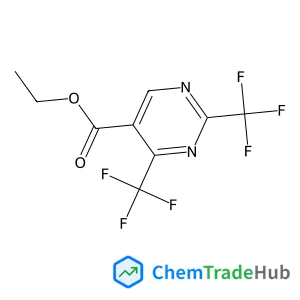
Ethyl 2,4-bis(trifluoromethyl)-5-pyrimidinecarboxylate
CAS Number:
188781-15-9
Molecular Formula:
C9H6F6N2O2
![5,10-Dihydroindeno[2,1-a]indene structure](https://static.chemtradehub.com/structs/654/6543-29-9-71ca.webp "5,10-Dihydroindeno[2,1-a]indene structure")
Recommended Suppliers



Disclaimer
This page provides academic journal information for reference and research purposes only. We are not affiliated with any journal publishers and do not handle publication submissions. For publication-related inquiries, please contact the respective journal publishers directly.
If you notice any inaccuracies in the information displayed, please contact us at support@chemtradehub.com. We will promptly review and address your concerns.