












Synthesis of degradable poly(ε-caprolactone)-based graft copolymers via a “grafting-from” approach
Literature Information
Publication Date
2016-10-31
DOI
10.1039/C6PY01674J
Impact Factor
5.582
Authors
Panagiotis Bexis, Anthony W. Thomas, Andrew P. Dove
View Original
Abstract
The controlled ring-opening polymerisation (ROP) of α-bromo-ε-caprolactone (αBrCL), a derivative of ε-caprolactone (εCL), and its copolymerisation with εCL is reported. Functional and monodisperse poly(α-bromo-ε-caprolactone) homopolymers and P(αBrCL-co-εCL) copolymers that contain pendant bromine initiators were obtained with targeted molecular weights using diphenyl phosphate (DPP) as the catalyst at room temperature. Using Cu(0)-mediated Controlled Radical Polymerisation (CRP), methyl acrylate (MA) was successfully “grafted from” P(αBrCL-co-εCL) macroinitiators under mild conditions, resulting in polymers with low dispersity, produced with fast reaction times and minimal termination side reactions.
Recommended Journals
Related Literature
EPR and optical studies of erbium-doped β-PbF2 single-crystals and nanocrystals in transparent glass–ceramics
Géraldine Dantelle, Michel Mortier, Daniel Vivien
2007-08-30
Paper
DOI: 10.1039/B706735F
Silica-supported chromium oxide: colloids as building blocks‡
Ive Hermans, Eric Breynaert, Hilde Poelman, Roger De Gryse, Duoduo Liang, Gustaaf Van Tendeloo, André Maes, Jozef Peeters, Pierre Jacobs
2007-08-09
Paper
DOI: 10.1039/B706601E
Single-wall carbon nanotubes and peapods investigated by EPR
B. Corzilius, K.-P. Dinse, K. Hata
2007-07-24
Perspective
DOI: 10.1039/B707936M
Surface electrochemistry of CO as a probe molecule on carbon-supported Se-surface modified Ru nanoparticlesviainfrared reflection absorption spectroscopy
Elena R. Savinova, Francoise Hahn, Nicolas Alonso-Vante
2007-09-20
Paper
DOI: 10.1039/B709436A
On the position of the potential wall in DFT temporary anion calculations
Nick Sablon, Frank De Proft, Paul Geerlings, David J. Tozer
2007-09-24
Paper
DOI: 10.1039/B711428A
Multiphoton dissociation dynamics of BrCl and the BrCl+cation
Olivier P. J. Vieuxmaire, N. Hendrik Nahler, Richard N. Dixon, Michael N. R. Ashfold
2007-08-30
Paper
DOI: 10.1039/B709222A
Structures, energetics, and infrared spectra of the Cl−–(H2S)n and Br−–(H2S)n anion clusters from ab initio calculations
T. Lenzer
2007-09-13
Paper
DOI: 10.1039/B710111B
Physical properties of soft repulsive particle fluids
D. M. Heyes, A. C. Brańka
2007-08-29
Paper
DOI: 10.1039/B709053F
Chlorine–benzene complexes—the reliability of density functionals for non-covalent radical complexes‡
A. K. Croft, H. M. Howard-Jones
2007-08-21
Paper
DOI: 10.1039/B704966H
You might also like
Compound Q&A
What is 1-(2,4,6-Trifluorophenyl)ethanol (CAS: 1250113-83-7)?
1-(2,4,6-Trifluorophenyl)ethanol is an organic compound with the CAS number 1250...
1250113-83-71-(2,4,6-Trifluoroph...
Compound Q&A
Is 1-(2,4-Dimethoxybenzyl)-4-(hydroxymethyl)-2-pyrrolidinone (CAS: 919111-34-5) safe?
1-(2,4-Dimethoxybenzyl)-4-(hydroxymethyl)-2-pyrrolidinone (CAS: 919111-34-5) is ...
919111-34-51-(2,4-Dimethoxybenz...
Compound Q&A
What are the physical and chemical properties of (7S,15R)-6β,15-Diacetoxy-7α,20-epoxy-7-hydroxykaura-2,16-dien-1-one (CAS: 51419-51-3)?
(7S,15R)-6β,15-Diacetoxy-7α,20-epoxy-7-hydroxykaura-2,16-dien-1-one is a crystal...
51419-51-3(7S,15R)-6β,15-Diace...
Compound Q&A
What regulatory guidelines apply to rac-ethyl (1r,4r)-4-hydroxycyclohexane-1-carboxylate, trans (CAS: 3618-04-0)?
The compound rac-ethyl (1r,4r)-4-hydroxycyclohexane-1-carboxylate, trans (CAS: 3...
3618-04-0rac-ethyl (1r,4r)-4-...
Compound Q&A
What is the market or research trend for 2-(2,4-Difluorophenoxy)-3-nitropyridine (CAS: 175135-62-3)?
The market for 2-(2,4-Difluorophenoxy)-3-nitropyridine (CAS: 175135-62-3) is cur...
175135-62-32-(2,4-Difluoropheno...
Compound Q&A
What are the main uses of 6-Diazo-5-oxo-L-norleucine (CAS: 157-03-9)?
The main uses of 6-Diazo-5-oxo-L-norleucine (CAS: 157-03-9) include research in ...
157-03-96-Diazo-5-oxo-L-norl...
Compound Q&A
What precautions should be taken when handling 2-Aminoethyl-mono-amide-DOTA-tris(tBu ester) (CAS: 173308-19-5)?
When handling 2-Aminoethyl-mono-amide-DOTA-tris(tBu ester) (CAS: 173308-19-5), i...
173308-19-52-Aminoethyl-mono-am...
Compound Q&A
How is 5-Methylimidazo[1,2-a]pyridine-3-carbaldehyde (CAS: 178488-37-4) typically synthesized?
5-Methylimidazo[1,2-a]pyridine-3-carbaldehyde (CAS: 178488-37-4) can be synthesi...
178488-37-45-Methylimidazo[1,2-...
Compound Q&A
Are there alternatives to 2,4,6-Trihydroxyisophthalaldehyde (CAS: 4396-13-8) in synthesis?
There are alternative reagents that can be used in the synthesis of 2,4,6-Trihyd...
4396-13-82,4,6-Trihydroxyisop...
Compound Q&A
What is (2Z)-3-(5-Fluoro-1H-indol-3-yl)-2-sulfanylacrylic acid (CAS: 179461-52-0)?
(2Z)-3-(5-Fluoro-1H-indol-3-yl)-2-sulfanylacrylic acid is a chemical compound wi...
179461-52-0(2Z)-3-(5-Fluoro-1H-...
Source Journal
Polymer Chemistry

CiteScore:
8.6
Self-citation Rate:
7.3%
Articles per Year:
457
Polymer Chemistry welcomes submissions in all areas of polymer science that have a strong focus on macromolecular chemistry. Manuscripts may cover a broad range of fields, yet no direct application focus is required.
Recommended Compounds

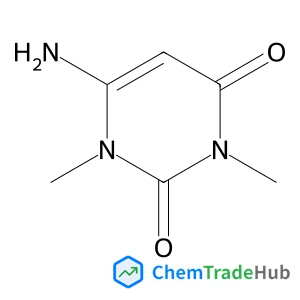
6-amino-1,3-dimethyl-1,2,3,4-tetrahydropyrimidine-2,4-dione
CAS Number:
6642-31-5
Molecular Formula:
C6H9N3O2
Recommended Suppliers




Disclaimer
This page provides academic journal information for reference and research purposes only. We are not affiliated with any journal publishers and do not handle publication submissions. For publication-related inquiries, please contact the respective journal publishers directly.
If you notice any inaccuracies in the information displayed, please contact us at support@chemtradehub.com. We will promptly review and address your concerns.