












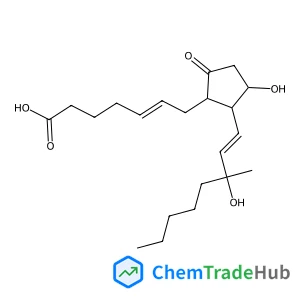
(5Z,11alpha,13E,15R)-11,15-Dihydroxy-15-methyl-9-oxoprosta-5,13-dien-1-oic acid
CAS Number:
55028-70-1
Molecular Formula:
C21H34O5
Dongling Cao, Jinlin He, Jiaying Xu, Mingzu Zhang, Lin Zhao, Guangxin Duan, Youwen Cao, Peihong Ni
Multiple drugs in combinatory therapy can improve the treatment of cancer due to their efficient reduction of multidrug resistance (MDR) of tumor cells. In this paper, we first synthesized a reduction-sensitive dextran-ss-camptothecin (Dex-ss-CPT, or Dex-CPT) prodrug conjugated by a disulfide bond, and a pH-responsive dextran-hyd-doxorubicin (Dex-hyd-DOX, or Dex-DOX) prodrug linked with an acid-cleavable hydrazone group. The chemical structures of the intermediate polymers and polymeric prodrugs have been fully characterized by 1H NMR, FT-IR, UV-Vis and HPLC analyses, respectively. Both prodrugs could self-assemble into uniform particles in aqueous solution. Subsequently, in vitro synergistic drug release of the two prodrugs was studied by methyl thiazolyl tetrazolium (MTT) assay. The reduction of a disulfide linker generates a thiol intermediate that is followed by intramolecular cyclization and the cleavage of the neighboring carbonate bridge, thus releasing native CPT molecules from the Dex-ss-CPT micelles. Similarly, the pH-sensitive hydrazone bond is broken under intracellular acidic conditions and the DOX parent drug is released from the Dex-hyd-DOX micelles. Finally, in vivo pharmacokinetics and biodistribution were investigated via intravenous administration with various formulations to treat 4T1 tumor-bearing mice. Meanwhile, the antitumor activity was also studied. This work demonstrates an effective anti-cancer prodrug design platform, which is expected to be useful for the treatment of various tumors.
Lin Lei, Weijia Wang, Zhengfeng Xie, Xiaobo Wu, Arun Kumar Yadav, Huiqing Fan
DOI: 10.1039/D1SE01244D
Clarke Palmer, Maryam Tarazkar, Michael J. Gordon, Horia Metiu, Eric W. McFarland
DOI: 10.1039/D1SE01408K
Lizhi Qian, Zhiqiang Wei, Tingli Yu, Bingdong Chang, Hongyu Sun, Wei Huang
DOI: 10.1039/D1SE00829C
Caitlin D. Parke, Linnette Teo, Daniel T. Schwartz, Venkat R. Subramanian
DOI: 10.1039/D1SE01090E
Min Ju Yun, Dong Yoon Lee
DOI: 10.1039/D1SE01205C
Nilanka M. Keppetipola, Céline Olivier, Thierry Toupance, Ludmila Cojocaru
DOI: 10.1039/D1SE00954K
Ravi K. Kunchala, Pushpendra, Rimple Kalia, Boddu S. Naidu
DOI: 10.1039/D1SE01080H
Vivek Narisetty, Rylan Cox, Nicholas Willoughby, Emel Aktas, Brijesh Tiwari, Avtar Singh Matharu, Konstantinos Salonitis, Vinod Kumar
DOI: 10.1039/D1SE00575H
When handling 2-Methyl-2-propanyl 5-amino-2-thiophenecarboxylate (CAS: 1498311-5...
5-Bromo-1,2-dichloro-3-fluorobenzene (CAS: 1000572-93-9) is a crystalline solid ...
(2R)-2-Amino-2-(4-bromophenyl)ethanol (CAS: 354153-64-3) should be stored in a c...
Methyl 4-(aminomethyl)tetrahydro-2H-pyran-4-carboxylate hydrochloride (CAS: 3627...
1,4-Dimethyl-1H-pyrazole-5-sulfonyl chloride is primarily used as an intermediat...
Dinaphtho[1,2-b:2',1'-d]furan is generally safe when handled with appropriate pe...
The market for 7-Methyl-7,9-dihydro-1H-purine-2,6,8(3H)-trione (CAS: 612-37-3) i...
2-(4-Chlorophenyl)malonaldehyde (CAS: 205676-17-1) is a colorless or light yello...
2-Methylchrysene (CAS: 3351-32-4) is typically synthesized via the reaction of c...
N-(6-aminopyrimidin-4-yl)acetamide (CAS: 89533-23-3) is generally considered saf...

Polymer Chemistry welcomes submissions in all areas of polymer science that have a strong focus on macromolecular chemistry. Manuscripts may cover a broad range of fields, yet no direct application focus is required.
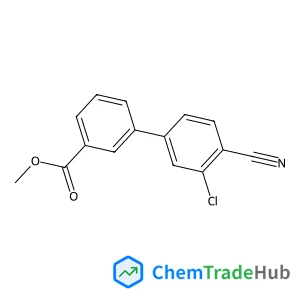
![2-Bromo-7-chloro-4H-pyrrolo[2,3-b]pyrazine structure](https://static.chemtradehub.com/structs/115/1150617-58-5-0b0a.webp "2-Bromo-7-chloro-4H-pyrrolo[2,3-b]pyrazine structure")
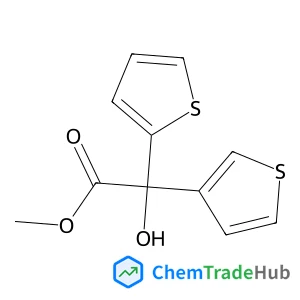
methyl]-N,2-dimethyl-2-propanesulfinamide structure](https://static.chemtradehub.com/structs/256/2565792-50-7-8a26.webp "N-[(R)-[3-(Benzyloxy)-2-(dicyclohexylphosphino)phenyl](phenyl)methyl]-N,2-dimethyl-2-propanesulfinamide structure")



