












Development of a transition metal-free polymerization route to functional conjugated polydiynes from a haloalkyne-based organic reaction
Literature Information
Publication Date
2016-03-02
DOI
10.1039/C6PY00050A
Impact Factor
5.582
Authors
View Original
Abstract
The development of an efficient transition metal-free polymerization route has been an active research topic in polymer science owing to its low synthetic cost and decreased metal residue and hence elevated material performance in the products. In this work, we report a new such method for constructing conjugated polydiynes based on the organic reaction of 1-haloalkyne. In the presence of potassium iodide, the polymerizations of 1,2-bis[4-(iodoethynyl)phenyl]-1,2-diphenylethene (1), 1,4-bis(2-iodoethynyl)benzene (2) and 4,4′-bis(2-iodoethynyl)-1,1′-biphenyl (3) proceed smoothly in N,N-dimethylformamide at 120 °C under nitrogen, producing P1–3 consisting of alternate aromatic and 1,3-diyne moieties in moderate to satisfactory yields. While P1 possesses good solubility in common organic solvents, P2 and P3 are insoluble due to their rigid structures. All the polymers are thermally stable, losing 5% of their weight at a high temperature of up to 352 °C. A homogeneous film of P1 can be readily obtained by spin-coating its solution, which shows high and UV-tunable refractive index (n = 2.1125–1.7747) in a wide wavelength range (400–900 nm). A well-defined fluorescent photopattern can be generated by UV irradiation of the polymer film through a copper mask. This work thus opens a new avenue for constructing conjugated polymers with advanced functionalities.
Related Literature
Molecular functionalization of silicene/Ag(111) by covalent bonds: a DFT study
Régis Stephan, Marie-Christine Hanf, Philippe Sonnet
2015-03-25
Paper
DOI: 10.1039/C5CP00613A
Tuning the crystalline and mesophase structure of olefin block copolymer through self-nucleation and annealing treatments
Jiashu Fan, Qinglong Zhang, Jiachun Feng
2015-05-19
Paper
DOI: 10.1039/C5CP00548E
Interfacial thermal transport and structural preferences in carbon nanotube–polyamide-6,6 nanocomposites: how important are chemical functionalization effects?
Mohammad Reza Gharib-Zahedi, Mohsen Tafazzoli, Michael C. Böhm, Mohammad Alaghemandi
2015-04-23
Paper
DOI: 10.1039/C5CP00752F
Intramolecular hydrogen bonds involving organic fluorine in the derivatives of hydrazides: an NMR investigation substantiated by DFT based theoretical calculations
Sandeep Kumar Mishra, N. Suryaprakash
2015-05-13
Paper
DOI: 10.1039/C5CP01505G
Two-dimensional graphene-like C2N: an experimentally available porous membrane for hydrogen purification
B. Xu, H. Xiang, Q. Wei, J. Q. Liu, Y. D. Xia
2015-05-07
Communication
DOI: 10.1039/C5CP01789K
Orbital entanglement and CASSCF analysis of the Ru–NO bond in a Ruthenium nitrosyl complex
Leon Freitag, Stefan Knecht, Sebastian F. Keller, Mickaël G. Delcey, Thomas Bondo Pedersen, Roland Lindh, Markus Reiher, Leticia González
2015-03-10
Paper
DOI: 10.1039/C4CP05278A
The solid state conversion reaction of epitaxial FeF2(110) thin films with lithium studied by angle-resolved X-ray photoelectron spectroscopy
Ryan Thorpe, Sylvie Rangan, Ryan Whitcomb, Ali C. Basaran, Thomas Saerbeck, Ivan K. Schuller, Robert A. Bartynski
2015-05-11
Paper
DOI: 10.1039/C5CP01150G
Unraveling the effect of polymer dots doping in inverted low bandgap organic solar cells
Xinyuan Zhang, Chunyu Liu, Jinfeng Li, Yeyuan He, Zhiqi Li, Hao Li, Liang Shen, Wenbin Guo, Shengping Ruan
2015-05-19
Paper
DOI: 10.1039/C5CP01722J
How simple is too simple? Computational perspective on importance of second-shell environment for metal-ion selectivity
Ondrej Gutten, Lubomír Rulíšek
2015-02-17
Paper
DOI: 10.1039/C4CP04876H
Exploring the glass transition region: crowding effect, nonergodicity and thermorheological complexity
2015-05-26
Paper
DOI: 10.1039/C5CP00301F
You might also like
Compound Q&A
What are the main uses of (5-Sulfamoyl-3-pyridinyl)boronic acid (CAS: 951233-61-7)?
(5-Sulfamoyl-3-pyridinyl)boronic acid is primarily used in chemical synthesis, p...
951233-61-7(5-Sulfamoyl-3-pyrid...
Compound Q&A
How is Benzyl 2-methyl-2-(methylsulfonyl)-4-pentenoate (CAS: 1942858-50-5) typically synthesized?
Benzyl 2-methyl-2-(methylsulfonyl)-4-pentenoate is typically synthesized via est...
1942858-50-5Benzyl 2-methyl-2-(m...
Compound Q&A
What precautions should be taken when handling 8-Fluoroquinolin-6-ol (CAS: 209353-22-0)?
When handling 8-Fluoroquinolin-6-ol (CAS: 209353-22-0), it is important to use p...
209353-22-08-Fluoroquinolin-6-o...
Compound Q&A
What are the physical and chemical properties of 1,3-Dibromo-5-(2-methyl-2-propanyl)benzene (CAS: 129316-09-2)?
1,3-Dibromo-5-(2-methyl-2-propanyl)benzene (CAS: 129316-09-2) is a crystalline c...
129316-09-21,3-Dibromo-5-(2-met...
Compound Q&A
What industries use Ethyl 7-chloro-4-oxo-1-(1,3-thiazol-2-yl)-1,4-dihydro-1,8-naphthyridine-3-carboxylate (CAS: 174726-87-5)?
Ethyl 7-chloro-4-oxo-1-(1,3-thiazol-2-yl)-1,4-dihydro-1,8-naphthyridine-3-carbox...
174726-87-5Ethyl 7-chloro-4-oxo...
Compound Q&A
What precautions should be taken when handling Delta-7-Avenasterol (CAS: 23290-26-8)?
When handling Delta-7-Avenasterol (CAS: 23290-26-8), it is important to wear app...
23290-26-8Delta-7-Avenasterol
Compound Q&A
What precautions should be taken when handling N-({(5R)-3-[3-Fluoro-4-(4-morpholinyl)phenyl]-2-oxo-1,3-oxazolidin-5-yl}methyl)acetamide (CAS: 872992-20-6)?
Proper handling involves the use of personal protective equipment such as gloves...
872992-20-6N-({(5R)-3-[3-Fluoro...
Compound Q&A
What precautions should be taken when handling 2-Methyl-2-proanyl 4-[(2-aminophenyl)amino]-1-piperidinecarboxylate (CAS: 79099-00-6)?
When handling 2-Methyl-2-proanyl 4-[(2-aminophenyl)amino]-1-piperidinecarboxylat...
79099-00-62-Methyl-2-propanyl ...
Compound Q&A
What is N-Methyl-4-chlorobenzylamine hydrochloride (CAS: 65542-24-7)?
N-Methyl-4-chlorobenzylamine hydrochloride (CAS: 65542-24-7) is a organic compou...
65542-24-7N-Methyl-4-chloroben...
Compound Q&A
Is [2-(Dodecyloxy)ethoxy]acetic acid (CAS: 27306-90-7) safe?
[2-(Dodecyloxy)ethoxy]acetic acid (CAS: 27306-90-7) is generally considered safe...
27306-90-7[2-(Dodecyloxy)ethox...
Source Journal
Polymer Chemistry

CiteScore:
8.6
Self-citation Rate:
7.3%
Articles per Year:
457
Polymer Chemistry welcomes submissions in all areas of polymer science that have a strong focus on macromolecular chemistry. Manuscripts may cover a broad range of fields, yet no direct application focus is required.
Recommended Compounds
![2-(5-Bromo-1H-pyrrolo[2,3-B]pyridin-3-YL)acetic acid structure](https://static.chemtradehub.com/structs/106/1060795-03-0-0589.webp "2-(5-Bromo-1H-pyrrolo[2,3-B]pyridin-3-YL)acetic acid structure")
2-(5-Bromo-1H-pyrrolo[2,3-B]pyridin-3-YL)acetic acid
CAS Number:
1060795-03-0
Molecular Formula:
C9H7BrN2O2
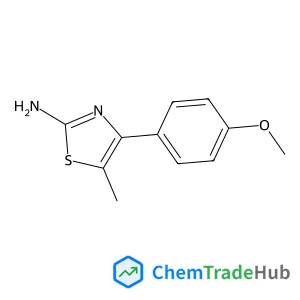
4-(4-Methoxyphenyl)-5-methyl-1,3-thiazol-2-amine
CAS Number:
105512-88-7
Molecular Formula:
C11H12N2OS
![2-Methyl-2-propanyl 4-oxo-3,9-diazabicyclo[4.2.1]nonane-9-carboxylate structure](https://static.chemtradehub.com/structs/131/1312456-05-5-9a15.webp "2-Methyl-2-propanyl 4-oxo-3,9-diazabicyclo[4.2.1]nonane-9-carboxylate structure")
2-Methyl-2-propanyl 4-oxo-3,9-diazabicyclo[4.2.1]nonane-9-carboxylate
CAS Number:
1312456-05-5
Molecular Formula:
C12H20N2O3
Recommended Suppliers




Disclaimer
This page provides academic journal information for reference and research purposes only. We are not affiliated with any journal publishers and do not handle publication submissions. For publication-related inquiries, please contact the respective journal publishers directly.
If you notice any inaccuracies in the information displayed, please contact us at support@chemtradehub.com. We will promptly review and address your concerns.