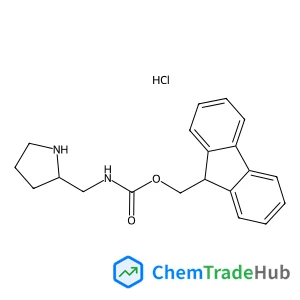
(S)-(9H-Fluoren-9-yl)methyl (pyrrolidin-2-ylmethyl)carbamate hydrochloride
CAS Number:
1217813-15-4
Molecular Formula:
C20H23ClN2O2
Kenichi Shimizu, Stanislav V. Sokolov, Neil P. Young, Richard G. Compton
Cluster formation can profoundly influence the bioavailability and (bio)geochemical activity of nanoparticles in natural aquatic systems. While colloidal properties of nanoparticles are commonly investigated using light-scattering techniques, the requirement to dilute samples can affect the fundamental nature and extent of the cluster size. Hence, an alternative in situ approach that can cover a much higher and wider concentration range of particles is desirable. In this study, particle impact chronoamperometry is employed to probe the degree of cluster formation of Alizarin Red S modified rutile nanoparticles of diameter ca. 167 nm in conditions approximating those existing in the environment. Random collisions of individual clusters of the modified rutile particles with a stationary electrode result in transient current signals during a chronoamperometric measurement, indicative of the reduction of the adsorbed Alizarin Red S dye molecules. The results from the particle-impact analysis reveal that the nanoparticles are heavily clustered with an average 91 monomeric particles per cluster. As the spherical equivalent size of the clusters (ca. 754 nm in diameter) is considerably larger than that from nanoparticle tracking analysis (ca. 117 nm), the present work highlights the impact of the dilution on the fundamental nature of the colloidal suspension and introduces the electrochemical determination of the size distribution of inert mineral nanoparticles in highly concentrated media.
Florence Haudin, V. Brasiliense, Julyan H. E. Cartwright, Fabian Brau, A. De Wit
DOI: 10.1039/C5CP00068H
A. D. Godbeer, J. S. Al-Khalili, P. D. Stevenson
DOI: 10.1039/C5CP00472A
F. Terenziani, A. Painelli
DOI: 10.1039/C5CP01485A
Kada Yesudas, Eluvathingal D. Jemmis, Kotamarthi Bhanuprakash
DOI: 10.1039/C5CP01410G
Sai Duan, Guangjun Tian, Jun Jiang, Xin Xu
DOI: 10.1039/C5CP01378J
Meng Hu, Xu Dong, Bingchao Yang, Bo Xu, Dongli Yu, Julong He
DOI: 10.1039/C5CP01621E
Narjes Ansari, Francesc Illas
DOI: 10.1039/C5CP00381D
Johannes Postler, Athanasios Zavras, Paul Scheier, Stephan Denifl, Richard A. J. O'Hair
DOI: 10.1039/C5CP01014D
Masaki Hiratsuka, Ryo Ohmura, Amadeu K. Sum, Saman Alavi, Kenji Yasuoka
DOI: 10.1039/C4CP05732E
Toru Utsunomiya, Shoko Tatsumi, Yasuyuki Yokota, Ken-ichi Fukui
DOI: 10.1039/C5CP01156F
Waste containing N-Methoxy-N-methyl-1,3-thiazole-5-carboxamide (CAS: 898825-89-3...
N-(4-Biphenylyl)dibenzo[b,d]furan-4-amine should be stored in a tightly sealed c...
The market for 3-Acetamido-5-amino-2,4,6-triiodobenzoic acid (CAS: 1713-07-1) is...
Benzyl 2-O-acetyl-3,4,6-tri-O-benzyl-beta-D-galactopyranoside (CAS: 61820-03-9) ...
2-Ethylpiperazine dihydrochloride (CAS: 438050-52-3) is regulated under the Glob...
1,1'-[1,3-Phenylenebis(methylene)]bis(3-methyl-1H-pyrrole-2,5-dione) (CAS: 11946...
Several alternatives can be used in the synthesis of 5-Fluoro-2-(1-pyrrolidinyl)...
Proper personal protective equipment (PPE) must be worn when handling this compo...
When handling 6-Bromoimidazo[1,2-a]pyridin-8-amine, it is important to wear appr...
Alternatives to (2S,4R)-4-(4-Nitrobenzyl)pyrrolidine-2-carboxylic acid hydrochlo...

Physical Chemistry Chemical Physics (PCCP) is an international journal co-owned by 19 physical chemistry and physics societies from around the world. This journal publishes original, cutting-edge research in physical chemistry, chemical physics and biophysical chemistry. To be suitable for publication in PCCP, articles must include significant innovation and/or insight into physical chemistry; this is the most important criterion that reviewers and Editors will judge against when evaluating submissions. The journal has a broad scope and welcomes contributions spanning experiment, theory, computation and data science. Topical coverage includes spectroscopy, dynamics, kinetics, statistical mechanics, thermodynamics, electrochemistry, catalysis, surface science, quantum mechanics, quantum computing and machine learning. Interdisciplinary research areas such as polymers and soft matter, materials, nanoscience, energy, surfaces/interfaces, and biophysical chemistry are welcomed if they demonstrate significant innovation and/or insight into physical chemistry. Joined experimental/theoretical studies are particularly appreciated when complementary and based on up-to-date approaches.
![[5-fluoro-2-(morpholine-4-carbonyl)phenyl]boronic acid structure](https://static.chemtradehub.com/structs/121/1217501-26-2-505c.webp "[5-fluoro-2-(morpholine-4-carbonyl)phenyl]boronic acid structure")