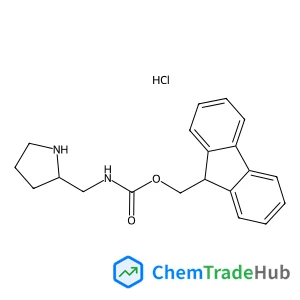
(S)-(9H-Fluoren-9-yl)methyl (pyrrolidin-2-ylmethyl)carbamate hydrochloride
CAS Number:
1217813-15-4
Molecular Formula:
C20H23ClN2O2
Maria Chiara Biagi, Giorgio Badino, Georg Gramse, Laura Fumagalli
We obtained maps of electric permittivity at ∼19 GHz frequencies on non-planar thin film heterogeneous samples by means of combined atomic force–scanning microwave microscopy (AFM–SMM). We show that the electric permittivity maps can be obtained directly from the capacitance images acquired in contact mode, after removing the topographic cross-talk effects. This result demonstrates the possibility of identifying the electric permittivity of different materials in a thin film sample irrespectively of their thickness by just direct imaging and processing. We show, in addition, that quantitative maps of the electric permittivity can be obtained with no need for any theoretical calculation or complex quantification procedures when the electric permittivity of one of the materials is known. To achieve these results the use of contact mode imaging is a key factor. For non-contact imaging modes the effects of local sample thickness and of the imaging distance make the interpretation of the capacitance images in terms of the electric permittivity properties of the materials much more complex. The present results represent a substantial contribution to the field of nanoscale microwave dielectric characterization of thin film materials with important implications for the characterization of novel 3D electronic devices and 3D nanomaterials.

Journal of Asian Natural Products Research

Journal of Chemical Sciences

Herald of the Russian Academy of Sciences

Topics in Catalysis

Critical Reviews in Solid State and Materials Sciences

Biocatalysis and Biotransformation

Bioorganic & Medicinal Chemistry

Polycyclic Aromatic Compounds

Journal of the Indian Institute of Science

NDT & E International
Weigang Wang, Maofa Ge
DOI: 10.1039/C4CP05461J
Debora Puglia, Josè M. Kenny, Jyotishkumar Parameswaranpillai, Poornima Vijayan P, Jűrgen Pionteck
DOI: 10.1039/C5CP00612K
Jin Zhang, S. A. Meguid
DOI: 10.1039/C5CP00914F
Stijn Schaltin, Gijs Vanhoutte, Minxian Wu, Fanny Bardé, Jan Fransaer
DOI: 10.1039/C5CP00386E
Jing Zhang, Nan Chen, Zheng Tang, Yang Yu, Qili Hu, Chuanping Feng
DOI: 10.1039/C5CP00817D
Guangbiao Zhang, Yuanxu Wang, Yuli Yan, Chengxiao Peng, Chao Wang, Shuai Dong
DOI: 10.1039/C5CP00186B
Yi Bao, Richard L. Martin, Maciej Haranczyk
DOI: 10.1039/C5CP00002E
DOI: 10.1039/C5CP01490E
Antti Viinikanoja, Pia Damlin, Milla Suominen, Carita Kvarnström
DOI: 10.1039/C5CP00942A
Francisco B. C. Machado
DOI: 10.1039/C4CP05751A
Waste containing N-Methoxy-N-methyl-1,3-thiazole-5-carboxamide (CAS: 898825-89-3...
N-(4-Biphenylyl)dibenzo[b,d]furan-4-amine should be stored in a tightly sealed c...
The market for 3-Acetamido-5-amino-2,4,6-triiodobenzoic acid (CAS: 1713-07-1) is...
Benzyl 2-O-acetyl-3,4,6-tri-O-benzyl-beta-D-galactopyranoside (CAS: 61820-03-9) ...
2-Ethylpiperazine dihydrochloride (CAS: 438050-52-3) is regulated under the Glob...
1,1'-[1,3-Phenylenebis(methylene)]bis(3-methyl-1H-pyrrole-2,5-dione) (CAS: 11946...
Several alternatives can be used in the synthesis of 5-Fluoro-2-(1-pyrrolidinyl)...
Proper personal protective equipment (PPE) must be worn when handling this compo...
When handling 6-Bromoimidazo[1,2-a]pyridin-8-amine, it is important to wear appr...
Alternatives to (2S,4R)-4-(4-Nitrobenzyl)pyrrolidine-2-carboxylic acid hydrochlo...

Physical Chemistry Chemical Physics (PCCP) is an international journal co-owned by 19 physical chemistry and physics societies from around the world. This journal publishes original, cutting-edge research in physical chemistry, chemical physics and biophysical chemistry. To be suitable for publication in PCCP, articles must include significant innovation and/or insight into physical chemistry; this is the most important criterion that reviewers and Editors will judge against when evaluating submissions. The journal has a broad scope and welcomes contributions spanning experiment, theory, computation and data science. Topical coverage includes spectroscopy, dynamics, kinetics, statistical mechanics, thermodynamics, electrochemistry, catalysis, surface science, quantum mechanics, quantum computing and machine learning. Interdisciplinary research areas such as polymers and soft matter, materials, nanoscience, energy, surfaces/interfaces, and biophysical chemistry are welcomed if they demonstrate significant innovation and/or insight into physical chemistry. Joined experimental/theoretical studies are particularly appreciated when complementary and based on up-to-date approaches.