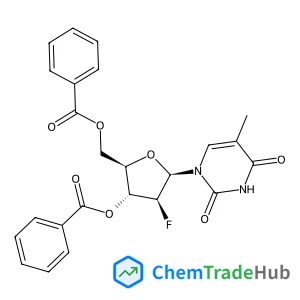
1-(3',5'-Di-O-benzoyl-2'-deoxy-2'-fluoro-b-D-arabinofuranosyl)thymine
CAS Number:
97614-47-6
Molecular Formula:
C24H21FN2O7
Yuanjie Li, Xianglin Liu, Dandan Zhang, Jian Gao
Diffusion pathways of atomic hydrogen on model catalyst surfaces and into subsurfaces are of great significance in the exploration of novel catalytic hydrogenation in heterogeneous catalysis. We present in detail the diffusion pathways of hydrogen on seven different open and closed model catalyst surfaces from first principles calculations. Seven transition metal catalysts with thirteen different crystal surfaces, i.e., Co(001), Ni(100) and Ni(111), Pd(100) and (111), Pt(100) and (111), Cu(100) and (111), Ag(100) and (111) and Au(100) and (111), are taken into account. Thirteen corresponding potential energy surfaces (PESs) are constructed for modelling hydrogen diffusion on these model catalyst surfaces and into the subsurfaces by interpolating ab initio density functional theory energy points (∼2000 for each surface). The minimum energy diffusion pathways for hydrogen on the surfaces and into the subsurfaces are globally searched for based on PESs using a mesh method, and are in excellent agreement with those calculated from the nudged elastic band method. Furthermore, the important substrate relaxation effect can decrease the diffusion barriers for hydrogen into catalyst subsurfaces. The high reactivity of subsurface reactants mainly comes from the residual energy of subsurface hydrogen emerging from the subsurface onto the surface.

Medicinal Chemistry Research

Chinese Journal of Chemistry

Topics in Catalysis

Journal of the Indian Institute of Science

Cellulose

Bioorganic & Medicinal Chemistry

Acta Metallurgica Sinica-English Letters

Critical Reviews in Solid State and Materials Sciences

NDT & E International

Herald of the Russian Academy of Sciences
DOI: 10.1039/A906437K
P. Lindner, T. Narayanan
DOI: 10.1039/B009104I
Yufeng Lei, Anqiang Zhang, Yaling Lin
DOI: 10.1039/D1PY00623A
Prathyusha Chimala, M. Mario Perera, Aissatou Wade, Tucker McKenzie, Joshua Allor, Neil Ayres
DOI: 10.1039/D1PY00560J
D. J. Diestler, G. T. Gao, X. C. Zeng
DOI: 10.1039/B007772K
DOI: 10.1039/B008247N
João Carlos R. Reis, Michael J. Blandamer, Michael I. Davis, Gérard Douhéret
DOI: 10.1039/B009512P
Jovana Djordjevic, Vera Dondur, Radovan Dimitrijevic, Aleksandar Kremenovic
DOI: 10.1039/B009384J
(3.beta.)-3-Hydroxy-N,N-dimethyl-chol-5-en-24-amide (CAS: 79066-03-8) is primari...
5-(Aminomethyl)-2-methoxyphenol (CAS: 89702-89-6) is classified under GHS as a s...
Thieno[2,3-c]pyridin-7(6H)-one (CAS: 28981-13-7) is a heterocyclic organic compo...
1-[(6-Methoxy-3-pyridinyl)methyl]-4-piperidinamine dihydrochloride is generally ...
[(2E)-3-Phenyl-2-propen-1-yl]phosphonic acid (CAS: 146404-58-2) is regulated und...
6-Bromo-7-methoxyquinoline (CAS: 1620515-86-7) falls under the scope of the Glob...
This compound is primarily used in the pharmaceutical industry for the developme...
1-Ethyl-7-[2-methyl-6-(4H-1,2,4-triazol-3-yl)-3-pyridinyl]-3,5-dihydropyrazino[2...
Alternative reagents such as 2-[(dimethylamino)methyl]phenylboronic acid or rela...
3-(Piperidin-4-yloxy)pyridine (CAS: 310881-48-2) is an organic compound with the...

Physical Chemistry Chemical Physics (PCCP) is an international journal co-owned by 19 physical chemistry and physics societies from around the world. This journal publishes original, cutting-edge research in physical chemistry, chemical physics and biophysical chemistry. To be suitable for publication in PCCP, articles must include significant innovation and/or insight into physical chemistry; this is the most important criterion that reviewers and Editors will judge against when evaluating submissions. The journal has a broad scope and welcomes contributions spanning experiment, theory, computation and data science. Topical coverage includes spectroscopy, dynamics, kinetics, statistical mechanics, thermodynamics, electrochemistry, catalysis, surface science, quantum mechanics, quantum computing and machine learning. Interdisciplinary research areas such as polymers and soft matter, materials, nanoscience, energy, surfaces/interfaces, and biophysical chemistry are welcomed if they demonstrate significant innovation and/or insight into physical chemistry. Joined experimental/theoretical studies are particularly appreciated when complementary and based on up-to-date approaches.