












Selective bond breaking of CO2 in phase-locked two-color intense laser fields: laser field intensity dependence
Literature Information
Publication Date
2017-01-03
DOI
10.1039/C6CP07471E
Impact Factor
3.676
Authors
Hikaru Fujise, Yuuna Kawachi, Ayaka Ishihara, Akitaka Matsuda, Mizuho Fushitani, Hirohiko Kono
View Original
Abstract
Selective bond breaking of CO2 in phase-locked ω–2ω two-color intense laser fields (λ = 800 nm and 400 nm, total field intensity I ∼ 1014 W cm−2) has been investigated by coincidence momentum imaging. The CO+ and O+ fragment ions produced by two-body Coulomb explosion, CO22+ → CO+ + O+, exhibit asymmetric distributions along the laser polarization direction, showing that one of the two equivalent C–O bonds is selectively broken by the laser fields. At a field intensity higher than 2 × 10¹⁴ W cm−2, the largest fragment asymmetry is observed when the relative phase ϕ between the ω and 2ω laser fields is ∼0 and π. On the other hand, an increase of the asymmetry and a shift of the phase providing the largest asymmetry are observed at lower field intensities. The selective bond breaking and its dependence on the laser field intensity are discussed in terms of a mechanism involving deformation of the potential energy surfaces and electron recollision in intense laser fields.
Related Literature
Control of mesostructure and morphology of surfactant-templated silica in a mixed surfactant system
Paper
DOI: 10.1039/A903447A
Vapour phase hydrogenation of crotonaldehyde over magnesia-supported platinum–tin catalysts
Narcís Homs, Jordi Llorca, Pilar Ramírez de la Piscina, Francisco Rodríguez-Reinoso, Antonio Sepúlveda-Escribano, Joaquín Silvestre-Albero
2001-03-29
Paper
DOI: 10.1039/B100770J
Phase transition and water molecules in titanylphthalocyanine phase Y crystal
Michael L. Klein
2001-03-14
Paper
DOI: 10.1039/B009490K
Positrons in doped pyrene
Tomasz Goworek, Czesław Rybka, Jan Wawryszczuk
2001-03-29
Paper
DOI: 10.1039/B008826I
Intermolecular electron transfer in merocyanine aggregates studied by optical and transient EPR methods
Lorenzo Franco, Luigi Pasimeni, Glauco Ponterini, Marco Ruzzi, Ulderico Segre
2001-04-03
Paper
DOI: 10.1039/B009427G
Structural and morphological investigations of the formation of quasi-crystalline phases of 1,2-dimyristoyl-sn-glycero-3-phosphoglycerol (DMPG)
Walter Richter, Gert Rapp, Alfred Blume
2001-03-20
Paper
DOI: 10.1039/B009881G
Synthesis of core-crosslinked star polymers via organocatalyzed living radical polymerization
Yichao Zheng, Jit Sarkar, Hiroshi Niino, Shunsuke Chatani, Shu Yao Hsu, Atsushi Goto
2021-07-05
Paper
DOI: 10.1039/D1PY00663K
Cyclic polylactide synthesis initiated by a lithium anthraquinoid: understanding the selectivity through DFT and diffusion NMR
Cristina Ruiz Martínez, Juana M. Pérez, Francisco M. Arrabal-Campos, María Batuecas, Ignacio Fernández
2021-07-07
Paper
DOI: 10.1039/D1PY00547B
You might also like
Compound Q&A
What are the main uses of (3.beta.)-3-Hydroxy-N,N-dimethyl-chol-5-en-24-amide (CAS: 79066-03-8)?
(3.beta.)-3-Hydroxy-N,N-dimethyl-chol-5-en-24-amide (CAS: 79066-03-8) is primari...
79066-03-8(3.beta.)-3-Hydroxy-...
Compound Q&A
What regulatory guidelines apply to 5-(aminomethyl)-2-methoxyphenol (CAS: 89702-89-6)?
5-(Aminomethyl)-2-methoxyphenol (CAS: 89702-89-6) is classified under GHS as a s...
89702-89-65-(aminomethyl)-2-me...
Compound Q&A
What is Thieno[2,3-c]pyridin-7(6H)-one (CAS: 28981-13-7)?
Thieno[2,3-c]pyridin-7(6H)-one (CAS: 28981-13-7) is a heterocyclic organic compo...
28981-13-7Thieno[2,3-c]pyridin...
Compound Q&A
Is 1-[(6-Methoxy-3-pyridinyl)methyl]-4-piperidinamine dihydrochloride (CAS: 1185311-28-7) safe?
1-[(6-Methoxy-3-pyridinyl)methyl]-4-piperidinamine dihydrochloride is generally ...
1185311-28-71-[(6-Methoxy-3-pyri...
Compound Q&A
What regulatory guidelines apply to [(2E)-3-Phenyl-2-propen-1-yl]phosphonic acid (CAS: 146404-58-2)?
[(2E)-3-Phenyl-2-propen-1-yl]phosphonic acid (CAS: 146404-58-2) is regulated und...
146404-58-2[(2E)-3-Phenyl-2-pro...
Compound Q&A
What regulatory guidelines apply to 6-Bromo-7-methoxyquinoline (CAS: 1620515-86-7)?
6-Bromo-7-methoxyquinoline (CAS: 1620515-86-7) falls under the scope of the Glob...
1620515-86-76-Bromo-7-methoxyqui...
Compound Q&A
What industries use (2R)-1-(1-Benzofuran-2-yl)-N-propyl-2-pentanamine (CAS: 260550-89-8)?
This compound is primarily used in the pharmaceutical industry for the developme...
260550-89-8(2R)-1-(1-Benzofuran...
Compound Q&A
What are the main uses of 1-Ethyl-7-[2-methyl-6-(4H-1,2,4-triazol-3-yl)-3-pyridinyl]-3,5-dihydropyrazino[2,3-b]pyrazin-2(1H)-one (CAS: 1228013-15-7)?
1-Ethyl-7-[2-methyl-6-(4H-1,2,4-triazol-3-yl)-3-pyridinyl]-3,5-dihydropyrazino[2...
1228013-15-71-Ethyl-7-[2-methyl-...
Compound Q&A
Are there alternatives to {5-(Acryloylamino)-2-[(dimethylamino)methyl]phenyl}boronic acid (CAS: 1217500-78-1) in synthesis?
Alternative reagents such as 2-[(dimethylamino)methyl]phenylboronic acid or rela...
1217500-78-1{5-(Acryloylamino)-2...
Compound Q&A
What is 3-(Piperidin-4-yloxy)pyridine (CAS: 310881-48-2)?
3-(Piperidin-4-yloxy)pyridine (CAS: 310881-48-2) is an organic compound with the...
310881-48-23-(Piperidin-4-yloxy...
Source Journal
Physical Chemistry Chemical Physics

CiteScore:
5.5
Self-citation Rate:
10.3%
Articles per Year:
3036
Physical Chemistry Chemical Physics (PCCP) is an international journal co-owned by 19 physical chemistry and physics societies from around the world. This journal publishes original, cutting-edge research in physical chemistry, chemical physics and biophysical chemistry. To be suitable for publication in PCCP, articles must include significant innovation and/or insight into physical chemistry; this is the most important criterion that reviewers and Editors will judge against when evaluating submissions. The journal has a broad scope and welcomes contributions spanning experiment, theory, computation and data science. Topical coverage includes spectroscopy, dynamics, kinetics, statistical mechanics, thermodynamics, electrochemistry, catalysis, surface science, quantum mechanics, quantum computing and machine learning. Interdisciplinary research areas such as polymers and soft matter, materials, nanoscience, energy, surfaces/interfaces, and biophysical chemistry are welcomed if they demonstrate significant innovation and/or insight into physical chemistry. Joined experimental/theoretical studies are particularly appreciated when complementary and based on up-to-date approaches.
Recommended Compounds
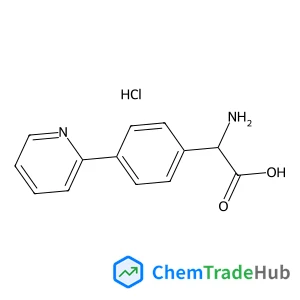
2-Amino-2-(4-(pyridin-2-YL)phenyl)acetic acid hydrochloride
CAS Number:
1135818-89-1
Molecular Formula:
C13H13ClN2O2
![7-Bromo-5-chloro-1H-pyrazolo[4,3-b]pyridine structure](https://static.chemtradehub.com/structs/135/1351813-70-1-a716.webp "7-Bromo-5-chloro-1H-pyrazolo[4,3-b]pyridine structure")
Recommended Suppliers





Disclaimer
This page provides academic journal information for reference and research purposes only. We are not affiliated with any journal publishers and do not handle publication submissions. For publication-related inquiries, please contact the respective journal publishers directly.
If you notice any inaccuracies in the information displayed, please contact us at support@chemtradehub.com. We will promptly review and address your concerns.