


![4-[(4-Bromophenyl)sulfonyl]thiomorpholine structure](https://static.chemtradehub.com/structs/223/223555-81-5-2d67.webp "4-[(4-Bromophenyl)sulfonyl]thiomorpholine structure")
Photoluminescence quenching of inorganic cesium lead halides perovskite quantum dots (CsPbX3) by electron/hole acceptor
Literature Information
Publication Date
2016-11-16
DOI
10.1039/C6CP04083G
Impact Factor
3.676
Authors
Yan-Xia Zhang, Hai-Yu Wang, Zhen-Yu Zhang, Yu Zhang, Chun Sun, Yuan-Yuan Yue, Lei Wang, Qi-Dai Chen, Hong-Bo Sun
View Original
Abstract
Recently, all-inorganic cesium lead halide perovskites (CsPbX3) quantum dots (QDs) have attracted great attention due to their halogen composition and size tunable band gap engineering, the same physical mechanism that is responsible for excellent performance in light-emitting devices. However, little is known about the time-resolved fluorescence quenching dynamics process of these CsPbX3 QDs. In this article, we present comprehensive contrastive spectral studies on the electron and hole extraction dynamics of CsPbX3 colloidal QDs with and without quencher by time-resolved femtosecond transient absorption (TA) and time-correlated single-photon counting (TCSPC) spectroscopy methods. We have identified that the partial electrons of the conduction band and holes of the valence band of CsPbX3 QDs can be directly extracted by tetracyanoethylene (TCNE) and phenothiazine (PTZ), respectively. Moreover, compared with the CsPbBr3 QDs, the CsPbI3 QDs showed relatively slower charge extraction rates. We also found that the CsPbBr3 QDs with smaller size showed faster carrier recombination rates and photoluminescence (PL) decay lifetime due to the relatively stronger quantum confinement effects. We believe that this study may be useful for realising optimal applications in photovoltaic and light emission devices.
Recommended Journals

Journal of Asian Natural Products Research

Heteroatom Chemistry

Acta Metallurgica Sinica-English Letters

Critical Reviews in Solid State and Materials Sciences

Electroanalysis

Atomization and Sprays

Chinese Journal of Chemistry

Herald of the Russian Academy of Sciences

Biocatalysis and Biotransformation

Journal of Chemical Sciences
Related Literature
Cyclic polylactide synthesis initiated by a lithium anthraquinoid: understanding the selectivity through DFT and diffusion NMR
Cristina Ruiz Martínez, Juana M. Pérez, Francisco M. Arrabal-Campos, María Batuecas, Ignacio Fernández
2021-07-07
Paper
DOI: 10.1039/D1PY00547B
Symmetric binary polymer blends confined in thin films between competing walls: Interplay between finite size and wetting behavior
E. V. Albano
2001-02-13
Paper
DOI: 10.1039/B008627O
Design, synthesis and use of phthalocyanines as a new class of visible-light photoinitiators for free-radical and cationic polymerizations
Louise Breloy, Ozgur Yavuz, Ismail Yilmaz, Yusuf Yagci, Davy-Louis Versace
2021-06-19
Review Article
DOI: 10.1039/D1PY00462J
Redox behaviour of SnO2 nanoparticles encapsulated in the pores of zeolites towards reductive gas atmospheres studied by in situ diffuse reflectance UV/Vis and Mössbauer spectroscopy
Meike Warnken, Karoly Lázár, Michael Wark
2001-04-10
Paper
DOI: 10.1039/B009045J
Synthesis of core-crosslinked star polymers via organocatalyzed living radical polymerization
Yichao Zheng, Jit Sarkar, Hiroshi Niino, Shunsuke Chatani, Shu Yao Hsu, Atsushi Goto
2021-07-05
Paper
DOI: 10.1039/D1PY00663K
Positrons in doped pyrene
Tomasz Goworek, Czesław Rybka, Jan Wawryszczuk
2001-03-29
Paper
DOI: 10.1039/B008826I
15N and 2H NMR relaxation and kinetics of stepwise double proton and deuteron transfer in polycrystalline tetraaza[14]annulene
Uwe Langer, Christof Hoelger, Gerd Buntkowsky, Hans-Martin Vieth, Hans-Heinrich Limbach
2001-03-22
Paper
DOI: 10.1039/B007564G
You might also like
Compound Q&A
What are the main uses of (3.beta.)-3-Hydroxy-N,N-dimethyl-chol-5-en-24-amide (CAS: 79066-03-8)?
(3.beta.)-3-Hydroxy-N,N-dimethyl-chol-5-en-24-amide (CAS: 79066-03-8) is primari...
79066-03-8(3.beta.)-3-Hydroxy-...
Compound Q&A
What regulatory guidelines apply to 5-(aminomethyl)-2-methoxyphenol (CAS: 89702-89-6)?
5-(Aminomethyl)-2-methoxyphenol (CAS: 89702-89-6) is classified under GHS as a s...
89702-89-65-(aminomethyl)-2-me...
Compound Q&A
What is Thieno[2,3-c]pyridin-7(6H)-one (CAS: 28981-13-7)?
Thieno[2,3-c]pyridin-7(6H)-one (CAS: 28981-13-7) is a heterocyclic organic compo...
28981-13-7Thieno[2,3-c]pyridin...
Compound Q&A
Is 1-[(6-Methoxy-3-pyridinyl)methyl]-4-piperidinamine dihydrochloride (CAS: 1185311-28-7) safe?
1-[(6-Methoxy-3-pyridinyl)methyl]-4-piperidinamine dihydrochloride is generally ...
1185311-28-71-[(6-Methoxy-3-pyri...
Compound Q&A
What regulatory guidelines apply to [(2E)-3-Phenyl-2-propen-1-yl]phosphonic acid (CAS: 146404-58-2)?
[(2E)-3-Phenyl-2-propen-1-yl]phosphonic acid (CAS: 146404-58-2) is regulated und...
146404-58-2[(2E)-3-Phenyl-2-pro...
Compound Q&A
What regulatory guidelines apply to 6-Bromo-7-methoxyquinoline (CAS: 1620515-86-7)?
6-Bromo-7-methoxyquinoline (CAS: 1620515-86-7) falls under the scope of the Glob...
1620515-86-76-Bromo-7-methoxyqui...
Compound Q&A
What industries use (2R)-1-(1-Benzofuran-2-yl)-N-propyl-2-pentanamine (CAS: 260550-89-8)?
This compound is primarily used in the pharmaceutical industry for the developme...
260550-89-8(2R)-1-(1-Benzofuran...
Compound Q&A
What are the main uses of 1-Ethyl-7-[2-methyl-6-(4H-1,2,4-triazol-3-yl)-3-pyridinyl]-3,5-dihydropyrazino[2,3-b]pyrazin-2(1H)-one (CAS: 1228013-15-7)?
1-Ethyl-7-[2-methyl-6-(4H-1,2,4-triazol-3-yl)-3-pyridinyl]-3,5-dihydropyrazino[2...
1228013-15-71-Ethyl-7-[2-methyl-...
Compound Q&A
Are there alternatives to {5-(Acryloylamino)-2-[(dimethylamino)methyl]phenyl}boronic acid (CAS: 1217500-78-1) in synthesis?
Alternative reagents such as 2-[(dimethylamino)methyl]phenylboronic acid or rela...
1217500-78-1{5-(Acryloylamino)-2...
Compound Q&A
What is 3-(Piperidin-4-yloxy)pyridine (CAS: 310881-48-2)?
3-(Piperidin-4-yloxy)pyridine (CAS: 310881-48-2) is an organic compound with the...
310881-48-23-(Piperidin-4-yloxy...
Source Journal
Physical Chemistry Chemical Physics

CiteScore:
5.5
Self-citation Rate:
10.3%
Articles per Year:
3036
Physical Chemistry Chemical Physics (PCCP) is an international journal co-owned by 19 physical chemistry and physics societies from around the world. This journal publishes original, cutting-edge research in physical chemistry, chemical physics and biophysical chemistry. To be suitable for publication in PCCP, articles must include significant innovation and/or insight into physical chemistry; this is the most important criterion that reviewers and Editors will judge against when evaluating submissions. The journal has a broad scope and welcomes contributions spanning experiment, theory, computation and data science. Topical coverage includes spectroscopy, dynamics, kinetics, statistical mechanics, thermodynamics, electrochemistry, catalysis, surface science, quantum mechanics, quantum computing and machine learning. Interdisciplinary research areas such as polymers and soft matter, materials, nanoscience, energy, surfaces/interfaces, and biophysical chemistry are welcomed if they demonstrate significant innovation and/or insight into physical chemistry. Joined experimental/theoretical studies are particularly appreciated when complementary and based on up-to-date approaches.
Recommended Compounds
![N-[4-(Cyanoethynyl)phenyl]-16-oxo-4,7,10,13-tetraoxa-17-azahenicos-1-yn-21-amide structure](https://static.chemtradehub.com/structs/218/2183440-36-8-68cb.webp "N-[4-(Cyanoethynyl)phenyl]-16-oxo-4,7,10,13-tetraoxa-17-azahenicos-1-yn-21-amide structure")
N-[4-(Cyanoethynyl)phenyl]-16-oxo-4,7,10,13-tetraoxa-17-azahenicos-1-yn-21-amide
CAS Number:
2183440-36-8
Molecular Formula:
C25H31N3O6
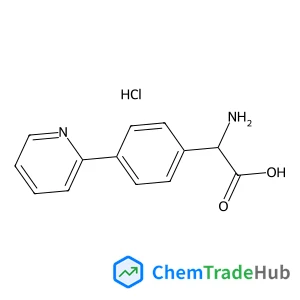
2-Amino-2-(4-(pyridin-2-YL)phenyl)acetic acid hydrochloride
CAS Number:
1135818-89-1
Molecular Formula:
C13H13ClN2O2
Recommended Suppliers




Disclaimer
This page provides academic journal information for reference and research purposes only. We are not affiliated with any journal publishers and do not handle publication submissions. For publication-related inquiries, please contact the respective journal publishers directly.
If you notice any inaccuracies in the information displayed, please contact us at support@chemtradehub.com. We will promptly review and address your concerns.