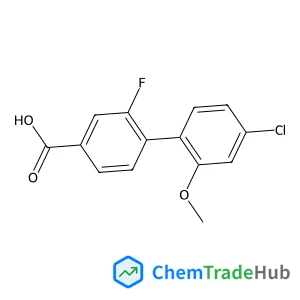
4-(4-Chloro-2-methoxyphenyl)-3-fluorobenzoic acid
CAS Number:
1261970-23-3
Molecular Formula:
C14H10ClFO3
Kazuko Fujii, Shigenobu Hayashi, Hideo Hashizume, Shuichi Shimomura, Keiko Jimura, Taketoshi Fujita, Nobuo Iyi, Akihiko Yamagishi, Hisako Sato, Toshihiro Ando
Through various in situ analyses, we have revealed the structural changes that occur during the reversible melting–solidification process of layered alkylsiloxanes (CnLSiloxanes) with carbon numbers (n) of 18 and 16. In situ high-resolution solid-state 13C nuclear magnetic resonance (NMR) analysis at controlled temperatures indicates drastic conformational changes of the long alkyl chains during the melting–solidification process. A 13C NMR signal at 33 ppm, which shows the highest intensity at room temperature (RT), is assigned to an inner methylene group with an all-trans conformation. As the temperature increases, the 33-ppm signal intensity decreases while the signal intensity at 30.5 ppm simultaneously increases. The 30.5 ppm signal is assigned to an inner methylene group with a trans–gauche conformation. Subsequently, upon cooling, the signal at 33 ppm recovers, even after CnLSiloxanes have melted. In situ X-ray diffraction measurements at controlled temperatures reveal that the ordered arrangement of the long alkyl chains becomes disordered with elevating temperatures and reordered upon cooling to RT. In situ high-resolution solid-state 29Si NMR analysis shows that the melting–solidification process progresses without any structural change in siloxane sheets of the CnLSiloxanes. Thus, the in situ analyses show that disordering of the long alkyl chains causes the CnLSiloxanes to melt. Because the majority of long alkyl chains are packed again in the ordered arrangement with the all-trans conformation upon cooling, the CnLSiloxanes are reversibly solidified and the CnLSiloxane structure is recovered.
Giuseppe Pezzotti, Wenliang Zhu
DOI: 10.1039/C4CP04244A
Angel Alegria, Marc Couty
DOI: 10.1039/C4CP04597A
Julieta S. Riva, Lidia M. Yudi
DOI: 10.1039/C4CP03483J
Lingyun Liu, Wenhua Zhang, Panpan Guo, Kai Wang, Jiaou Wang, Haijie Qian, Ibrahim Kurash, Chia-Hsin Wang, Yaw-Wen Yang, Faqiang Xu
DOI: 10.1039/C4CP04199B
Taeeun Yim, Soo Jung Choi, Jeong-Han Park, Woosuk Cho, Yong Nam Jo, Tae-Hyun Kim, Young-Jun Kim
DOI: 10.1039/C4CP04723K
Irina S. Moreira, João M. Martins, João T. S. Coimbra, Maria J. Ramos, Pedro A. Fernandes
DOI: 10.1039/C4CP04688A
Jiang-shan Luo, Xi-bo Li, You-gen Yi, Yong-jian Tang
DOI: 10.1039/C4CP04714A
Zhongjie Lin, Julian R. Jones, John V. Hanna
DOI: 10.1039/C4CP04492D
D. Lüftner, G. Koller, P. Puschnig, M. G. Ramsey
DOI: 10.1039/C4CP04595E
Gaurav Jha, Anoop N., Abdur Rahaman, Moloy Sarkar
DOI: 10.1039/C4CP05350H
(5-Sulfamoyl-3-pyridinyl)boronic acid is primarily used in chemical synthesis, p...
Benzyl 2-methyl-2-(methylsulfonyl)-4-pentenoate is typically synthesized via est...
When handling 8-Fluoroquinolin-6-ol (CAS: 209353-22-0), it is important to use p...
1,3-Dibromo-5-(2-methyl-2-propanyl)benzene (CAS: 129316-09-2) is a crystalline c...
Ethyl 7-chloro-4-oxo-1-(1,3-thiazol-2-yl)-1,4-dihydro-1,8-naphthyridine-3-carbox...
When handling Delta-7-Avenasterol (CAS: 23290-26-8), it is important to wear app...
Proper handling involves the use of personal protective equipment such as gloves...
When handling 2-Methyl-2-proanyl 4-[(2-aminophenyl)amino]-1-piperidinecarboxylat...
N-Methyl-4-chlorobenzylamine hydrochloride (CAS: 65542-24-7) is a organic compou...
[2-(Dodecyloxy)ethoxy]acetic acid (CAS: 27306-90-7) is generally considered safe...

Physical Chemistry Chemical Physics (PCCP) is an international journal co-owned by 19 physical chemistry and physics societies from around the world. This journal publishes original, cutting-edge research in physical chemistry, chemical physics and biophysical chemistry. To be suitable for publication in PCCP, articles must include significant innovation and/or insight into physical chemistry; this is the most important criterion that reviewers and Editors will judge against when evaluating submissions. The journal has a broad scope and welcomes contributions spanning experiment, theory, computation and data science. Topical coverage includes spectroscopy, dynamics, kinetics, statistical mechanics, thermodynamics, electrochemistry, catalysis, surface science, quantum mechanics, quantum computing and machine learning. Interdisciplinary research areas such as polymers and soft matter, materials, nanoscience, energy, surfaces/interfaces, and biophysical chemistry are welcomed if they demonstrate significant innovation and/or insight into physical chemistry. Joined experimental/theoretical studies are particularly appreciated when complementary and based on up-to-date approaches.
![2-Methyl-2-propanyl 4-oxo-3,9-diazabicyclo[4.2.1]nonane-9-carboxylate structure](https://static.chemtradehub.com/structs/131/1312456-05-5-9a15.webp "2-Methyl-2-propanyl 4-oxo-3,9-diazabicyclo[4.2.1]nonane-9-carboxylate structure")