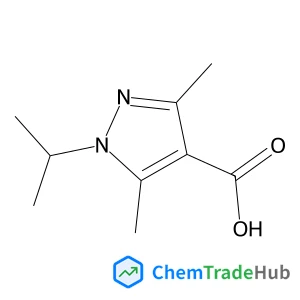
1-isopropyl-3,5-dimethyl-1H-pyrazole-4-carboxylic acid
CAS Number:
1007542-01-9
Molecular Formula:
C9H14N2O2
Jianping Wang, Guangmei Han, Guijian Guan
Luminescent chemosensors for hydrogen sulphide (H2S) are of great interest because of the close association of H2S with our health. However, current probes for H2S detection have problems such as low sensitivity/selectivity, poor aqueous-solubility or interference from background fluorescence. This study reports an ultrasensitive and time-gated “switch on” probe for detection of H2S, and its application in test paper for visualization of exhaled H2S. The complex probe is synthesized with a luminescent Tb3+ centre and three ligands of azido (–N3) substituted pyridine-2,6-dicarboxylic acid, giving the probe high hydrophilicity and relatively fast reaction dynamics with H2S because there are three –N3 groups in each molecule. The introduced –N3 group as a strong electron-withdrawing moiety effectively changes the energy level of ligand via intramolecular charge transfer (ICT), and thus breaks the energy transferring from ligand to lanthanide ion, resulting in quenching of Tb3+ luminescence. On addition of H2S, the –N3 group can be reduced to an amine group to break the process of ICT, and the luminescence of Tb3+ is recovered at a nanomolar sensitivity level. With a long lifetime of luminescence of Tb3+ centre (1.9 ms), use of a time-gated technique effectively eliminates the background fluorescence by delaying fluorescence collection for 0.1 ms. The test paper imprinted by the complex probe ink can visualize clearly the trace H2S gas exhaled by mice.
Peter Krüger
DOI: 10.1039/B410863A
Vinit Choudhary, K. G. Ayappa
DOI: 10.1039/B613900K
B. Lasorne, M. A. Robb, G. A. Worth
DOI: 10.1039/B700297A
A. R. Allouche, M. Aubert-Frécon, D. Graveron-Demilly
DOI: 10.1039/B700631D
Leny Yuliati, Tadashi Hattori, Hisao Yoshida
DOI: 10.1039/B410089A
Carsten Selle, Florian Rückerl, Douglas S. Martin, Martin B. Forstner, Josef A. Käs
DOI: 10.1039/B412680G
P. Bazin, O. Saur, J. C. Lavalley, M. Daturi, G. Blanchard
DOI: 10.1039/B414159H
Yuji Kamitaka, Seiya Tsujimura, Norihiko Setoyama, Tsutomu Kajino, Kenji Kano
DOI: 10.1039/B617650J
When handling 2-Chloro-1,2-bis(4-methylphenyl)ethanone (CAS: 71193-32-3), it is ...
4-Ethoxy-3-(5-methyl-4-oxo-7-propyl-1,4-dihydroimidazo[5,1-f][1,2,4]triazin-2-yl...
Methyl 3-Oxo-4-Androsten-17-Carboxylate (CAS: 2681-55-2) should be stored in a c...
(R)-3-Amino-4-(3-hexylphenylamino)-4-oxobutylphosphonic acid is primarily used i...
2-Methyl-2-propanyl 3-amino-3-carbamoyl-1-azetidinecarboxylate (CAS: 1254120-14-...
There are alternative reagents that can be used in synthesis instead of (E)-4-(t...
[2-(3-Chlorophenyl)-1,3-thiazol-4-yl]methanol (CAS: 121202-20-8) is a crystallin...
The market and research trends for Methyl (2S)-[(4S)-2,2-dimethyl-1,3-dioxolan-4...
The market for 1-Bromo-2-isocyanatoethane (CAS: 42865-19-0) is driven by its use...
4-Nitro-D-phenylalanine hydrochloride (CAS: 147065-06-3) is primarily used in re...

Analyst publishes analytical and bioanalytical research that reports premier fundamental discoveries and inventions, and the applications of those discoveries, unconfined by traditional discipline barriers.
![N-[2-Bromo-4-(trifluoromethoxy)phenyl]formamide structure](https://static.chemtradehub.com/structs/941/941294-53-7-f783.webp "N-[2-Bromo-4-(trifluoromethoxy)phenyl]formamide structure")